


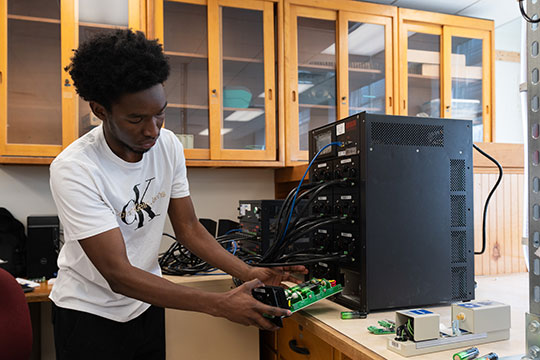
A group of 11 students took part in a class at Alfred University that taught them how to use machine learning to predict battery health. Students used recently acquired equipment installed in a lab in McMahon Engineering Building to study how factors like weather and humidity can impact battery lifetime.
The class “Machine Learning Applications in Prediction of Battery Lifetime,” which began in mid-March, is part of a pilot workforce training program. The program is called “Training College Students in Battery Degradation and Remaining Useful Life Prediction Using Machine Learning.” Its goal is to help prepare students for jobs in the battery and energy storage industry—both in the region and across the country.
The program is funded by a $160,644 grant from the National Science Foundation (NSF). The funding comes through the NSF Energy Storage Engine in Upstate New York, part of the GROW (Generating Regional Opportunities in Workforce) program. Its goal is to help prepare engineering students with the skills and knowledge needed to succeed in the battery and energy storage job market.
Kun Wang, assistant professor of materials science and engineering in Alfred University’s Inamori School of Engineering, is principal investigator for the project and an instructor for the class. Gabrielle Gaustad ’04, dean of the Inamori School of Engineering; Scott Misture ’90, ’94 PhD, Inamori Professor of Materials Science and Engineering; and Xingwu Wang, professor of electrical engineering, are co-investigators on the project.
Kun Wang said the grant funding is being used to secure several pieces of battery testing equipment, some of which was installed in the battery machine learning lab in McMahon.
The equipment includes a battery testing system that measures the charge of a battery, its remaining useful life, and how many cycles a battery can undergo before it is no longer usable. There are two additional pieces of equipment that can be used to test how hot and cold temperatures can affect battery life. One single-chamber unit can test the impact of temperatures ranging from minus-30 degrees Celsius up to 190 degrees Celsius, also taking into account changes in humidity. A smaller unit has eight chambers that each can test two batteries in temperatures ranging from 10 to 60 degrees Celsius.
“Each student can run their own tests independently (with the eight-chamber unit) and set up their own individual testing environments,” Kun Wang explained. He said another unit, expected to be delivered in June, will accommodate an additional 16 testing chambers.
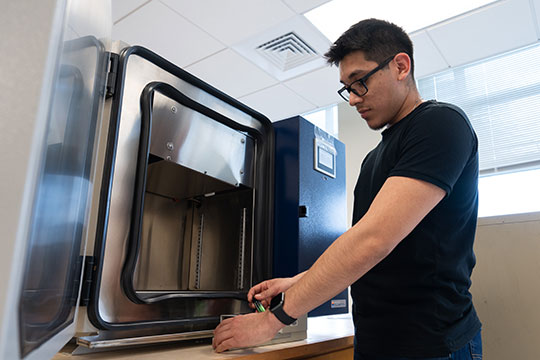
David Gonzalez, a sophomore at Alfred University majoring in biomaterials and electrical engineering, gets ready to place a lithium-ion battery into a testing chamber. The equipment measures how different temperatures affect the battery’s lifespan.
The class, which met once a week, included 10 undergraduate students and one graduate student, majoring in ceramic engineering, electrical engineering, materials science and engineering, and computer science. It will be offered again next fall and in the spring of 2026. Wang said it will also be offered this summer and will be open to students from Alfred University, Alfred State College and Corning Community College, as well as employees of businesses in New York State that utilize battery technology.
Housed at Binghamton University, the NSF Energy Storage Engine in Upstate New York is one of the inaugural NSF-supported Regional Innovation Engines across the country. The program aims to build a strong battery and energy storage ecosystem in Upstate New York by supporting innovation, technology development, workforce training, and collaboration—helping the U.S. stay independent and lead in these industries. Alfred University’s grant is a sub-award from GROW funding awarded to Syracuse University.
The grant awarded to Alfred University started October 17, 2024, with a projected end date of February 28, 2026. The program will equip students from the materials science, renewable energy, and electrical engineering fields with skills in battery testing, data analysis, and machine learning for performance prediction. It aligns with the NSF Energy Storage Engine in Upstate New York’s mission to advance the battery industry by fostering a highly skilled workforce capable of driving innovation in energy storage systems.
About the NSF Energy Storage Engine in Upstate New York
The NSF Energy Storage Engine in Upstate New York, led by Binghamton University, is a National Science Foundation-funded, place-based innovation program. The coalition of 40-plus academic, industry, nonprofit, state, and community organizations includes Cornell University, Rochester Institute of Technology, Syracuse University, Launch-NY and NY-BEST as core partners. The Engine advances next-gen battery technology development and manufacturing to drive economic growth and bolster national security. Its vision is to transform upstate New York into America’s Battery Capital.