

A global leader in simulation programming for complex power electronics systems is donating software to Alfred University, which engineering students will use to model electrical circuits, power converters, and control systems before building them physically.
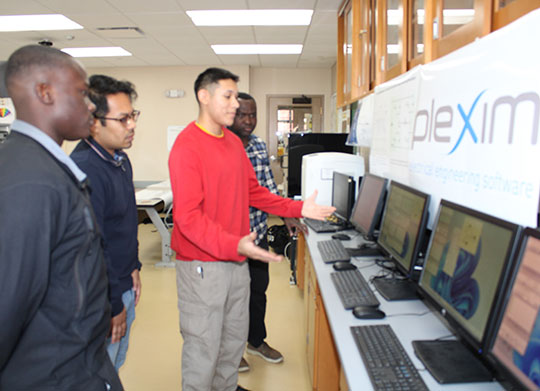
The PLECS software—developed and donated to the university by Swiss company Plexim—allows students and faculty to see how voltage, current, and power change over time, helping them better understand circuit behavior. By experimenting with different components and system configurations, students can test designs, examine results, and better understand power electronics and system dynamics.
“Plexim is dedicated to advancing education and research, which is why we proudly offer our PLECS software licenses free of charge to academic institutions worldwide. We firmly believe that removing financial barriers ensures the next generation of power electronics engineers has access to industry-standard tools, enabling them to gain practical skills and contribute to groundbreaking discoveries,” said Kristofer Eberle, director of Business Development at Plexim. “This initiative is a vital step in bridging the gap between theoretical knowledge and practical application, ensuring that academic institutions can drive innovation forward and ultimately build a stronger pipeline of talent for the entire power electronics industry.”
Power electronics is a field of electrical engineering that uses solid-state semiconductor devices to control and convert electric power efficiently. Unlike traditional electronics, which handle low-power signals for tasks like data processing, power electronics deals with substantial amounts of electrical energy, often at high voltages and currents.
Applications for power electronics include power generation, power transmission and distribution, and power control. It is used in renewable energy systems, such as inverters for solar panels and converters for wind turbines to condition power for the grid; in electric vehicles, managing the power flow between the battery and the motor; and for high voltage direct current (HVDC) transmission for long-distance power transmission systems using converters to send power more efficiently.
Xingwu Wang, professor of electrical engineering, said he hopes the university can acquire a power electronics module that will allow students to utilize both hardware and PLECS software to create a system that simulates power electronic systems. He said there are several U.S. companies that make power electronics modules compatible with PLECS software.
The power electronics simulation system, Wang said, would ideally be installed in the Edibon Power Systems Simulation Lab in the McMahon Engineering Building. The lab, which was unveiled this fall at the annual AUEnergy Conference, features modules for traditional steam generation, solar, wind, and hydroelectric power generation. Other modules simulate advanced energy storage such thermal and flywheel and a spectrum of battery and non-battery energy storage technologies.
John Simmins ’84, PhD ’90, director of the GE Vernova Advanced Power Grid Lab and the Edibon Power Systems Simulation Lab, sees the addition of the PLECS software as furthering the University’s mission of providing the energy sector with a pipeline of talented workers. Students receive hands-on learning with industry-standard equipment and software which improves learning outcomes.
“As one of only a few accredited Renewable Energy programs in the nation, the addition of the PLECS software further expands our students’ access to systems that are used in real-world applications,” Simmins commented. “This makes them far more attractive to potential employers, significantly increasing the value of their degrees in the Renewable Energy and Electrical Engineering disciplines.”
The Edibon lab also supports existing university research in fuel cells, syngas generation, and hydrogen separation, which rely on the types of advanced ceramic and glass materials developed at Alfred University’s New York State College of Ceramics.
“Expanding Alfred University’s capabilities in modeling the impacts from the integration of new types of energy generation and storage technologies, and better understanding their impacts on grid management and resiliency, will help to accelerate the deployment and market acceptance of new advanced ceramics and glass-based energy systems,” said David Gottfried, Director of the Center for Advanced Ceramic Technology (CACT).
These capabilities enable full simulation of both grid-connected and islanded microgrids, offering a rare, immersive opportunity for students to engage with virtual power plant (VPP) models, demand response algorithms, and grid interoperability protocols. The system will be used immediately in upper-level courses on distributed energy resources, microgrids, virtual power plants, and advanced energy storage systems.