

This fall, Alfred University sophomore Dagim Mindaye, an international student from Addis Ababa, Ethiopia, represented the university at the FABRIC KNIT workshop, presenting original research on programmable networks and data plane security. His participation marks a major milestone, not only for his personal academic journey but also for Alfred’s growing commitment to undergraduate research and innovation in computer science.
Dagim’s research journey began last summer through a hands-on opportunity with Assistant Professor of Computer Science Garegin Grigoryan. “I’ve always wanted to contribute to real research problems,” Dagim said. “Through this project, I discovered an interest in programmable networks and in pushing intelligence into the data plane. Now we can mitigate certain QUIC security issues at line rate inside the network.”
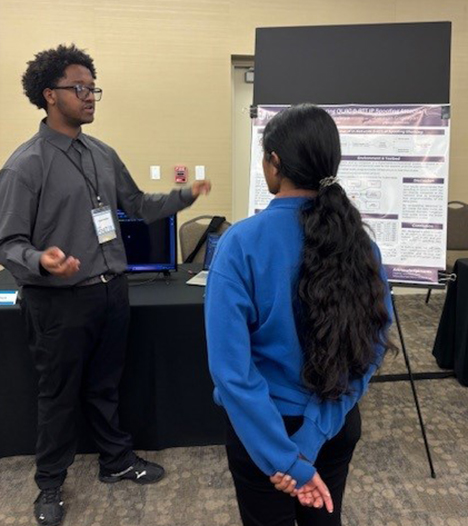
At the FABRIC user workshop in Salt Lake City, Dagim presented his project on integrating Kubernetes with programmable switches. He modified Kubernetes plugins to pull live load data from nodes, ensuring only healthy nodes are assigned to serve client requests. In addition, he designed a QUIC 0-RTT attack mitigation system capable of detecting and throttling abnormal network bursts in real time. “I actually got to build something and see it run, not just on paper,” Dagim explained. “This experience gave me hands-on exposure to P4, Kubernetes, and security that I wouldn’t have gained otherwise.”
Beyond technical growth, the experience boosted his confidence as a researcher. “(It) showed me that I can be in those rooms even as a sophomore,” he said. “Whether I choose grad school or industry, I now have concrete work I can point to”
Grigoryan expressed pride in Dagim’s achievement and the broader value of undergraduate research at Alfred. “When I was a graduate student, presenting my work at workshops was incredibly motivating,” he said. “I’m happy to guide my students through their first steps, and I hope this experience benefits them as much as it did me. I’m also grateful to FABRIC for approving the student travel grant and organizing these events.”
Alfred University supports student research through a variety of programs and funds, including ARGUS (Alfred University Grants for Undergraduate Research) and APEX (Applied and Experiential Learning). Opportunities like the CASTLE Lab (Computer and Software Technology Learning Environment) also allow students to collaborate on innovative projects early in their academic journey.
Grigoryan noted that many computer science courses, such as Algorithm Design, Artificial Intelligence, Computer Networking, and Operating Systems, incorporate project-based assignments that often lead to research ideas. “Participating in research helps students learn how to frame problems, test solutions, and communicate findings—skills that are invaluable in both academia and industry,” he said.
For Dagim, this research experience has already shaped his future goals. “I’m very interested in working in industry on ML/AI, cloud systems, and networking,” he shared. “At the same time, I really enjoy research, so graduate school is definitely an option.”
This article was written by undergraduate Andrii Maltzev.