

Zhongbei (Daisy) Wu, clinical associate professor of Music and Language at Alfred University, recently performed the traditional Chinese instrument guzheng at the Great Hall of the Library of Congress in Washington, D.C., marking the opening of “The Arts, Culture, Connection."
Zhongbei (Daisy) Wu, clinical associate professor of Music and Language at Alfred University, recently performed the traditional Chinese instrument guzheng at the Great Hall of the Library of Congress in Washington, D.C., marking the opening of “The Arts, Culture, Connection."
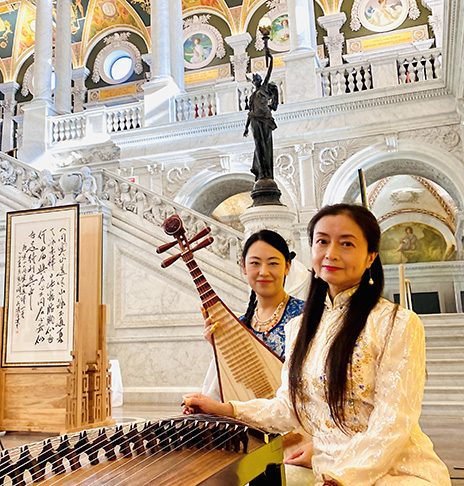
The exhibition held Aug. 2, celebrated Chinese calligraphy and art and was was co-hosted by the Chinese American Museum DC—an organization dedicated to preserving and promoting the history and contributions of Chinese Americans—and Shanghai Longhua Temple, Shanghai’s oldest and largest Buddhist temple dating back to the 3rd century, which serves as both a spiritual center and cultural landmark in China’s largest city.
The Library of Congress, founded in 1800, is the world’s largest public library and the official research arm of the U.S. Congress, housing millions of books, manuscripts, and cultural treasures.
The exhibition launched an international cultural exchange featuring a delegation led by Master Zhao Cheng, Abbot of Longhua Temple. The event showcased exquisite Chinese calligraphy including works inspired by Tang dynasty (618–907) poetry and Zen Buddhist meditations. Chinese calligraphy, an ancient art form, expresses philosophical ideas through brush strokes and the dynamic flow of ink.
Wu’s program for the evening reflected that same depth. She began with the Buddhist Great Compassion Mantra, followed by the guzheng classic High Mountains, Flowing Water. She later joined pipa artist Fei Liu for Dance of the Yi People.
To Wu, guzheng music is more than performance. “It is a bridge,” she writes, “between languages, histories, and ways of thinking. High Mountains, Flowing Water embodies the Chinese ideal of harmony between humanity and nature, while the mantra invites reflection on compassion and inner peace. When audiences connect with these sounds, they are connecting with centuries of cultural wisdom that still speaks to us today.”
Wu says the audience — made up of diplomats, scholars, and cultural leaders — listened intently, applauded enthusiastically and expressed surprise and delight that Alfred University offers courses in traditional Chinese guzheng music. They praised Alfred University for giving such a unique opportunity that broadens students’ cultural horizons and hoped more colleges would follow Alfred’s example by including diverse musical traditions in their programs.
Professor Wu received the performance invitation in June. When the event’s poster arrived, she was deeply moved by its design: a majestic image of the Library of Congress paired with the elegant brush calligraphy of a saying by Wang Yangming (1472–1529), China’s Ming dynasty (1368–1644) philosopher and Confucian scholar whose ideas have influenced generations.
“The contrast and harmony between the Western classical architecture and ancient Chinese philosophical thought expressed through calligraphy felt like a vivid cultural dialogue.”
For Wu, the night was a conversation across centuries and continents, one where the voice of an ancient Chinese instrument found its place beneath the soaring ceilings of an American landmark. “For Alfred University,” she says, “it was proof that even from a university in a quiet corner of western New York, a melody can carry across the nation.