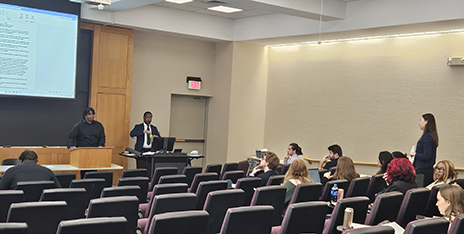


Alfred University student Sean Killian describes himself as inquisitive by nature, with a desire to learn how things work and how they can be improved. That mindset led Sean, a sophomore at Alfred University and a member of the men’s swimming and diving team, to make significant improvements to timing-scoring system and audio-video capabilities at the McLane Center swimming pool, saving the university thousands.
Brian Striker ’00, head swimming and diving coach, explained that as long as Sean has been at Alfred, he’s been interested in how the McLane Center physical plant (electronics in particular) functions—in general and with regard to the swimming and diving facilities. “He has expressed an interest in how things work,” Striker said. “He’s curious. He wants to know about the backbone of this (McLane Center) building.”
Alfred University wants students to take part in applied, experiential learning opportunities, which is why Striker encouraged Sean, as an electrical engineering and mathematics double-major, to pursue the projects at the pool.
Sean, a Kenmore, NY, resident and graduate of St. Joseph’s Collegiate Institute in Tonawanda, NY, said when he first arrived on campus in the fall of 2024, he noticed that the scoreboard in the pool area did not display a running clock as races were going on. As someone who had tinkered with electronics from an early age, he had a general understanding of how the circuitry connecting the timing system and scoreboard worked and began looking at ways he could synchronize the pace clocks—used by swimmers during training sessions to monitor time and gauge performance—and feed the timing data to the scoreboard.

Sean Killian stands by a pace clock at the Alfred University swimming pool. Sean, a sophomore electrical engineering-mathematics double major and a member of the Saxons men’s swimming and diving team, was able to synchronize the times of the three pace clocks in the pool with the meet scoreboard.
Simultaneously, Sean was hoping to get the underwater audio system in the pool working again, and asked Striker if he could go to the basement under the pool area to look at the wiring for the speakers. While there, Sean came upon a pair of old Daktronics basketball shot clocks. He switched out the circuit boards from the scoreboard (also a Daktronics model) and the shot clocks, which allowed the running time to be displayed on the scoreboard during meets.
Over the summer, Sean purchased a microcontroller made by Arduino, an open-source electronic prototyping platform that enables users to create interactive electronic objects. He housed the device in a shoe box, connecting it with cables to pace clock and scoreboard.
“The (Arduino microcontroller) generates the same signal as the timing system and ensures all the clocks are synched together,” said Sean, who hopes to be able to replace the wiring carrying signals between the timing system and the scoreboard with wireless capability.
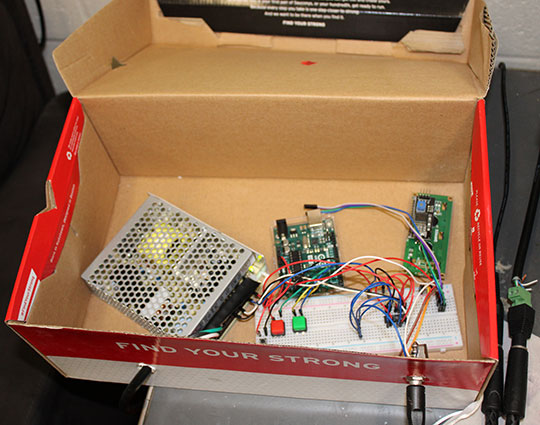
The microcontroller developed by Sean Killian to transmit data between the timing system and scoreboard at the Alfred University pool. Sean is a sophomore electrical engineering-mathematics double major and a member of the Saxons men’s swimming and diving team.
Striker and the Athletics Department are certainly pleased with Sean’s work. A few years ago, the department was considering acquiring a new scoreboard for the pool, which at the time was estimated to cost approximately $20,000. Synchronizing the existing scoreboard with the pace clocks would have cost between $5,000 and $6,000. Sean was able to make the necessary modifications for about $260.
“He has taken the technology we had and made it better,” Striker said, noting in particular the enhancements Sean has been able to make to the live stream broadcasts of meets. Sean created an app that reads each of the lane timers, conveying to times to the video broadcasting the live stream of swim meets. The live results are displayed in a picture-in-picture on the video monitor in the pool and in the live stream broadcast.
Sean said he searched online for an application that would transmit an image of the meet scoreboard onto the video stream of swim meets. This allows spectators watching live meet streams to know who is swimming in each event and their lane assignments. “The one (app) I found didn’t work anymore so I used AI to help with the coding and I was able to make it work,” he said, adding that the displays contain Alfred University colors and the Saxon athletics logo.
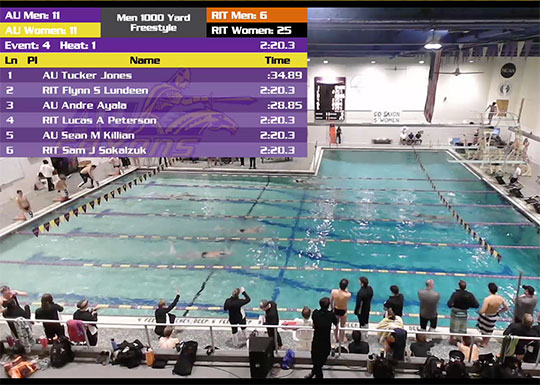
An image of a live stream from a recent swimming and diving meet hosted by Alfred University. Sean Killian, a sophomore electrical engineering-mathematics double major and a member of the Saxons men’s swimming and diving team, developed an app that allows the scoreboard image to be overlaid onto the live stream of meets, enhancing the viewing experience.
“This is huge because we have several international students on the team” whose families watching the meets from afar, Striker said. “People watching the live stream can now tell what swimmers are in what lanes and what their times are.”
Striker said with Sean’s help, the university was able to acquire, for no cost, a scoreboard used at Buffalo State. Sean’s father works at Buff State, which was getting rid of its old swimming and diving scoreboard. Sean’s dad talked to a project manager at Buff State and asked what the school planned to do with the scoreboard. “He said if no one wanted it, it would be thrown out,” Sean related.
Sean’s dad told him about the scoreboard and Sean told Striker, suggesting the scoreboard—made by Colorado, a maker of swim meet timing and scoring systems—could replace the older Daktronics model. The scoreboard will still operate in tandem with the Daktronics pace clocks.
Swimmers and divers love to have music playing while they are training, so Sean took on the task of improving the audio system in the pool. Last fall, he acquired a surround sound system for free on Facebook. He has connected the system to wiring in the walls of the pool area which had originally been used to connect with microphones and speakers and hadn’t been utilized since the late 1990s. He also uses that wiring to carry data from the microcontroller device to the pace clocks and scoreboard. He has replaced the surround sound system with larger speakers and an amplifier that easily fills the pool area with music. The new sound system also improved the experience for spectators, as they can now better hear the meet announcer.
Sean said that from a young age, he has had an interest in learning how things work and how they can be repaired or improved.
“Since I was a kid, when my dad was fixing something, I’d watch him and see if there was anything I could do to help,” Sean said. He recalled the sound system at a pool near home where he lifeguarded not functioning properly and he was able to get the speakers working. “I realized that a lot of problems you have are solvable if you put your mind to it.”
Sean said his interest in how things work, particularly electronics, influenced his decision to major in electrical engineering. He is unsure of his career goals but said he could see himself starting a business where he can put his aptitude for solving electronics problems to use.
He said the work he has done in the short time he has been at Alfred has given him a solid foundation for whatever career path his chooses to take. “Just having the experience of recognizing a problem and figuring out how to deal with it. To see a problem and break it down into (manageable pieces) and go from there.”
Striker said he expects Sean will always be able to find a task, small and not so small, to keep him busy at the pool.
“He’s found his passion. Who knows where it will lead?” Striker said, who is more than happy to help Sean indulge in his work. “It has him working on all these projects. This is experiential learning. It’s setting an example (for other students) that if you put forth the effort, you can accomplish things.”