


Mark Zupan, Alfred University president, was a guest on a recent episode of Hornell, NY, radio station WLEA’s “Newsmakers” program. Zupan’s appearance first aired on Saturday, June 27.
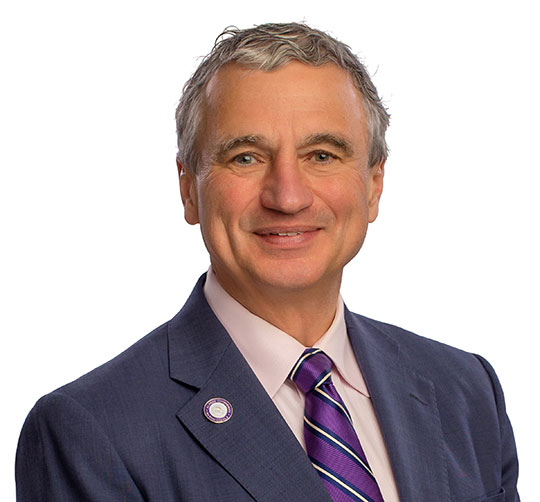
In Saturday’s show, Zupan discussed with Brian O’Neil, WLEA news director, a variety of topics related to Alfred University educational offerings, including those related to artificial intelligence, as well as studies on advanced ceramics materials, which has an impact on broader research related to national defense and space research.
“It is important we prepare our students to succeed,” Zupan said of Alfred University’s efforts to integrate instruction on artificial intelligence into classrooms and research labs. He noted that Alfred recently introduced an AI minor. “It’s a very fluid field that is changing rapidly.”
Zupan also discussed a $13.5 million federal contract awarded to Alfred University four years ago, to support a project with the U.S. Army to conduct research in forming and characterization of ultra-high temperature ceramic (UHTC) materials.
Due to their high-temperature performance, toughness, and light weight, ceramic materials are a necessary component of systems being developed by the Army. Research at Alfred University will focus on conducting high temperature characterization of UHTC materials used in defense systems to improve performance. These materials must be able to withstand the extreme temperatures that result from traveling at speeds greater than Mach 5. Research into UHTC materials and hypersonics is “very important to our national well-being,” Zupan said.
He also talked about the Space Materials Institute, launched at Alfred in the fall of 2024. The SMI was established in the Inamori School of Engineering to advance the science and technology of materials in support of aerospace and outer space exploration. It facilitates industry and governmental agency projects with Alfred University that engage students in hands-on experiential learning opportunities. The New York State College of Ceramics at Alfred University is a key provider of quality ceramic, glass and materials engineers to the advanced materials workforce pipeline. The Space Materials Institute is working with Alfred University’s CACT to initiate and grow New York State capabilities in the space and aerospace sectors.
“Anything to do with space right now is huge,” Zupan told O’Neil, noting that Alfred University alumni make up a significant share of Space-X employees in Cape Canaveral, FL. He also referred to the addition of a bachelor’s degree program in astrophysics in 2024, which along with the Space Materials Institute “provides great research opportunities for our undergraduate students.”
O’Neil asked Zupan about the war in Iran and its impact on global and domestic energy prices, to which Zupan responded that he is surprised prices have not been higher, given the significant interruption of the flow of crude oil and natural gas coming out of the Middle East.
“Usually, a one-to-two percent reduction in supply or increase in demand leads to a much high spike than we’ve witnessed,” he said. “It’s a real puzzle right now to economists why we haven’t seen a more appreciable (increase) when you have 20 percent of the world’s crude oil and natural gas supply cut off.”