

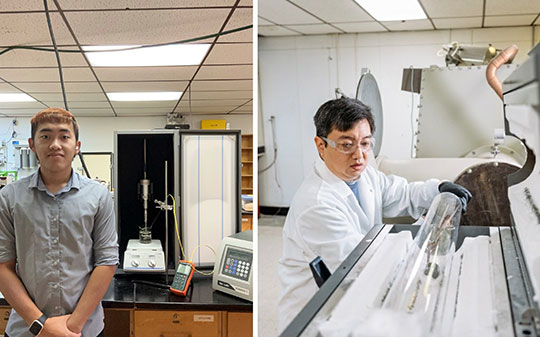
Two Alfred University undergraduate students collaborated with Myungkoo Kang, assistant professor of ceramic engineering in the Inamori School of Engineering, to create an illustration that graces the cover of the July issue of the Materials Research Society (MRS) Bulletin.
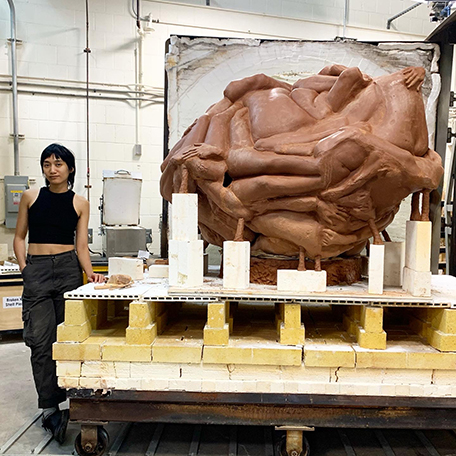
Lam Tran, a glass engineering science major in the Inamori School of Engineering, and Elle Dry DeSanto, an art major in the School of Art and Design, worked with Kang on the cover art. Lam and DeSanto will be seniors this fall. The MRS Bulletin, which is now published online, includes an article—“Accelerated low-temperature stabilization of glasses via thermo-ultrasonication”—for which Kang and Lam are co-authors.
Other co-authors from Alfred University include alumni Patrick Lynch, who earned a bachelor’s degree in glass engineering science from Alfred University in 2025, and Ecem A. Yamac, ’23 PhD (glass engineering science), research assistant; current student Gil B.J. Sop Tagne, undergraduate research assistant majoring in materials science and engineering; Rebecca Welch, visiting assistant professor of materials science and engineering; Collin Wilkinson, assistant professor of glass science; William LaCourse, emeritus professor of glass science; Stuart Yaniger, glass research chemist; and alumna Kathleen Richardson ’82, MS ’88, PhD ’92.
Richardson, who earned bachelor’s and doctoral degrees in ceramic engineering and a master’s degree in glass engineering science from Alfred University, is Pegasus Professor of Optics and Materials Science in CREOL, the College of Optics and Photonics at the University of Central Florida (UCF) and is a member of Alfred University’s Board of Trustees.
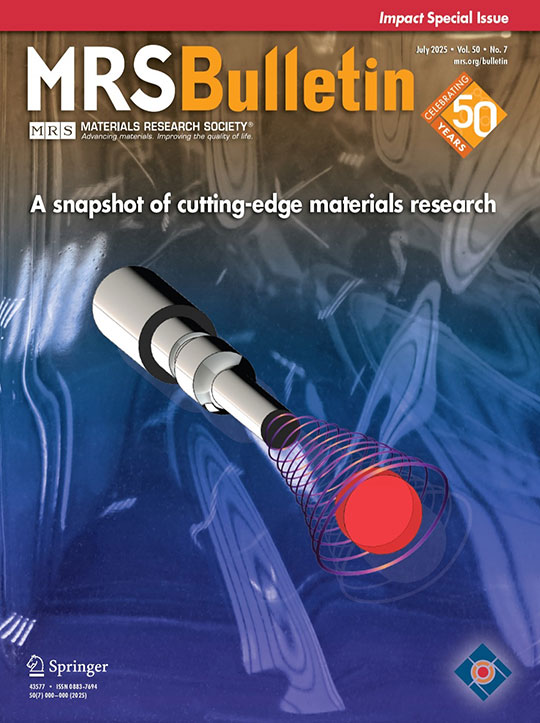
The cover art developed by Lam, DeSanto, and Kang illustrates a novel thermo-ultrasonication technique used to accelerate the relaxation of arsenic trisulfide glasses as an example of widely used optical materials. By coupling thermal energy with ultrasonic waves, this method expedites glass relaxation well below the glass transition temperature, avoiding deformation while ensuring stability. This approach addresses the long-standing challenge of non-equilibrium behavior of glasses which has been a substantial issue in the development of optical materials where their properties need to be consistent and homogeneous.
Kang’s research group has been working with a group of researchers to identify an underlying mechanism behind the counterintuitive phenomenon while also testing the applicability of the process on a wide variety of materials systems that temporally relax.