


The success of a team of Alfred University students at a recent competition which tested their skills as financial analysts reflects the College of Business’ emphasis on providing experiential learning opportunities.

The success of a team of Alfred University students at a recent competition which tested their skills as financial analysts reflects the College of Business’ emphasis on providing experiential learning opportunities.
The four finance majors— senior Ryan Hughes of Olean, NY; sophomore Maksym Smirnov and junior Artem Kolisnychenko, both from Kyiv, Ukraine, and sophomore Chris Coyle of Livonia, NY—traveled to Buffalo in February to compete in the 15th annual Chartered Financial Analyst (CFA) Institute Research Challenge of Western New York. The competition brings together the top business, finance, and economics students from the region to research a publicly traded company, develop a comprehensive investment recommendation, and then present and defend their analysis to a panel of industry professionals.
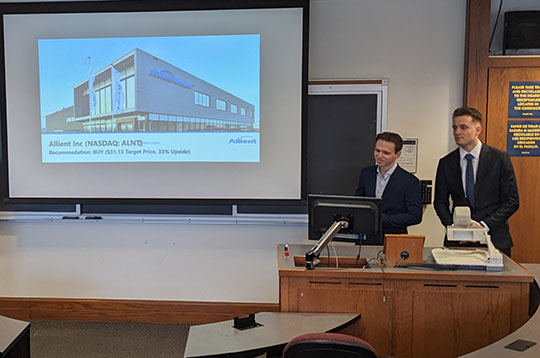
Entering the competition for the first time, Alfred’s team placed second in its group, behind perennial powerhouse Canisius College and ahead of three other schools from the region: Rochester Institute of Technology, St. John Fisher University, and University of Rochester.
On May 1, the College of Business announced the creation of the Institute for Experiential Entrepreneurship, for which business faculty Jean Ellefson, assistant professor of analytics and the Jon and Mary Tabor Chair in Family Business and Entrepreneurship; Shelly Freyn, associate professor of marketing; and Jason Morrison, assistant professor of finance, serve as directors. The Institute, which emphasizes the intersection between curricular and career experience, is built on the belief that the best way to learn business is by doing business. The Alfred team’s performance at the financial analysis competition is a prime example of how students are benefiting from experience-based learning initiatives.
Team members talked about the important role their finance classes and experience-based activities contributed to their success and has helped prepare them for career success after college. Among the activities each participates in at Alfred is the Student Managed Investment Fund (SMIF), a club open to any student, regardless of academic discipline, in which students research and make investing decisions for the fund. Originally seeded in 1995 with a $100,000 initial investment approved by the Board of Trustees, SMIF is now valued at more than $1.1 million.
“Being finance majors involved in SMIF helped us a lot (in the competition) because we frequently present stock pitches and final projects in front of our peers and professors,” Coyle commented. “This experience, coupled with the opportunity to present the SMIF portfolio to the Board of Trustees last May, made us feel more confident.”
“We frequently pitched stocks, presenting buy or sell recommendations for different companies, and truly enjoyed the process,” Kolisnychenko said of students’ experiences in SMIF. “I believe this experience prepared us the most for high-level competitions like this one.”
“The finance classes we take in Alfred helped us immensely in preparing for this competition. We utilized a lot of financial analysis and modeling skills that we studied in our classes to draft our report,” Smirnov added.
Hughes credited the 300 level classes in finance for helping prepare students for the CFA Challenge. The competition “was sort of challenging as our finance program isn't necessarily about equity research at that level. The four of us are very nerdy about financial markets and learn a lot of information on our own,” Hughes said, crediting Morrison for preparing and supporting the team.
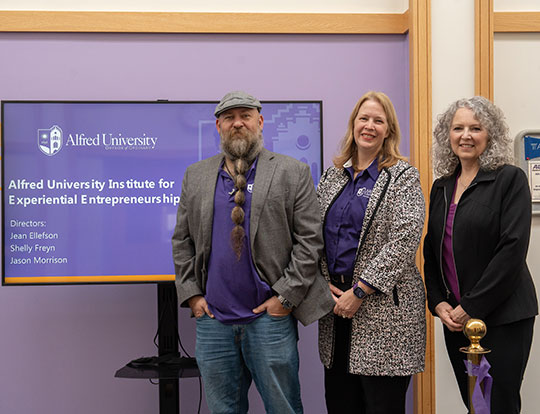
Faculty directors of the Alfred University College of Business Institute for Experiential Entrepreneurship, from left: Jason Morrison, assistant professor of finance; Jean Ellefson, assistant professor of analytics and the Jon and Mary Tabor Chair in Family Business and Entrepreneurship, and Shelly Freyn, associate professor of marketing.
SMIF is just one of a number of hands-on, out-of-classroom learning opportunities that engage students in the College of Business.
Freyn teaches a number of classes that give students the experience of working directly with local businesses and organizations. “Student teams work with real organizations, whether it’s developing campaign strategies, gathering research on consumer behavior, or conducting focus groups and online surveys to develop strategy,” she explained. “Marketing majors and minors gain hands-on experience by tackling real-world marketing challenges faced by small businesses, start-ups, and non-profit organizations.”
“Experiential learning is at the heart of our business program,” added Ellefson. “By immersing students in real-world challenges, we help them build not only academic skills but also the confidence and adaptability they need to thrive in an unpredictable world. In the College of Business, we’re also researching the impact of applied learning—examining how it shapes student capability, improves problem-solving under uncertainty, and accelerates readiness for futures beyond the classroom.”
For years, students in the College of Business have collaborated with area businesses and non-profits—through courses such as Marketing Research and Strategic Marketing, as well as a variety of capstone projects—assisting with market research, business planning, succession planning, and social media outreach.
One such project this year, a capstone for MBA students, involved working with local business Sunny Cove Farm in support of the launch of The Crowded Table, a farm-to-table café Sunny Cove plans to open in Alfred. Mairin Farchione, from Fairport, NY, and Sienna Cefalu, from Amherst, NY—who will receive their MBA degrees from Alfred at commencement on May 17 NY—were part of a team of students who worked on the project. Mairin and Sienna both earned bachelor’s degrees in marketing in 2024 and went on to pursue MBA through the College of Business’s 4+1 program. As seniors last year, the two took a marketing capstone class taught by Freyn in which they helped develop a marketing strategy for the Hornell YMCA.
“Our goal (in the MBA capstone) was to help the Sunny Cove Farm owners develop strategies for branding, marketing and community engagement,” Farchione said. She and fellow team members conducted market research, developed surveys, and analyzed survey results to help make decisions about menu offerings, events, marketing campaigns, and hours of operations. “The project allowed me to apply what I learned at Alfred in a real-world setting—especially skills from marketing, research methods, and analytics courses. It was a hands-on, collaborative experience that brought together everything from data analysis to storytelling.”
“We helped Sunny Cove by bringing in different points of view. As a team made of students, we were able to bring in what students may want from the café,” Cefalu added. “This project gave us an opportunity to work on communicating with real businesses and helping to mold and shape their ideas into actionable recommendations. We took everything we’ve learned in our undergraduate and graduate programs to create an all-encompassing project that will help the local community.”
Some other experiential learning initiatives in the College of Business include:
- The Allegany County Startup Collegiate Competition, where teams from Alfred University, Alfred State College, and Houghton University pitch their businesses ideas to a panel of judges, with the winners earning cash prizes to help facilitate their start-ups. Teams from Alfred University placed first and second in this year’s and last year’s competitions.
- “Saxon Tank”—a competition modeled after the popular reality television show, “Shark Tank”—in which budding student entrepreneurs pitch their business plans with a chance to bring them to fruition.
- BUSI 105 (Business Perspectives) and 106 (Contemporary Business), mandatory first-year experience classes taught in the fall and spring semesters, respectively. In BUSI 105, students learn about expectations they must meet as students and, later, in their careers, and hear from guest speakers in business who visit the class and discuss their experiences. In BUSI 106 students put what they learned into action by operating small pop-up businesses, with proceeds donated to charity.
- A number of study-abroad opportunities are offered through the College of Business. Theresa Gunn, associate professor of accountancy and associate dean of the College, has taken student on trips to Costa Rica to learn about sustainable business practices on the Caribbean island. Since 2014, Mark Lewis, dean of the College of Business, has taken students to Germany, where they learn about the automotive industry and take an intensive class on business simulation. Freyn has accompanied students to Spain, where they have learned how culture, economics, and politics can influence marketing strategies. And Fred Farley, associate professor of management, has taken students in the Health Care Management program on Allen Term excursions to the Netherlands, where they learn about the Dutch healthcare system.
- Freyn taught a Strategic Marketing course in which the entire class created a logo, a marketing plan and strategies, pricing and projections and a web site for a student-run market research consulting firm set to open in the fall of 2025.
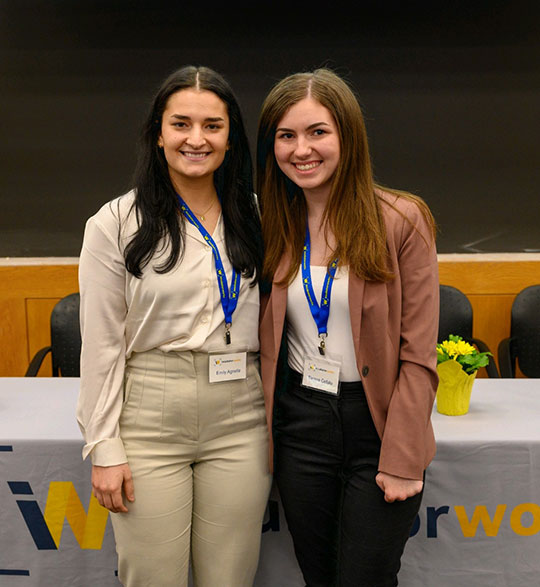
Cefalu and Emily Agnello, who earned a degree in marketing in 2024, placed second in last’s year’s Allegany County Startup Collegiate Competition, with Freyn serving as their faculty advisor. The business they pitched in the competition, Insights Into Answers, organized focus groups for businesses and assisted in compiling and analyzing data. The Alfred team of Kolisnychenko, Matthew Bittel (junior ceramic engineering major), Ryan Haggerty (first-year ceramic engineering major), and Mike Pinney (senior ceramic engineering major), won this year’s competition. Advised by Morrison, the group pitched a business, DeCayse, which focuses on creating biodegradable phone cases.
“We believe it is vital to be able to go beyond the theories about business, and to have practical experience. Those experiences prepare our graduates for the expectations and challenges that await them after they enter the workforce,” Lewis said. “The experiences let them apply theories in various settings, and to deeply understand the challenges that will face them post-graduation. We provide experience that prepares them to transition successfully into their careers.”
“We’re giving students the chance to apply finance and other business skills in ways that matter. Whether it's building financial models, managing real budgets, or pitching viable ventures, they’re seeing how financial thinking drives results,” Morrison said. “And when that work supports a local business or helps a nonprofit grow, it’s no longer just theory, it’s real. That’s the kind of experience that sticks and shapes future leaders.”
The BUSI 106 is a perfect example. “This gives students hands-on experience with the challenges and opportunities of running a business and provides a foundation for their studies the next three years,” Lewis said. “When students have these experiences, they can differentiate themselves from other applicants in the job search process. They have a competitive edge when they can speak about actual experience, challenges and lessons learned, and not just talk about theory.”
Natalie Farchione, Mairin’s sister, is a senior double-major in marketing and business analytics who plans to pursue her MBA at Alfred University next year. She and Mairin are two of three triplet sisters; the other does not attend Alfred University, but an older brother, Daniel, earned a bachelor’s degree in biomaterials engineering from Alfred in 2022. The Farchione sisters and Cefalu collaborated with other classmates in their BUSI 106 class, taught by Ellefson, to create a business that made and sold customizable keychains, with proceeds donated to the Pancreatic Cancer Action Network.
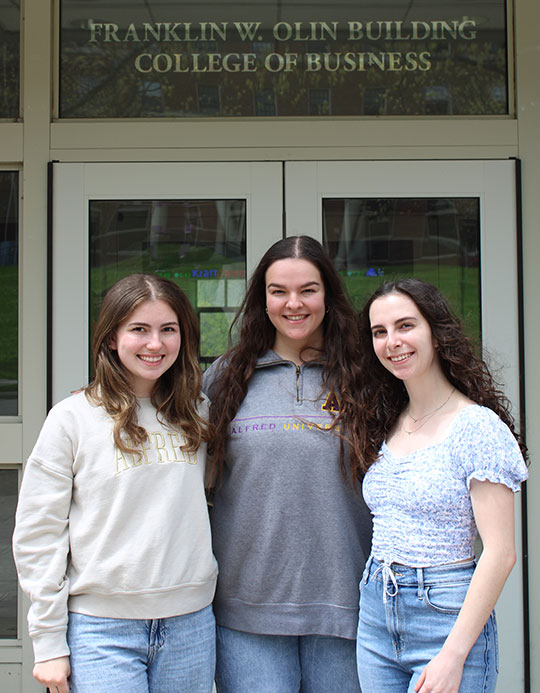
“Not only did we learn about starting a business, but we were able to do something good for a cause we care about,” Natalie said. She and Mairin also took Market Research course taught by Freyn, in which they researched ways to enhance the student experience at Alfred University’s Foster Lake recreational area.
“With the Foster Lake project, doing actual research and hearing real feedback from students made the experience feel more meaningful. It wasn’t just theory, it was real people, real opinions, and real data that we had to analyze and respond to. These kinds of hands-on projects also help build confidence, because you’re not just practicing in a classroom, you’re doing the work and seeing the results,” Natalie said.
In marketing, textbooks can quickly become outdated as the field rapidly evolves, especially with advancements in digital marketing, artificial intelligence, analytics, and social media platforms.
“Real-world exercises allow students to engage with current challenges that marketers face in real time, offering insights and experiences that can't be fully captured through quizzes or even traditional case studies,” Freyn said. Experiential learning opportunities “equip students with a variety of tools and hands-on experience in a dynamic, ever-changing discipline, while also building their confidence to apply these skills in their future careers.”
“The College of Business is great about experiential learning,” Hughes commented. He and Coyle noted that they and other fellow business students have participated in the Global Asset Management and Education (GAME) Forum in New York City several times and have also attended the Student Managed Investment Fund Consortium (SMIFC) Conference in Chicago.
“Both of these experiences allowed me to hear from industry leaders about their experiences, network with employers, meet fellow finance students across the nation, and grow a closer bond with other SMIF officers,” Coyle said.
Students agree that experiential learning is invaluable, both for their success academically and as they pursue career opportunities. Smirnov said his experience in SMIF, and participating in the CFA Challenge, will help him prepare for a career in equity research.
“SMIF has been one of the best things that happened to me during my time in Alfred. It gave me an opportunity to experience the job of financial manager before I actually entered the workforce. It helped me gain a much better understanding of the financial markets, but most importantly it also helped me find like-minded people that share my interest,” he said. “As a person whose goal after graduation is to work in equity research, this experience helped to better understand the job, and equipped me with a practical experience that I can use to showcase my skills to the potential employers.”
“I believe the (financial analysis) competition and our SMIF pitches closely mirror how things work in the real world, and prepares us exceptionally well for future real-world experiences,” said Kolisnychenko.
Cefalu, whose MBA focuses on Healthcare Planning and Management, will work at her family’s construction business this summer, “applying skills I’ve learned in this program to help them with compliance research, data analysis, and predictive analytics.” She hopes the skills she developed in her MBA capstone project with Sunny Cove will help her in her pursuit of a career in market research in the healthcare industry. “We did a lot of market research in that project,” she said. “It helped me gain real-world experience to show potential employers in the market research industry.”
“Experiential learning is incredibly valuable because it bridges the gap between theory and practice. While classroom instruction builds foundational knowledge, hands-on projects teach adaptability, teamwork, and problem-solving in unpredictable, real-world contexts,” Mairin Farchione said. “These experiences helped me gain confidence and taught me how to communicate with clients, handle feedback, and apply tools like survey software and data visualization platforms in meaningful ways. They’ve made me more prepared for the workforce than traditional lectures alone.”
Added Natalie Farchione, “I think both types of learning (classroom instruction and out of classroom activities) are important, but experiential learning gives you skills and lessons you remember and use long after the project ends.”