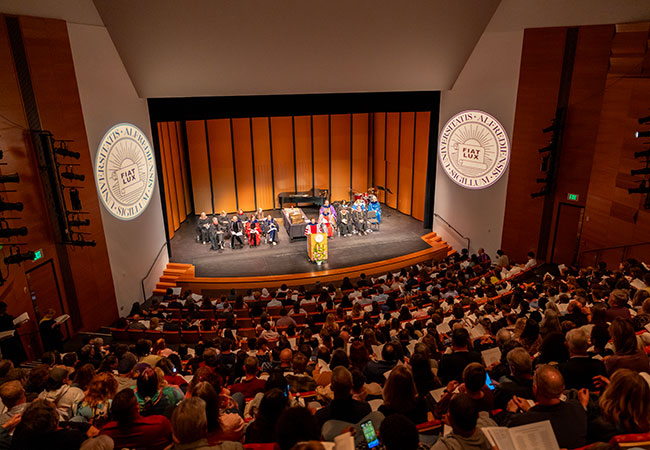


More than 130 Alfred University students participated in the 2026 Undergraduate Research Forum, held Thursday, April 23, in the Joyce-Walton Center. The students, representing each of the university’s academic units— the College of Liberal Arts and Sciences, the College of Business, the Inamori School of Engineering and the School of Art & Design + Performing Arts Division—were on hand to present their research projects to faculty, staff, fellow students, and external audiences.
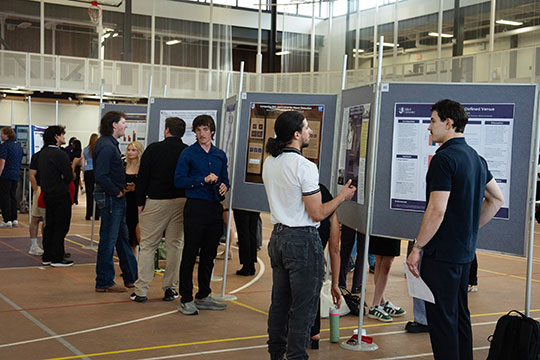
More than 100 poster abstracts (multiple students shared some posters) were on display at this year’s Undergraduate Research Forum. This marks an increase of approximately 20 posters from last year’s event, and more than 40 from two years ago.
The Undergraduate Research Forum provides a unique educational opportunity for aspiring researchers to present their work, whether it be in preliminary stages or as a capstone project, and gain experience by presenting their research and answering questions about their work from visitors and guests. All currently-enrolled Alfred University undergraduate students who are engaged in original work are eligible to participate. Those who received an undergraduate degree in the December immediately prior to Undergraduate Research Forum are also eligible.
Projects presented Thursday included, among others, a study on female distance by first-year political science major Riley Bell; another by sophomore art major West Armstrong that focused on his incorporation of found materials in his artwork; and senior mechanical engineering major Michael Donor, whose presented his work to convert a standard bicycle into an electric-powered bike.
Bell, a political science major from Syracuse, ran her first half-marathon in March 2026 and plans to run her first full marathon in the fall. Along the way, she developed a scholarly interest in the area of long-distance runners who were women, and she brought that interest to the Introduction to Women’s and Gender Studies class held this semester.
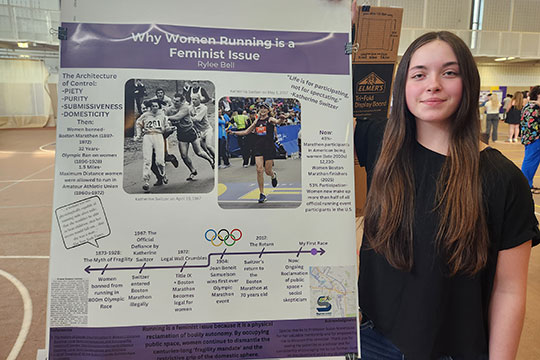
Rylee Bell ’29 with the poster for her project presented at the Alfred University’s Undergraduate Research Forum.
Her research project focused on the runner Katherine Switzer, who in 1967 became the first woman to run in the Boston Marathon as a registered competitor. The Amateur Athletic Union subsequently banned women from participating in races against men, and the medical profession joined the AAU is working to keep women from participating in rigorous sports such as marathons, suggesting the constant jarring of marathon running could cause serious harm to a woman’s reproductive organs.
Bell’s research shows how women have continued competing in marathons. “What female runners are doing,” she says, “is reclaiming their bodies one mile at a time, proving that their strength and personhood was never a liability, but a right.”
“I have a passion for this idea because of my passion for running,” said Bell, who hopes to complete a full marathon within the prescribed time limit to qualify for the Boston Marathon.
Armstrong began collecting samples of mud in the backyard of his home in Jacksonville, FL, in order to experiment with materials used in creating ceramic art. He baked the mud samples in a kiln, continued his experiments, and is still working on incorporating found material into his ceramic art as he studies in the School of Art & Design at Alfred University.
He presented his findings at the Undergraduate Research Forum with a poster titled “You Can Make Anything You Want with Everything You Have.”
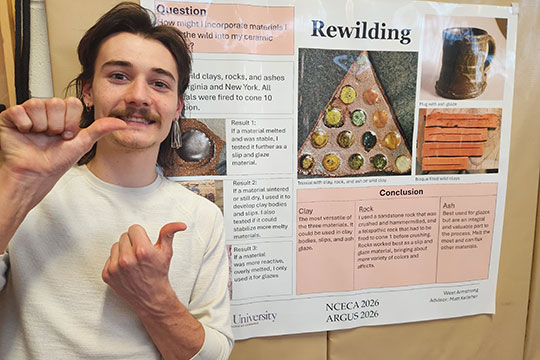
West Armstrong ’28 with the poster for his project presented at the Alfred University’s Undergraduate Research Forum.
“Why are we as artists not asking where and how our materials come from, especially if it’s not made in an ethical way?” West asks. “I want to do my own gathering.”
West displayed some his locally harvested ceramic artwork at an exhibit called “Rewilding,” in the Robert C. Turner Gallery. He digs for clay around the Alfred University campus, and experiments with glazes created from ash he collects after burning different materials. He looks forward to continuing his research, experimenting with different materials. His exhibit at the Research Forum illustrates “a notion I have of creating functional ceramic pieces using only the materials from the local environment.”
According to the abstract for Doner’s project, his research objective “is to design and re-engineer a (bicycle) frame that holds a battery and motor and (has) modified suspension,” demonstrating how a traditional pedal-powered bicycle frame can be constructed and engineered for conversion to an electric-powered bike.
The Newfield, NY, resident explained how he used CAD (computer-aided design) software to model the frame of an existing bicycle and convert it into an electric bicycle by incorporating a motor, battery and upgraded suspension. The modified suspension—achieved by adding shock absorbing components to the rear of the frame—is needed to create a smoother ride on rougher roads, protecting the electrical components.
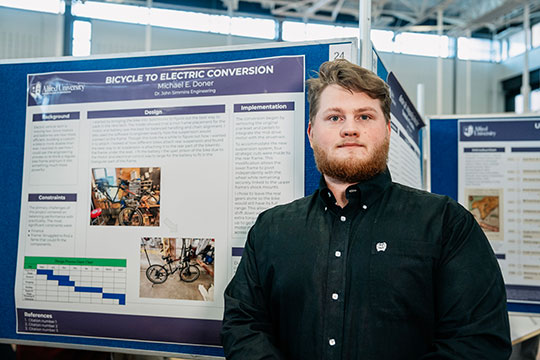
Michael Doner ’26 with the poster for his project presented at the Alfred University’s Undergraduate Research Forum.
“I designed the frame using the SolidWorks modeling software,” he said. The suspension was modified, he said, to allow the rear wheel to pivot as the bicycle turns, improving stability in the frame. The bicycle is fully motorized—the pedals were replaced with pegs, which can be replaced with larger foot rests to provide greater comfort and balance for the rider. The motor, which starts up with a key, has three speeds and the bicycle seven gears and operates with a throttle mounted on the handle bar. The next steps are to create a custom housing for the motor and batteries, to protect them against poor weather and dust and dirt from the road.