

Three undergraduate mechanical engineering majors at Alfred University are studying how to mitigate the affects of heat generated by batteries powering satellites orbiting the earth, thus prolonging the battery life and that of the satellites.
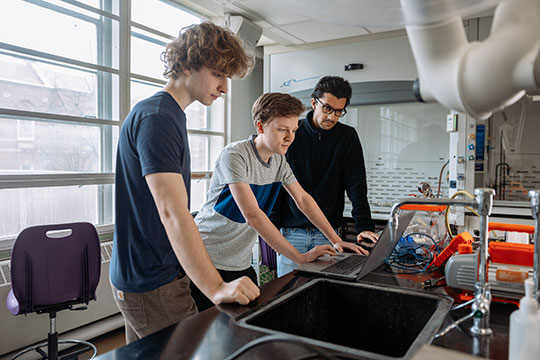
Alfred University senior mechanical engineering majors (from left) David Howe, Corey Field, and Saqlain Zaheer look over data related to their capstone research project, which looks at ways to create heat sinks that will protect satellite batteries from the intense heat they are exposed to while in orbit.
The research is the capstone project of seniors David Howe of South Wales, NY, Corey Field of Scio, NY, and Saqlain Zaheer of Brooklyn. The three are advised in their senior capstone by Medhi Kabir, assistant professor of mechanical engineering.
Howe explained that he and his fellow students on his research team are studying how low melting point alloys (LMPAs) can be used to manage heat generated by batteries used to power satellites and small aircraft in space. LMPAs, according to the abstract for the students’ research, “are considered one of the most promising substances to be engaged passively in thermal management and storage systems for spacecrafts where it is critical to diminish the overall mass of on-board thermal storage system while minimizing temperature fluctuations upon drastic changes of the environmental temperature within the orbit stage.”
“When a satellite is in orbit, the computers and sensors are battery operated,” Howe explained, noting that when in orbit, the battery, especially when the satellite is exposed to the sun, is susceptible to extreme temperatures. “Our project focuses on passive thermal management of the batteries.”
Satellite manufacturers strive to make devices that last as long as possible while orbiting in space, Field said. “If you can control the heat in (the satellite’s) electronics, it is huge as far as maximizing longevity” of both battery and satellite.
The project is studying how LMPAs can be utilized in creating a “heat sink” — defined as a passive heat exchanger that transfers heat away from high-temperature electronic components (like CPUs or GPUs) to prevent overheating. A heat sink doesn’t require its own power source to function, unlike a forced convection cooling system.
Howe’s team’s research is a continuation of a senior capstone advised by Kabir in 2024-25, when students used paraffin wax as the heat-transferring material in the heat sink. For this project, the heat sink consists of LMPAs contained in a small metal enclosure (about 4-x-4 inches) which is mounted against a heat source that replicates a battery powering a satellite.
“One of the key challenges in spacecraft design is passively managing heat without the presence of air in space or an externally powered cooling system,” Howe said. “Satellites and small spacecraft generate heat from their electronics and batteries, but unlike on Earth, there is no atmosphere to aid in dissipating that heat. This means temperature swings can be extreme and possibly dangerous for sensitive electronic components.”
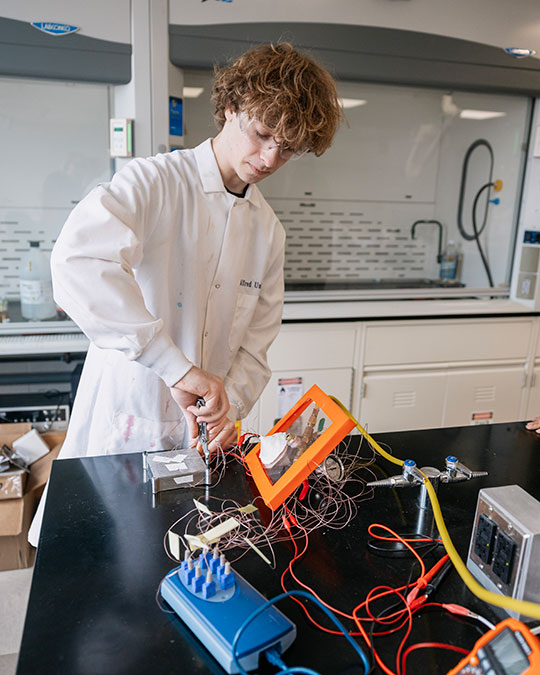
David Howe, a mechanical engineering major at Alfred University, works on a heat sink he and two other seniors—Corey Field and Saqlain Zaheer—are developing as part of their senior capstone project.
The solution explored in the students’ research uses LMPAs—which, while in space, melt at very low temperatures and absorb and release large amounts of heat as they melt and re-solidify throughout the satellite’s orbit—in the heat sink.
“The challenge with these alloys is that they don’t conduct heat very well on their own,” Howe pointed out. To remedy that problem, the research focuses on designing and testing heat sinks that combine LMPAs with highly conductive materials — such as carbon foam, expanded graphite, and copper foam — to dramatically improve how quickly heat moves through the sink.
Howe, Field and Zaheer test the heat sink materials in a vacuum chamber to simulate real space conditions, with a focus on keeping the electronics and batteries of small CubeSat modules within safe operating temperatures. CubeSats are a type of miniaturized, modular satellite used for space research. Developed for low-cost access to space, they are often used for Earth observation, technology demonstrations, and educational projects, usually launched into Low Earth Orbit.
The findings of the research could potentially be applied to the manufacture of batteries powering satellites, including those used by the military. Increasing longevity of satellites will benefit the space environments, as those that wear out will continue to orbit in space despite no longer functioning. “This will help mitigate waste,” Howe said.
The students say they have benefited from their project in a number of ways.
“It’s been a lot of trial and error. It’s been fun seeing what we need to improve on,” Field commented. “There has been a lot of trouble shooting, but that’s good. That’s how you learn.”
“Our critical thinking skills have really taken off,” Howe added.
“It has helped us to think independently, which will help us in our careers,” Zaheer said. “It has also helped us to work together as a team, which is important.”
Zaheer hopes to pursue a career in the aerospace/aeronautics industry. This project, he said, is giving him valuable experience. “This is my first time researching this type of experiment. Hopefully, I’ll be able to use what I’ve learned here in future research,” he said.
Field said he may pursue a career in computer-aided design, something for which he gained experience while working on computer modeling for this project. “Computer simulation is something I’m very interested in, and I’ve been doing that here.”
Howe said he is considering enrolling in graduate school after earning his bachelor’s degree from Alfred this spring but may enter the workforce first. “I’m leaning toward the aerospace industry, but am also interested in automotive,” he said.
The three students will present their research findings at Alfred University’s annual Undergraduate Research Forum in April.