

When Alfred University Associate Math Professor Amanda Lipnicki took up knitting as an undergraduate student, she didn’t immediately recognize how mathematics and geometry underlay the patterns of stitches holding together any knitted or crocheted surface.
It was an insight that came later, after years of teaching university-level mathematics, and it led Lipnicki to creative collaborations with other mathematicians, as well as to an exploration of ways mathematics and art can overlap. She explores those latter issues in classes on mathematical art, which she teaches in Alfred University’s College of Liberal Arts and Sciences.
Along the way, she has also crocheted a fascinating collection of textile sculptures, exploring the outer limits of Euclidean geometry and pushing into non-Euclidean areas such as hyperbolic planes: three-dimensional curving surfaces that disrupt the two-dimensional coherencies of Euclidean geometry.
“It’s exploring a new geometric world,” she says.
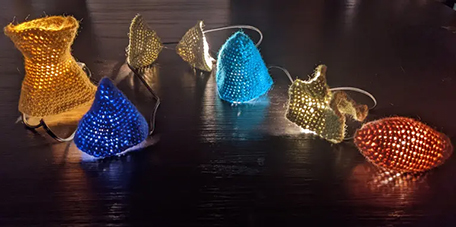
It’s an exploration through which she has been leading her students too.
In the early days of her hobby, Lipnicki found the flexible properties of yarn ideal for the surface-warping phenomena of non-Euclidean geometry. Other mathematicians had made the same discovery, including Cornell University Math Professor Daina Tamina, whose paper “Crocheting Adventures with Hyperbolic Plane” won the 2012 Euler Prize from the Mathematical Association of America, and whose research Lipnicki studied as a student.
Lipnicki also has been collaborating with Meghan Martinez, a math professor at Ithaca College, producing the joint articles “Hooked on Calculus: Crocheting Quadric Surfaces” and “Automating Crochet Patterns for Surfaces of Revolution,” which were published in the 2023 Bridges Conference Proceedings.
Together, Lipnicki and Martinez created algorithms for surfaces called “quadric surfaces” and for surfaces of revolution that are possible through knitting and crocheting. As Lipnicki explains in her office on the Alfred campus: A flat knitted or crocheted surface will consist of sequences of rows and stitches governed by a mathematical regularity that you might encounter in a first-year algebra class. If, however, you complicate the underlaying math, you can develop sequences of rows and stitches that force the surface to bend into three-dimensional curves. Picture, she says, the sleeve of a crocheted sweater that balloons or contracts in the middle. There is an underlying algorithm that describes that disruption of flatness, Lipnicki explains.
Such work is adaptable not only to Alfred University courses in math, but also art. Lipnicki uses fiber arts to teach courses in mathematical art. “We’re making these awesome things out of yarn and learning about math along the way,” she says.