

A thriving culture of higher education is key to a thriving economy, Alfred University President Mark Zupan told members of the Rochester Rotary Club this week.
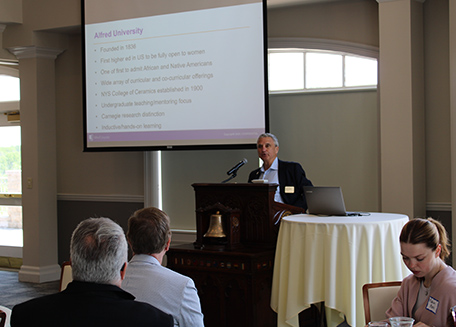
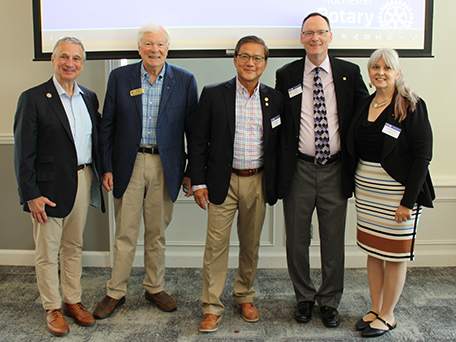
Zupan was guest of honor for the club’s weekly meeting at Locust Hill Country Club. Following his introduction, he addressed Rotarians for about 30 minutes, describing Alfred University, its role in the economy of New York State, and the challenges and opportunities facing higher education in the post-Covid era.
He reminded Rotarians that higher education “is a huge part of the Rochester economy,” with 21 current degree-granting institutions in the greater Rochester area. Those institutions enroll approximately 80,000 students, Zupan noted, and the University of Rochester alone, with 39,000 employees including those working in the Strong Health System, generates about $13 billion in statewide economic impact and is the largest employer in Upstate New York.
Nationally, Zupan observed, Monroe County is one of 44 counties out of the 100 most productive counties in the country that have at least one research university based within its borders.
Zupan also reminded Rotary Club members that higher education, nationally and within New York State, is facing serious financial challenges in the post-Covid Era. Fifteen New York institutions of higher learning have closed since 2020, he noted. Both the University of Rochester and Rochester Institute of Technology have reported declines in their international student populations, and the population of U.S. high school students is in the midst of a sharp decline.
Birth rates are part of the demographic story, Zupan said. However, he also observed social media devices such as cell phones may also be a contributing factor to a contracting pool of applicants. “If you’re not interacting with someone personally, it’s hard to have babies,” he quipped.
At the same time, Zupan said numerous opportunities are available to colleges and universities working their way through a difficult economy. Educational institutions, he maintained, need to focus on offering students a chance to develop intellectual versatility, social and academic connections, opportunities for applied learning, and the chance to develop emotional and intellectual judgement.
Colleges and universities traditionally have offered students the chance to develop and hone those personal qualities, which makes them incubators of future leaders. Citing historic financial supporters of higher education such as George Eastman and J.D. Rockefeller, Zupan said, “The smart money traditionally goes to higher education.”