MessageOpen or Close Message
Close
It's Not Too Late to Apply!

We're continuing to review applications! You're going to love being a Saxon, and we would be so happy to have you.

Apply Now

A photo of students at Alfred University
Contribute

Have an idea for a post on our blog? We'd love to hear from you! 

Submit an Idea

About the Spark

The Spark is the official blog of Alfred University, created to illuminate the dynamic experiences, creative achievements, and unique perspectives of our student community. The Spark captures the essence of what it means to be a Saxon. Whether you're a prospective student dreaming of your next chapter, or a current Saxon shaping your journey, let The Spark guide you. 

How Kiani Barnard-Pratt Explored Tissue Regeneration at Alfred

Posted By Alfred University
Jul 15, 2026   |   Alumni   Engineering   General Blogs  

When Kiani Barnard-Pratt arrived at Alfred University, she envisioned a future in prosthetics. As a biomaterials engineering student, she was drawn to the intersection of engineering and healthcare and the opportunity to improve people's lives through innovation. What she didn't expect was to become fascinated by a material that most people would never associate with medicine: glass.

Today, Barnard-Pratt leaves behind a research project that explored how specialized bioactive glass materials can be used in 3D-printed structures to support tissue regeneration and bone repair. Her work highlights the type of hands-on research opportunities available to Alfred students and demonstrates the growing role of engineering in shaping the future of healthcare.
Share this Post

Research Built on Real Innovation

As a senior, Barnard-Pratt completed a capstone project focused on optimizing the 3D printing of bioactive glass materials. Her research built upon doctoral work conducted by Alfred alumna Danielle Perry '20, M.S. '22, whose research examined bioactive glass composites designed to support tissue regeneration and other biomedical applications.

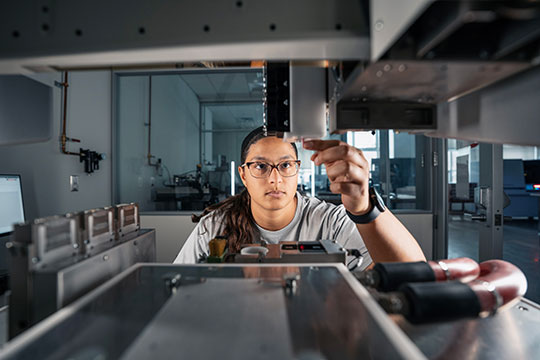
Working in Alfred's CREATE Center, Barnard-Pratt used a specialized bioplotter, a form of advanced 3D printing technology capable of producing scaffolds from biomaterials, ceramics, and glass-based materials.

Rather than simply testing whether the materials could be printed, her research focused on determining the ideal amount of bioactive glass to incorporate into the scaffolds and how those choices affected the material's performance.

What Makes Bioactive Glass So Exciting?

Bioactive glass is engineered to interact with the human body in ways that traditional materials cannot. When implanted, it can stimulate cellular activity and support the body's natural healing process, making it a promising material for tissue regeneration and bone repair.

"My project uses bioactive glasses, which react with the cells in the human body to regenerate tissue," Barnard-Pratt explained. "It can speed up the healing process."

Researchers can incorporate these materials into scaffold-like structures that provide support for new tissue growth. Over time, the bioactive glass gradually breaks down and becomes integrated into the body's healing process.

The potential applications are significant, ranging from bone regeneration and dental repair to future advances in tissue engineering and regenerative medicine.

Exploring the Possibilities of 3D Printing

kiani barnard-pratt in CREATE lab, bioplotter
Kiani Barnard-Pratt '26 conducts an experiment on the bioplotter, a 3-D printing device located in the CREATE Center during her time as a student at Alfred University.

A key component of Barnard-Pratt's research was Alfred University's bioplotter, an advanced piece of equipment capable of working with a wide variety of materials.

"The bioplotter can 3-D print using plastics, glasses...many different materials. It can 3-D print living cells," she said.

Using the machine, Barnard-Pratt created and analyzed scaffold structures that contained varying concentrations of bioactive glass. After printing, she examined the materials to determine how evenly the glass was distributed and whether the scaffolds were structurally sound.

The research helped establish a better understanding of how the technology can be used to create effective biomaterials for future medical applications.

Discovering a New Passion

One of the most interesting aspects of Barnard-Pratt's story is that tissue regeneration was not originally part of her career plan. She credits faculty mentorship from Dr. Tim Keenan for introducing her to an area of research she had never considered before.

"When I got here, Dr. Keenan got me interested in tissue regeneration and bioglass. I didn't know it was a thing," she said.

That introduction led to a new fascination with the possibilities of biomaterials engineering.

"I thought it was pretty cool that you could grow back bone using glass," Barnard-Pratt added.

Why Undergraduate Research Matters

While the research was conducted as an undergraduate capstone project, its implications extend far beyond the classroom.

Advances in bioactive glass and 3D printing technology could help researchers develop new approaches to repairing damaged tissue and bone, improving outcomes for patients and expanding treatment options in regenerative medicine.

At the same time, the project demonstrates how engineering students can contribute to meaningful research long before they graduate. By working with advanced technology, analyzing real-world challenges, and contributing to ongoing scientific investigations, students gain valuable experience while helping advance knowledge in their field.

Looking Ahead

Following graduation, Barnard-Pratt planned to pursue a career in the biomedical industry with interests in prosthetics and tissue engineering. The skills she developed through her research—including additive manufacturing, microscopy, biomaterials analysis, and scientific problem-solving—provide a strong foundation for that next step.

This post was inspired by an article in Alfred University News.

Read More News at Alfred University

Related Posts

A photo of Alfred University alumnus Huang Chunmao
Posted By Alfred University
July 14, 2026
A photo of three mechanical engineering students working in an engineering lab
Posted By Alfred University
July 13, 2026
The Knee family at Reunion 2026 Reconfirmation of Love
Posted By Carol Marcy
July 08, 2026
We'll Help You Find the Answers

Contact Us

Office of Marketing & Communications
Greene Hall
M-F, 8:30a - 4:00p
Emma Vallelunga
Emma Vallelunga
Digital Content Specialist
Mark Whitehouse
Mark Whitehouse
Director of Communications