MessageOpen or Close Message
Close
It's Not Too Late to Apply!

We're continuing to review applications! You're going to love being a Saxon, and we would be so happy to have you.

Apply Now

A female shown next to a large purple sign on a college campus that says Fiat Lux!
Contribute

Have an idea for a post on our blog? We'd love to hear from you! 

Submit an Idea

About the Spark

The Spark is the official blog of Alfred University, created to illuminate the dynamic experiences, creative achievements, and unique perspectives of our student community. The Spark captures the essence of what it means to be a Saxon. Whether you're a prospective student dreaming of your next chapter, or a current Saxon shaping your journey, let The Spark guide you. 

How Alfred Engineering Students Are Solving a Satellite Challenge

Posted By Alfred University
Jul 13, 2026   |   Current Students   Engineering   General Blogs  

What does undergraduate research look like at Alfred University? For three mechanical engineering seniors, it looks a lot like solving a problem faced by the aerospace industry: how to protect satellite batteries from extreme heat in space. As part of their senior capstone project, David Howe, Corey Field, and Saqlain Zaheer are exploring ways to improve thermal management systems for satellites, helping critical electronics operate safely in one of the most unforgiving environments imaginable.
Share this Post

The Challenge of Keeping Satellites Cool

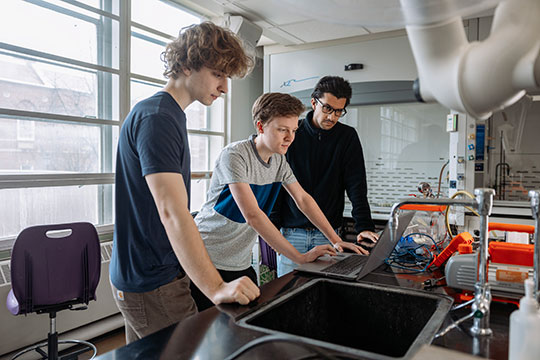
three students working on mechanical engineering senior capstone, heat sink
Alfred University senior mechanical engineering majors David Howe, Corey Field, and Saqlain Zaheer look over data related to their capstone research project.

When satellites orbit Earth, they rely on batteries to power onboard computers, sensors, and communication systems. But unlike electronics on Earth, satellites can't simply use fans or air circulation to dissipate heat.

"One of the key challenges in spacecraft design is passively managing heat without the presence of air in space or an externally powered cooling system," explained Howe. "Satellites and small spacecraft generate heat from their electronics and batteries, but unlike on Earth, there is no atmosphere to aid in dissipating that heat."

Those temperature fluctuations can damage sensitive electronics and reduce the lifespan of both batteries and satellites. Finding better ways to regulate temperature is critical for the future of aerospace technology.
Engineering a Solution

Working under the guidance of Assistant Professor of Mechanical Engineering Medhi Kabir, the students are investigating how low melting point alloys (LMPAs) can absorb and release heat inside a specially designed heat sink.

Their goal is to create a passive cooling system that protects batteries without consuming additional power—a major advantage for spacecraft where every ounce of weight and watt of energy matters.

To improve performance, the team is testing combinations of LMPAs with materials such as carbon foam, expanded graphite, and copper foam, all designed to move heat more efficiently through the system.

The students conduct their experiments in a vacuum chamber to simulate the conditions satellites experience in orbit.

Learning Through Trial and Error

As with many engineering projects, success hasn't come from getting everything right the first time.

"It's been a lot of trial and error," Field said. "It's been fun seeing what we need to improve on. There has been a lot of troubleshooting, but that's good. That's how you learn."

That process of testing, refining, and redesigning has become one of the most valuable parts of the experience.

"Our critical thinking skills have really taken off," Howe added.

For students considering engineering, projects like this demonstrate what real-world problem solving looks like. The answers aren't always in a textbook. Instead, students learn by experimenting, analyzing data, and adapting their designs based on what they discover.

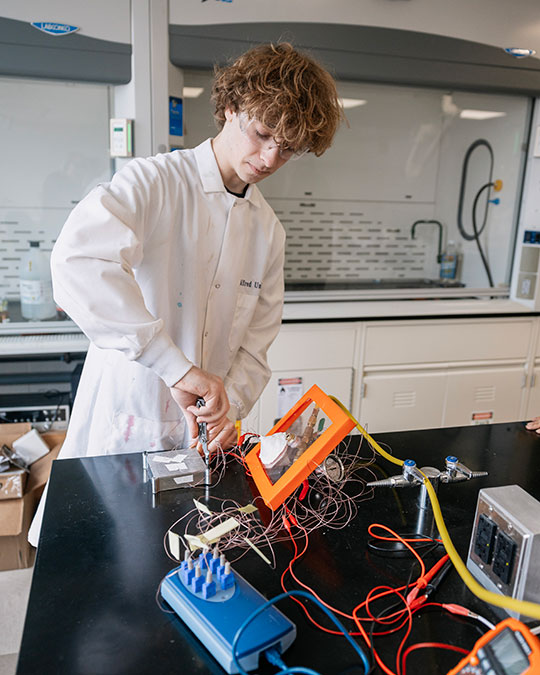
David Howe working on mechanical engineering senior capstone, heat sink
David Howe, a mechanical engineering major at Alfred University, works on a heat sink.

Research with Real Career Impact

Beyond the technical knowledge, the project is helping students define their career goals.

Zaheer hopes to pursue a career in the aerospace or aeronautics industry and sees the project as an important first step.

"This is my first time researching this type of experiment," he said. "Hopefully, I'll be able to use what I've learned here in future research."

Field discovered an interest in computer simulation and modeling through the project, an area he may pursue professionally after graduation.

"Computer simulation is something I'm very interested in, and I've been doing that here," he said.

Howe is considering graduate school and is exploring careers in both aerospace and automotive engineering. The project has provided firsthand experience in an industry he may one day join.

More Than a Capstone Project

The team's research could one day contribute to longer-lasting satellites and spacecraft. By improving battery performance and longevity, engineers can reduce failures and potentially decrease the amount of nonfunctioning equipment left in orbit. But perhaps the most immediate impact is on the students themselves.

"It has helped us to think independently, which will help us in our careers," Zaheer said. "It has also helped us to work together as a team, which is important."

Those are the kinds of skills that employers look for, and the kinds of experiences that define an engineering education.

Howe, Field, and Zaheer presented their findings at Alfred University's Undergraduate Research Forum. They demonstrated the value of undergraduate research: tackling complex problems, building confidence, and gaining experience that extends far beyond the classroom.

For prospective students interested in engineering, that's perhaps the biggest takeaway. At Alfred, research isn't reserved for graduate students. Opportunities to solve real-world problems start at the undergraduate level, and sometimes, those problems are literally out of this world.

This post was inspired by an article in Alfred University News.

Read More News at Alfred University

Related Posts

The Knee family at Reunion 2026 Reconfirmation of Love
Posted By Carol Marcy
July 08, 2026
A photo of two Alfred University students sitting on a bed in a dorm room
Posted By Alfred University
July 07, 2026
A drone photo of a sunset over Alfred New York
Posted By Alfred University
July 02, 2026
We'll Help You Find the Answers

Contact Us

Office of Marketing & Communications
Greene Hall
M-F, 8:30a - 4:00p
Emma Vallelunga
Emma Vallelunga
Digital Content Specialist
Mark Whitehouse
Mark Whitehouse
Director of Communications