


Matthew Versaggi was an undergraduate student at Alfred University in 1985, studying computer science and business, when the concept of artificial intelligence first piqued his interest. Herbert Simon, one of the early theorists of artificial intelligence, delivered a presentation on AI in Holmes Theater on the Alfred campus.
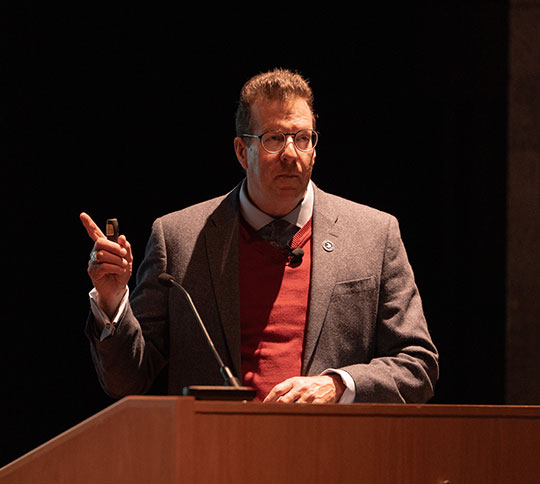
“I was bitten by the bug,” Versaggi said while giving an engineering seminar in the same lecture hall Thursday, April 17, as part of AI Week at Alfred University. “I was one of the starry-eyed sophomores sitting in the back row right here.”
Versaggi, who earned bachelor’s degrees in finance/management information systems and computer science from Alfred University in 1987, has been learning and working in the AI space ever since. He has served as an artificial intelligence engineer at Imagine One Technology and Management, Charleston, SC, a military contractor for the U.S. Department of Defense; worked as senior director of Artificial Intelligence & Cognitive Technology at Optum Technology (UnitedHealthcare) in Eden Prairie, MN; and was principal consultant for Versaggi Information Systems, LLC, which advised companies on the development and execution of AI business strategies.
Today, Versaggi is a White House Presidential Innovation Fellow in AI. As a Presidential Innovation Fellow stationed in Washington, D.C., for a two-year term in the U.S. Centers for Medicare and Medicaid Service (CMS), he is charged with proliferating artificial intelligence throughout CMS operations.
During Thursday’s engineering seminar, Versaggi discussed his career in AI, and how artificial intelligence is prevalent in nearly all sectors of employment, from industry and manufacturing to education. “AI is pervasive across every industry,” he said.
Versaggi talked about AI’s prevalence in the various sectors of the health care industry: patient personalization and precision prescription of medication; the development of “smart hospitals” which are made more efficient and effective through the use of artificial intelligence; wellness and preventative care; drug discovery and development; and in the diagnosis of medical conditions.
“AI can predict when people are in the last stages of life” and develop and appropriate plan of care and treatment, he said.
Artificial intelligence is used to detect fraud, waste, and abuse as well, Versaggi said, with $68 billion identified each year in the health care industry alone.
Versaggi urged students to commit to taking the time to learn more about artificial intelligence and how it can help them on their career paths. “What future will you carve out for yourself in the AI world?” he asked.