

A research team that includes faculty, students and alumni from Alfred University has been named the recipient of a prestigious 2026 R&D 100 Award, which recognize the top 100 revolutionary technologies developed in the past year.
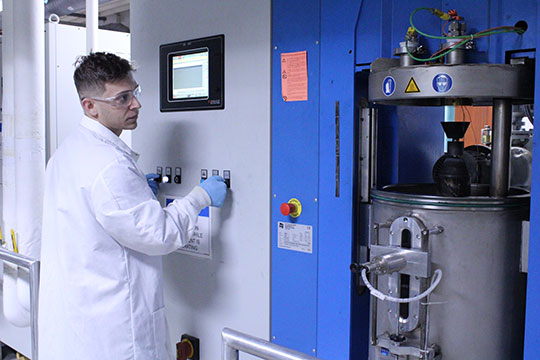
Nate Marrero ’23, M.S. ’25, a PhD student pursuing a doctoral degree in materials science and engineering at Alfred University, prepares a sample of cermet—a heat-resistant ceramic-metallic composite—for sintering in the Spark Plasma Sintering furnace, located in the furnace lab of McMahon Engineering Building.
Established in 1963, the R&D 100 Awards are the only science and technology-focused awards competition that recognizes new commercial products, technologies and materials for their technological significance that are available for sale or license. The awards are presented annually by R&D World — which delivers informative content to engineers, scientists, laboratory professionals, R&D managers, and others involved in the world of research.
Past R&D 100 Awards recipients include established Fortune 500 companies and federally funded research institutions, as well as academic and government labs and smaller companies.
“This is a huge feather in our cap. Out of hundreds of (award entries) we are one of 100 winners,” said S.K. Sundaram, Inamori Professor of Materials Science and Engineering, and a co-principal investigator on the award-winning project. Sundaram was assisted in research conducted at Alfred University by alumnus Nate Marrero, a current Alfred University Ph.D. student in materials science and engineering from Newport, NY. Marrero earned a bachelor’s degree in ceramic engineering from Alfred University in 2023 and went on to earn a master’s, also in ceramic engineering, from Alfred in August 2025.
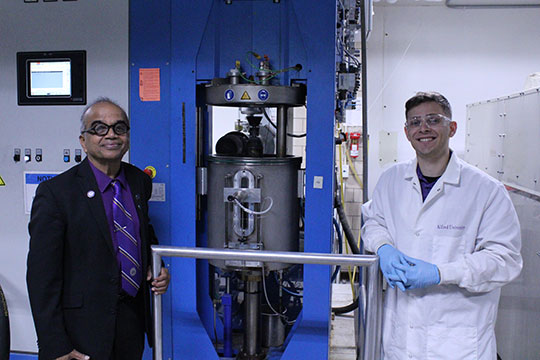
Nate Marrero ’23, M.S. ’25 (right), a PhD student pursuing a doctoral degree in materials science and engineering at Alfred University, with his academic advisor, S.K. Sundaram, Inamori Professor of Materials Science and Engineering. Sundaram was a co-principal investigator, on a federally-funded project researching nuclear waste forms. Marrero worked on the project as part of Sundaram’s research team.
“This R&D 100 award recognition showcases the very best of Alfred: talented faculty and students, accomplished alumni, and a culture of innovation that translates ideas into impact,” said Gabrielle Gaustad ’04, dean of the Inamori School of Engineering at Alfred University.
Alfred University, four other schools, and two national laboratories collaborated to develop the product, “Engineered Cermets for Advanced Reactor Waste Disposal.” R&D World, in its profile on the winners, described the product as “high-density, extremely durable ceramic-metal composites that offer reduced storage footprints, operational flexibility, less complexity, and cost savings over current technologies used for nuclear waste immobilization, management and storage. Cermets and related manufacturing process are key innovations that will accelerate deployment of next-generation nuclear power plants.”
Research on the project was funded by a $4 million awarded in 2022 by the U.S. Department of Energy (DoE) through the Advance Research Projects Agency-Energy (ARPA-E) “Optimizing Nuclear Waste and Advanced Reactor Disposal Systems” (ONWARDS) program. Unveiled by the DoE in 2021, the ONWARDS program was created to identify and facilitate technologies for advanced research on used nuclear fuel (UNF) recycling, waste forms, UNF disposal pathways and associated advanced safeguards technologies.
The three-year (2022-25) project focused on Pioneering a Cermet Waste Form for Disposal of Waste Streams from Advanced Reactors (PACE-FORWARD). The goal of PACE-FORWARD was to deliver a simple, scalable route for turning used nuclear fuel into a high-density, durable cermet (a heat-resistant ceramic and metallic composite) waste form. The product resulting from the research—which has been granted a U.S. patent—is expected to lower waste burden and sustain future deployment of carbon-free nuclear power.
Alfred University’s share in the ARPA-E grant was approximately $500,000. The research leveraged extensive processing capabilities such as spark plasma sintering (SPS), hot uniaxial pressing (HUP), and state-of-the art high temperature characterization tools at Alfred University and partnering institutions, to produce highly engineered cermets into which a variety of ceramic and metallic phases from wastes could be incorporated into a single waste form.
Sundaram explained in 2022 when the grant was awarded that “early versions” of cermet samples were produced and characterized in labs at Alfred University. Those samples were shared with the entire ARPA-E project team for various advanced characterizations at other institutions. The multi-disciplinary team that worked on the project included product developer Savannah River National Laboratory (SRNL), along with co-developers Rutgers University (principal investigator), Alfred University, Washington State University, University of South Carolina, Missouri University of Science and Technology, and Pacific Northwest National Laboratory (PNNL).
Two Alfred University alumni: Jake Amoroso ’03 (glass science engineering) Ph.D. ’10 (materials science and engineering), principal engineer at Savannah River National Laboratory, and John Vienna ’91 (ceramic engineering), ’93 M.S. (ceramic engineering), materials scientist and a Fellow at Pacific Northwest National Laboratory also worked on the project. Marrero explained that SRNL’s work on the project focused on cermets’ chemical durability, while PNNL focused on the scaled-up production of cermets.
SRNL-produced video on the award-winning project
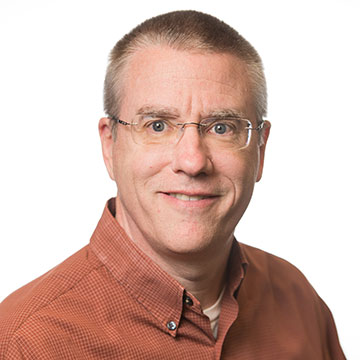
John Vienna ’91, M.S. ’93, materials scientist and a Fellow at Pacific Northwest National Laboratory.
“This cermet waste form is an exciting technology for treating advanced nuclear reactor wastes as it will protect the environment while reducing disposal volume and cost. Managing nuclear wastes is crucial to the success of a nuclear renaissance – this cermet waste form will add a crucial new tool to help the industry thrive,” Vienna commented. —“It was great working with this team of experts from seven different organizations, each bringing their complimentary expertise to develop a game-changing nuclear waste form.”
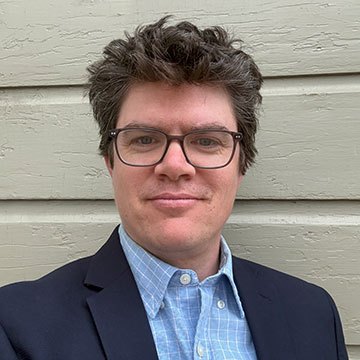
Jake Amoroso ’03, PhD ’10, principal engineer at Savannah River National Laboratory.
“This research was all about developing a ceramic-metal composite, or cermet, that could be used to safely treat nuclear waste. Especially nuclear waste from the new reactor designs. The basic premise is to combine metal and ceramic wastes into a single material, thereby maximizing waste loading and reducing the total volume and footprint of the final waste destined for disposal,” Amoroso said. “This was a large team effort, led by Rutgers University. I know the whole team is also really excited to win this award. We could not have developed this cermet technology without the joint effort across the entire team and this award highlights what we have accomplished.”
Four recent Alfred graduates completed undergraduate capstone projects as part of their work with Sundaram’s research team. They include Alyssa Piechota ’24 (B.S., ceramic engineering), whose capstone was title “Processing of Stainless Steel 316-Sodalite Cermet by Spark Plasma Sintering for Nuclear Waste Form Application”; Nathan Sponenberg ’24 (B.S., ceramic engineering; MBA ’25), “Sintering of Hastelloy X-Silicon Carbide Cermet for Nuclear Waste Form Applications”; Samuel Gross ’25 (B.S., materials science and engineering), “Investigating Tungsten Based Cermet Fuels for Nuclear Thermal Propulsion”; and Andrew Flemming ’26 (B.S., materials science and engineering), “Entropy Driven Disorder and Phase Stability in Pyrochlore Ceramics.”
Sundaram, who was part of four winning R&D 100 award-winning projects when he was working as a scientist at PNNL, said he, Amoroso and Vienna are named in the patent as co-inventors on this year’s winning PACE-FORWARD project. He was quick to note Marrero role in the research. “Nate was a key contributor,” he said.
Sundaram and Marrero discussed their research on the PACE-FORWARD project at the American Ceramic Society (ACerS) 10th International Congress in the fall of 2024. Marrero gave two presentations—an oral presentation with Sundaram, “Processing and Characterization of Model Cermet Waste Forms for Nuclear Applications,” and presented a poster, “Novel Waste Forms for Nuclear Applications,” with Sundaram—based on research progress and data collected in the Inamori School of Engineering under a current multi-institutional U.S. Department of Energy Advanced Research Projects Agency-Energy (ARPA-E) project. In addition, Sundaram, Marrero, and Gross authored a paper related to the research, “Processing limits of cermets for nuclear waste form application, which appeared in the August 2025 edition of the ACerS Bulletin.
Marrero, who was starting his master’s degree studies when he began working with Sundaram on the project, said the experience, which involved collaborating with researchers from two national laboratories, was invaluable and something he hopes will help him reach his career goals.
“Being at a small school like Alfred and doing this type of work is significant,” said Marrero, who aspires to work as a research scientist at a national laboratory, with a focus on environmental management. He said during the summer of 2025, he visited SRNL in Jackson, SC, for two months and observed researchers conducting chemical durability testing on cermet samples he helped develop.
Amoroso noted Marrero’s contributions to the project. He said that Matthew Page, a lead scientist at SRNL for the PACE-FORWARD project, mentored and supported Marrero during his visit to the lab in 2025. He said Page and Marrero worked side by side testing durability of cermets to understand their performance and improve their design. “This type of exchange is rewarding and ultimately is what advances the technology. The entire team has worked really well together and that has shown in this award and what we have accomplished,” Amoroso said.
R&D 100 award winners will be recognized at an event Nov. 19 in Scottsdale, AZ, which Sundaram and Marrero plan to attend. Sundaram, who serves as Marrero’s Ph.D. advisor, said the event will provide an opportunity for students like Marrero to connect with members of the science and technology industries while also shining a spotlight on the work being done at Alfred University.