

Alfred University is partnering with clean-tech startup Ranial Systems Inc. to develop an artificial intelligence-assisted controller for power grid-scale battery storage, commercial and industrial microgrids, and Original Equipment Manufacturer (OEM) integrations.
The project, a collaboration between Alfred University’s Inamori School of Engineering and Ranial, started the week of June 29 and is supported by funding from New Energy New York (NENY), a Binghamton University-led partnership with the New York Battery and Energy Storage Technology Consortium (NY-BEST).
The Alfred University-Ranial partnership was among four in New York State to share in a combined $315,000 funding awarded through the most recent round of NENY’s Technical Assistance Program. The program is designed to advance new battery technologies and expand the growing energy storage innovation ecosystem in upstate New York by supporting startups and small businesses in their efforts to de-risk technology, scale, and advanced manufacturing readiness.
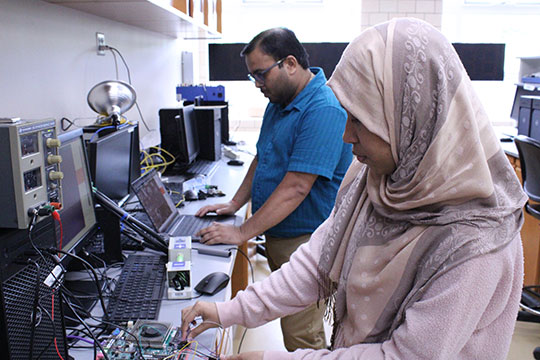
Ranial develops CognitEMS™, a patented edge-AI platform that unifies battery and energy management for Distributed Energy Resources. The project with Alfred University will develop a next-generation System-on-Chip EMS/BMS (Energy Management System/Battery Management System) controller powered by an advanced hardware technology. The controller will be validated through hardware-in-the-loop testing at Alfred University’s GE Vernova Advanced Power Grid Lab and Edibon Power Systems Simulation Lab, both located in the Inamori School’s McMahon Engineering Building.
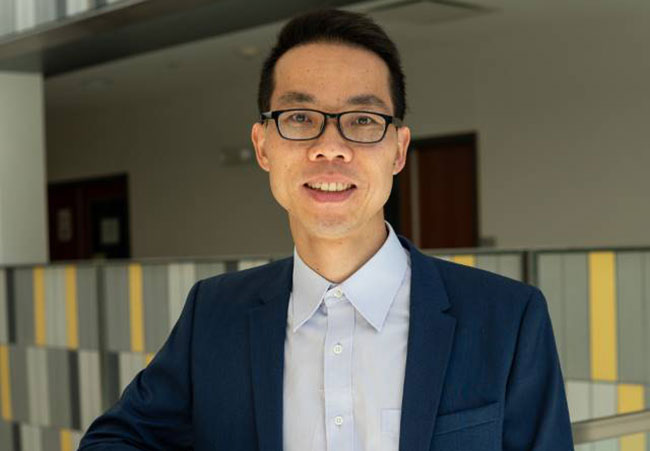
The Alfred University-Ranial project will receive $65,000 in funding and is expected to be completed in November. Dr. Chandan Kumar, Assistant Professor of Computer Science, is the Principal Investigator for the project; Dr. Xingwu Wang, Professor of Electrical Engineering, serves as co-Principal Investigator. Jannatun Naiem, a master’s degree student in electrical engineering from Bangladesh, is assisting Dr. Kumar with the project.
Dr. Kumar said Naiem is actively supporting the project across multiple workstreams, including hardware setup, sensor integration, and hardware-in-the-loop testing.
“This project provides an excellent opportunity for hands-on training in cutting-edge energy systems research, bridging the gap between academic learning and real-world industrial application,” Dr. Kumar said. “Her involvement ensures that the work also contributes to building the next generation of engineers equipped to tackle challenges in intelligent energy infrastructure.”
Over the course of five months, Dr. Kumar’s team will lead a multi-path hardware and software development effort that includes AI model development and validation, sensor integration, and rigorous hardware-in-the-loop testing using the university’s state-of-the-art power grid simulation infrastructure. The GE Vernova Advanced Power Grid Lab, located in McMahon Engineering Building, has Advanced Energy Management System (AEMS) and Advanced Distribution Management Solutions (ADMS) software platforms will support real-time simulation and benchmarking throughout the project.
“We see this collaboration as a meaningful opportunity to translate cutting-edge Machine Learning research into a commercially deployable, domestically developed solution with direct relevance to New York State's clean energy goals and the broader national push toward resilient, intelligent energy infrastructure,” Dr. Kumar commented.
“What excites me most about this work is that we are bringing unsupervised learning out of the research lab and into the power grid, where it can make a real difference in how we manage and protect our energy systems.”
The Advanced Power Grid Lab at Alfred University was launched in 2024 as part of a workforce development initiative that will prepare students for careers in the growing renewable energy industry. It is supported by a $466,853 grant from the New York State Energy Research and Development Authority (NYSERDA) and $2.8 million in software licenses donated by GE Vernova. The facility will benefit students in Alfred’s Renewable Energy Engineering and Electrical Engineering programs by providing them with access to state-of-the-art equipment and training.
Located on the second floor of the Inamori School’s McMahon Engineering Building, the Edibon Lab houses a microgrid control center and DERs (Distributed Energy Resources) command center to be used as a training resource. Software provided by GE Vernova will facilitate training in power grid planning and operations. NYSERDA funding will support student internships and a program that provides short course training for Renewable Energy Engineering students and workers in the electric utilities field.