

From April 1 to 4, 15 students from the Alfred University Economics Club traveled to Washington, D.C., for their annual professional development trip, an experience that reflected Alfred’s strong emphasis on experiential learning. Rather than remaining within the classroom, students engaged directly with professionals in public policy, finance, and economic development, gaining a clearer understanding of how economics operates in real-world environments.
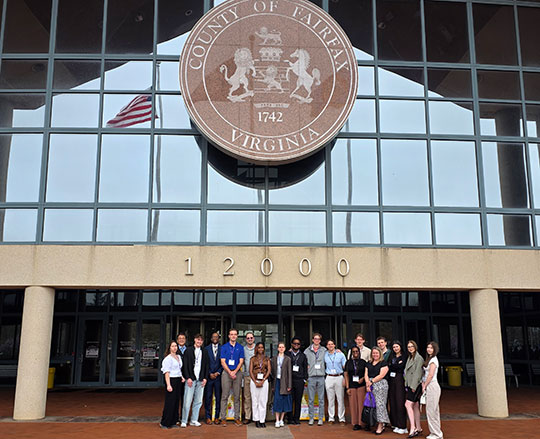
The trip—organized with the leadership of club president Maksym Smirnov, junior accounting, finance, and mathematics major from Ukraine; faculty advisor Sangjoon Lee, professor of economics in Alfred’s College of Business; and Alfred University alumnus Brandon Thurner ’05, project manager for Enegis, a Fairfax County (Virginia) energy consulting firm that focuses on strategy, technology, economics, and project development—was designed to bridge the gap between theory and practice.
Lee explained, the goal was to give students the opportunity to see how economic concepts play out beyond textbooks. By visiting a congressional office, private companies, and organizations such as the Fairfax County Economic Development Authority (FCEDA), students explored how topics like policy, supply chains, and regional development influence real decisions.
For students like Roy Wilson, junior data analytics major (minors in computer science and economics) from Bayport, NY, the experience was not only educational but also deeply motivating. He was particularly interested in learning more about economic development and the work of organizations like FCEDA.
“I was most excited to experience new insights within the business professional world,” Wilson said. “I hoped to find new perspectives in meetings with professionals and AU alumni and understand what it took for them to reach the positions they hold today.”
A key component of the trip was the opportunity to connect with professionals and alumni who have successfully transitioned from college into impactful careers. Through the efforts of Thurner, students met individuals such as Stephen Heine ’81, retired CEO of Woodsboro Bank and chair of the Alfred University Board of Trustees, and Bryan Hill ’90, Fairfax County Executive. They also visited the George Mason University Innovation District, a hub for entrepreneurship and innovation. These interactions allowed students to ask questions, gain advice, and better understand potential career paths.
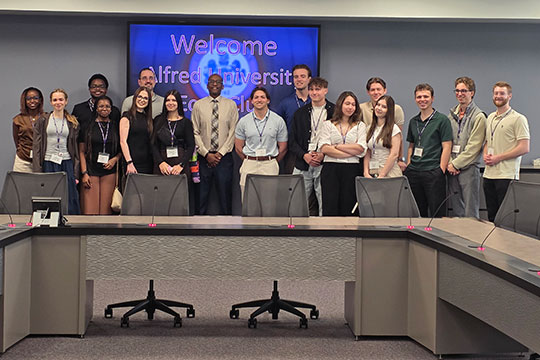
Lee emphasized that experiential learning is particularly valuable for economics students because it helps them connect abstract concepts to tangible outcomes. “Instead of just reading about economic concepts, students can see how professionals actually use them,” he noted. This exposure not only deepened understanding but also built confidence, helping students envision themselves in similar roles in the future.
Beyond the professional aspect, the trip also included cultural and social experiences, offering students a well-rounded perspective of the city. From exploring museums to attending events, students had the opportunity to engage with Washington, D.C., in a meaningful way, strengthening both their academic and personal growth.
Ultimately, the Economics Club’s trip to Washington, D.C. was an investment in students’ futures. By stepping outside the classroom and into real-world environments, students gained insight, built connections, and developed a stronger sense of direction. As Wilson reflected, the experience “opened [his] eyes to many more possibilities,” reinforcing the idea that the most impactful learning often happens beyond the classroom.