

More than 30 students from seven area high schools spent Thursday, Feb. 26, on the Alfred University campus vying for scholarships in a competition hosted by the Inamori School of Engineering as part of its annual Engineering and Materials Science Day.
The students participated in the Engineering Design Challenge, in which they were tasked with creating “Rube Goldberg” styled machines. A Rube Goldberg machine, named for cartoonist Rube Goldberg, is a deliberately over-engineered contraption, often made with readily-available household items, designed to perform a simple task through a complex, humorous chain reaction.
For the Alfred University competition, 36 participating students were divided into nine teams. They were provided a list of supplies they could use to create their Rube Goldberg machine, which included items such as pencils, clothes pins, paper clips, dominos, straws, yarn, rubber bands, and plastic spoons. The finished machine had to be completed in two hours, utilizing at least 10 steps and incorporating into its design at least four of the following six simple machines: wedge, pulley, inclined plane, screw, wheel and axle, and lever. The simple task the completed machine had to perform was a coin flip. Use of more than four simple machines garnered teams extra points.
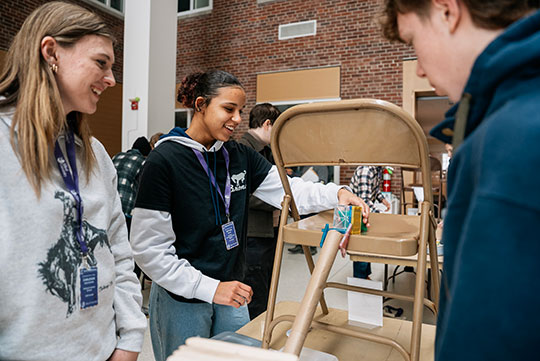
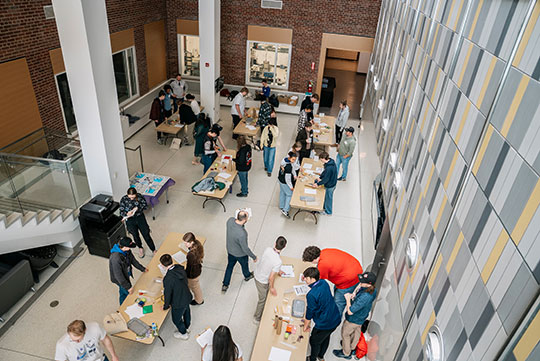
A team of high school students work on their Rube Goldberg machine during Thursday’s Engineering Design Challenge, hosted by Alfred University’s Inamori School of Engineering.
At stake in the competition were scholarships to Alfred University, with the first-place winner taking home a $10,000 award ($2,500 annually for four years); second- and third-place winners receiving $4,000 scholarships ($1,000 a year for four years). While students competed as teams, they were judged individually based on participation, contribution of knowledge, consideration of others, teamwork, overall project function, and project appearance. Judges for the competition included Alfred University faculty and staff, as well as graduate engineering students.
The following area school districts were represented at the competition: Canaseraga, Canisteo-Greenwood, Holland, Hornell, Pine Valley, Pioneer, and Prattsburgh.
Following the group challenge held in McMahon Engineering Building—during which time chaperones toured engineering and museum facilities—the group had lunch in Ade dining hall before returning to McMahon to make final changes to their projects. Winners were announced at a ceremony at Miller Theater.
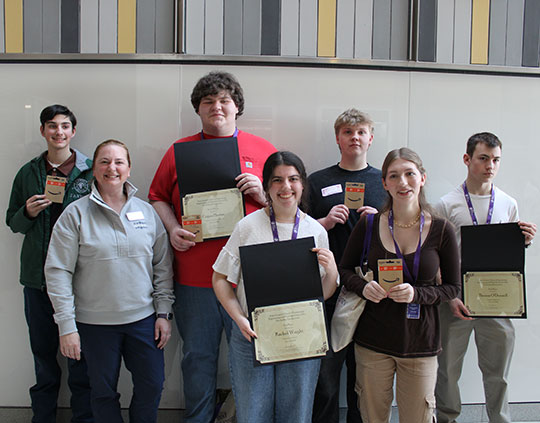
Rachel Wright, from Holland Central High School, took home the first-place prize: a $10,000 scholarship and $100 Amazon gift card.
“It was so nice to work with students from different schools. The competition was so well put together and the faculty and staff members I worked with were so welcoming and helpful,” Rachel commented. “I definitely will be looking at Alfred when I’m deciding on college.”
Cogan Horton of Canisteo-Greenwood Central High School and Thomas O’Donnell of Canaseraga Central High School placed second and third, respectively. Along with their $4,000 scholarships, Horton and O’Donnell took home Amazon gift cards for $75 and $50, respectively.
Taking honorable mention were Jamison Keen of Pioneer High School, Samantha Parsons of Holland Central High School, and Nickoli Cook of Pioneer High School. Each received a $25 Amazon gift card.
After registering in the morning, students and chaperones heard welcoming remarks from Mark Zupan, Alfred University president, and the announcement of the Engineering Design Challenge by Gabrielle Gaustad ’04, dean of the Inamori School of Engineering.
“The priority at Alfred University is the student experience. Research is key to the undergraduate experience,” Zupan told students, noting that Alfred University has received approximately $39 million in research grants over the last three years, which equates to about $9,200 per undergraduate student, per year. He also noted that last summer, 60 undergraduate students at Alfred spent their summer on campus working on projects for the Undergraduate Research Institute.
Gaustad told students that Alfred University engineering students “don’t just come to Alfred to study engineering,” noting that undergraduates have the latitude, unlike at some other universities, to participate in extra-curricular and other activities outside of the classroom.
“Now is a fantastic time to be an engineer,” Gaustad commented. “They are in high demand in the workforce. There is lots of potential for you in the fields of engineering.”