

Alfred University Emeritus Professor of English Benjamin Howard, a noted poet, literary critic, and essayist, has donated a generous selection of his working notebooks to Herrick Memorial Library. Housed in Special Collections, the material will be available to students of poetry, meditation, and the creative process.
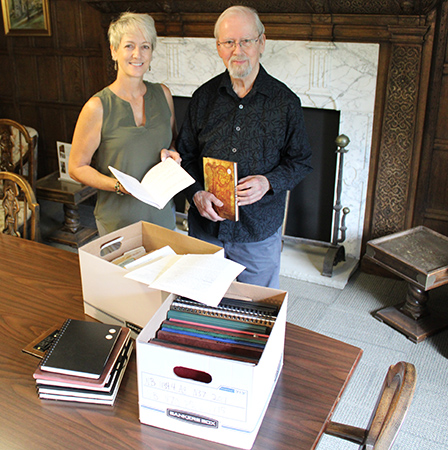
The 26 notebooks in this archive span the years 1989-2011. As Howard notes, this was an “especially fertile and productive period in [his] intellectual, literary, and spiritual life.” Three of his twelve books—his verse novella Midcentury (1998) and his poetry collections Dark Pool (2005) and Leaf, Sunlight, Asphalt (2010)—were published by Salmon Publishing, an international publisher based in Co. Clare, Ireland. Midcentury, the most ambitious of these books, was well-reviewed on both sides of the Atlantic and is now in 89 libraries here and abroad. Other poems appeared in such distinguished journals as Poetry (Chicago), Agenda (London), and Poetry Ireland Review (Dublin).
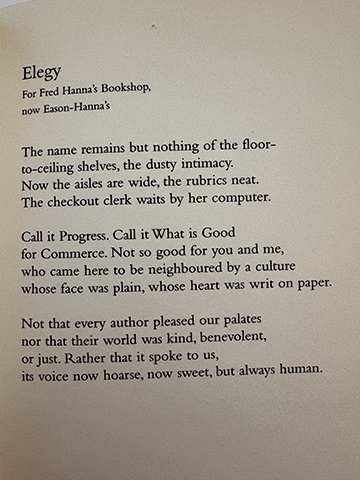
While Howard says he views poetry as his “first love” and primary vocation, he frequently contributed reviews, essays, and articles to American literary quarterlies during the 1990’s. From 1973 to 2002 he also was a regular reviewer for Poetry, where he evaluated new books by American poets and occasionally international figures such as Seamus Heaney, Joseph Brodsky, and Derek Walcott. His working notebooks abound with notes, impressions, and critical assessments of his contemporaries, many of whose poems he copied out in his own hand. As he explains, this practice helped him to become “more intimate with their textures, forms, syntax, and themes.”
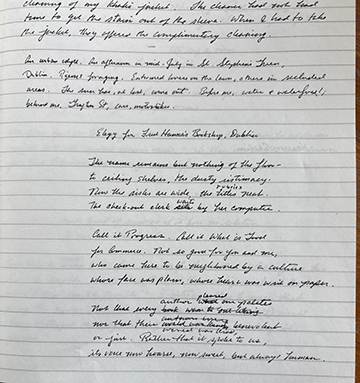
According to Alfred University Archivist Laurie Meehan, Howard’s donation will provide future Alfred students and scholars with a valuable perspective on the complex actions of a poet’s imagination and technical development.
“Receiving a collection of material that shows the thought process and development of an author’s writing is especially valuable to an archive, especially now in the digital age when much of that information is not retained,” Meehan says. “It provides researchers and students a peek into the author’s mind in a way no other material could, allowing them to better understand the author’s approach and style.”
Throughout his years at Alfred University, Howard continued to broaden his own work, and that spirit also imbues the archives. In 1985, he journeyed to Ireland, having been offered a residency at the Tyrone Guthrie Centre (Annaghmakerrig) in Co. Monaghan. While there, he engaged in conversations with multiple generations of Irish poets, fiction writers, critics, and intellectuals, who regaled him with stories of Irish literary life, past and present. In the ensuing two decades, he became a frequent visitor to Ireland, an active member of the American Conference on Irish Studies, and a dedicated scholar of modern Irish writing.
His essays and reviews on Irish history, literature, and culture subsequently appeared in such American quarterlies as the Sewanee Review and the New Hibernia Review and were later collected in his book The Pressed Melodeon: Essays on Modern Irish Writing (Story Line Press, 1998). Sprinkled throughout these notebooks are his impressions of Irish towns and cities, particularly Galway and Dublin, and his comments on the stories and poems of such leading Irish writers as John McGahern and William Trevor, Seamus Heaney and Michael Longley.
Centered though they are on literary subjects, these notebooks after 1995 contain many references to the practice of Buddhist meditation. In 1976, when Allen Ginsberg visited Alfred University, he offered Howard practical, first-hand instructions on the practice of Buddhist meditation. Over the next two decades, Howard’s continuing interest in meditative practice deepened and came to fruition. Between 1995 and 2000, he attended five weeklong retreats conducted by the Vietnamese Zen master Thich Nhat Hanh, whose teachings permeate these pages. In 2000, he undertook formal Zen training at Dai Bosatsu Zendo, and in November 2002 was lay-ordained by Jiro Osho Fernando Afable, then Vice Abbot of DBZ, in the Hakuin-Torei lineage of Japanese Rinzai Zen, taking the Dharma name Shiju Ben Howard. If his notebooks are, in his words, the “leavings of a tireless scribbler,” they also chart the “crooked path” of a spiritual explorer.
As Howard explains, he has entrusted his working notebooks to Herrick Library in the hope they will provide a window into the mind and the practical experience of a working writer. “In these pages,” he warns, “potential readers will find many false starts, dead-end paths, aborted stanzas, and fragmentary notions. But they will also find first lines, preliminary drafts, revisions, and final versions of poems that would one day reach an international readership.” And together, Howard hopes, his notebooks will offer “nurturance and guidance to young poets and essayists seeking to chart their own paths to artistic achievement and spiritual fulfillment.”
These archives may become a useful tool for someone learning to craft their own work, Meehan observes. “Along with the intricacies of his own thoughts and poetic development, Ben has provided contextual statements for his work that provide a unique insight into and better understanding of the collection and him as an author.”