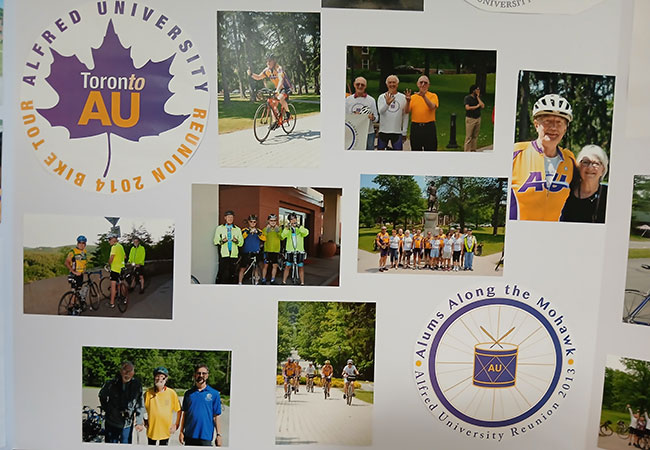


In previous articles, organizers of the Alfred University Reunion Bikers’ bicycle ride to Alfred during alumni Reunion weekend have discussed the early history of Saratoga Springs, pivotal battles fought there during the Revolutionary War, and several famous movies filmed in and around Saratoga. This article dives deeper into the controversial but critical American Continental Army Officer, Benedict Arnold.
Most of us know Benedict Arnold as the most notorious traitor in American history. His name has become synonymous with treason and betrayal. But there is another side to the story of Benedict Arnold.
Arnold was born in Connecticut on January 14, 1741. He joined the Continental Army in early 1775 soon after the outbreak of the war as a militia captain. As a commissioned colonel he and Ethan Allen led troops in the capture of Fort Ticonderoga on Lake George in May of 1775. Arnold’s left leg was wounded during the December 1775 assault on Quebec. While the siege on Quebec was ultimately unsuccessful, Arnold was promoted to brigadier general due to his heroism and fortitude during the march on Quebec.
By the time the battles of Saratoga were fought on September 19 (Freeman’s Farm) and October 7, 1777 (Bemis Heights) Arnold had been promoted to the rank of major general and served under the commanding officer, General Horatio Gates. Arnold and Gates did not get along. What began as professional respect for each other evolved into intense animosity and one of the most toxic and consequential rivalries of the American Revolution. Tensions rose as Gates began viewing Arnold as a competitor for military glory and promotion. The feud erupted during the Saratoga campaign. The two leaders argued over tactics with Gates preferring a more passive stance of a cautious defensive strategy of waiting for the British to come to them. Arnold favored a more aggressive approach with direct attacks on the British. (Gates reminds the writer of Northern Civil War generals before Ulysses S. Grant took over.)
As the old saying goes Arnold “won the battle but lost the war”. It signifies a hollow or “Pyrrhic” victory. Arnold indeed was a hero in the Saratoga campaign. He led aggressive tactical attacks in the Freeman’s Farm battle that resulted in heavy British casualties. As a result of heated arguments with Commander Gates regarding battle tactics Arnold was relieved of his command shortly after the first battle. Defying orders, Benedict Arnold led his troops in a daring charge against the Hessian redoubts during the Bemis Heights battle which lead to the capture of Breymann’s Redoubt and forced the British to surrender. Arnold’s left leg was again wounded during the battle, more severely than in Quebec, preventing him from continuing field command. Commander Gates inflicted the final insult onto Arnold by failing to recognize Arnold’s contributions to winning the Saratoga campaign when reporting the victory to the Continental Congress. Some historians believe this final perceived injustice was a pivotal factor in Arnold’s eventual traitorous actions.
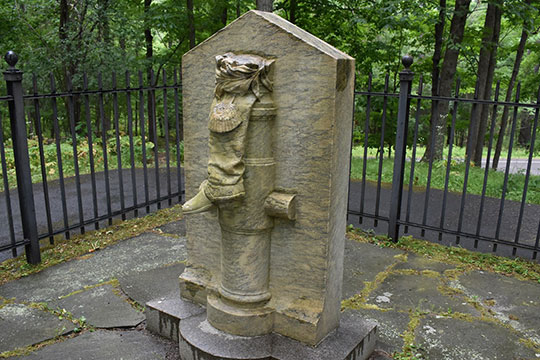
Finally, on to the Boot Monument. The Boot Monument commemorates Benedict Arnold’s heroic role in the Battles of Saratoga without naming him. It was erected in 1887 and donated by John Watts de Peyster, a Civil War brevet Major General. This monument is perhaps the most popular, unique, and controversial monument in the national park. It features a howitzer barrel with a left-footed horseman’s riding boot and a two-star epaulette on top of the barrel, representing a Major General. A laurel wreath sits on top of the howitzer. As a sign of dishonor, the howitzer barrel is pointed downwards. De Peyster decided on a boot for the monument because “the leg was the only part of Arnold not to later turn traitor and since it was sacrificed in winning the battle of Saratoga, it should be commemorated.”
In recognition of America250, our nation’s 250th birthday, the Alfred University Reunion Bikers have chosen the historic Saratoga Springs, NY as their pedal off point for this year’s journey back to campus. The area offers a unique variety of historical, cultural, and recreational opportunities. The city’s official slogan is “Health, History, and Horses”.
Early Participants include Mary Bouchard ’73, David ’77 and Regina Holleb, Terry Kiff ’84, Dave ’61 and Kate Perry, Jim Randall ’77, Conor Walsh ’02, and Harry Wilhelm ’74. All are veteran bikers having participated in one or many previous reunion rides.
We will start gathering in Saratoga Springs the weekend before Reunion Weekend on Saturday, June 6. The first bike ride will take place on Sunday, June 7. We will bike three days in the Saratoga area before moving on to the finger lakes area with a final “Victory Ride” Friday morning, June 12 into Alfred from Hornell with an anticipated arrival at the King Alfred Statue at noon. Stay tuned for future announcements in E-news concerning the ride and who is participating.
We welcome alumni, faculty and staff, students, and friends to join us as we ride through your local area, or for part or all of our trip. We also enjoy having lunch or dinner with friends of the University throughout our travels. Anyone interested in taking part in Friday’s “Victory Ride” that needs accommodations in Hornell is encouraged to make reservations early as the area hotels quickly fill up. Please email Jim Randall ’77 at [email protected] for additional information.