

Alfred University has been awarded an extension on a joint project with the U.S. Army Research Laboratory (ARL) to study the synthesis and characterization of ultra-high temperature ceramic (UHTC) materials. The university will receive $3.2 million in funding—part of a $13.5 million contract initially awarded in the spring of 2022.
The original contract provided $2.7 million per year for five years, from 2022-27, to fund joint research between The New York State College of Ceramics (NYSCC) at Alfred University’s Inamori School of Engineering and DEVCOM (U.S. Army Capabilities Development Command), Army Research Laboratory (ARL). U.S. Sen. Charles Schumer, D-N.Y., led the efforts to secure this federal funding for research to be conducted at Alfred University. The $13.5 million in funding represents the largest research contract the University has ever received from the federal government.
The research project focuses on UHTC materials, specifically artificial intelligence-enhanced materials discovery, and developing new techniques for the synthesis and additive manufacturing of carbides and diborides to create specialty ceramic materials designed to withstand extreme temperatures. Research also focuses on conducting high temperature characterization of UHTC materials used in defense systems to improve performance. Workforce development efforts will provide research opportunities for undergraduate students as well as internships with collaborating industry partners.
“With over 125 years advancing the field of technical ceramics, Alfred University is thrilled to extend our work with the Army Research Lab,” said Gabrielle Gaustad ’04, dean of the Inamori School of Engineering, referring to UHTC materials’ support of systems used in space exploration and in developing defense applications. “This program leverages Alfred’s specialized infrastructure to continue our efforts in discovering new and improved materials, fabrication processes, and characterization techniques for these critically important classes of materials.”
Due to their high-temperature performance, strength, and light weight, UHTC materials are ideal for meeting the needs of systems being developed by the Army. The advanced manufacturing effort included in the project will enable new concepts in design and construction of components that can operate in extreme environments. In addition to supporting the defense and aerospace industries, research will also impact industrial applications using UTHC materials, where operation in high temperature and corrosive environments makes these materials a top choice.
Scott Misture ’90, Ph.D. ’95, Inamori Professor, materials science and engineering, serves as principal investigator. Other participating faculty from the Inamori School of Engineering include Collin Wilkinson, assistant professor of glass science engineering; Kun Wang, associate professor of materials science and engineering; Mario Caccia, assistant professor of ceramic engineering; and Caio Bragatto, assistant professor of ceramic engineering. The research team also comprises post-doctoral researchers and staff scientists. Students, both undergraduate and graduate, are also contributing to the research, which reflects Alfred University’s commitment to applied learning opportunities.
“The project requires strong participation from a wide range of talent,” Misture said. “Such provides an unusual opportunity, especially for the undergraduates involved, to gain real-life experience as part of a large team.”
Among those serving on the project team are Alfred University graduate Montana Weidman ’24, M.S. ’25, from East Bethany, NY, and Zoey Keagle, a senior from Newfield, NY, pursuing a dual degree in ceramic engineering and art.
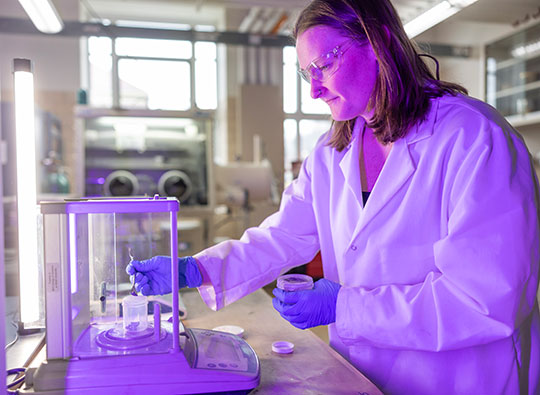
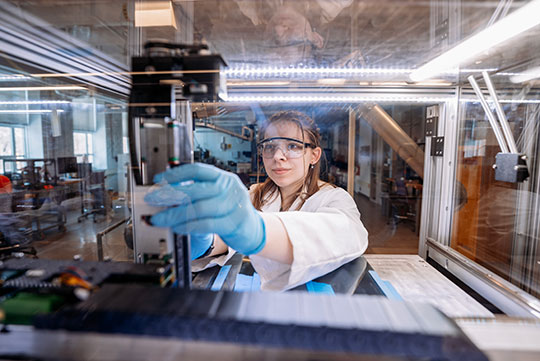
Weidman, who has bachelor’s and master’s degrees in materials science and engineering, serves as a full-time staff research engineer on the project. Her master’s thesis, which Misture advised, focused on research she conducted for the Alfred University-ARL project on UHTC materials. Keagle, who has worked as an undergraduate researcher for the university’s Space Materials Institute, is helping conduct research for this project as well. Among their work on the UHTC project is the 3-D printing and testing of materials.
Gaustad benefited from research opportunities during her time as an undergraduate at Alfred University in the early 2000s. These included participating in the Zero-G Flight Opportunities Program hosted by NASA, where she and three other Alfred students rode the Convair C-131 Samaritan aircraft in Houston, TX, experiencing the effects of zero gravity. Gaustad pointed to similar benefits to students enrolled in the university’s engineering programs.
“I had some amazing hands-on project opportunities as an undergraduate student at Alfred and I love that this project will provide those kinds of experiential learning opportunities for current students – both undergraduate and graduate,” said Gaustad, who earned a bachelor's degree in ceramic engineering from Alfred University in 2004. “We are excited to grow the pipeline from our engineering programs to our industry partners in space, aerospace, and defense.“
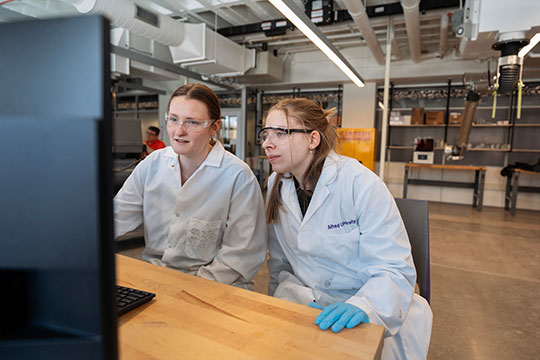
Research for the joint project between Alfred University and the ARL is being conducted in two Alfred University centers: the Center for High Temperature Characterization (CHTC) and the Ceramic Research, Education And Technology Enterprise (CREATE) Center. Work in the CREATE Center is focused on new additive manufacturing approaches, including extrusion and binder-jetting techniques for printing carbides and diborides. Work will also include using artificial intelligence (AI) and machine learning (ML) to improve the quality of 3D printed parts. Efforts at the CHTC will focus on examining the behaviors of UHTC materials during processing/sintering or post-sintering at high temperatures under simulated operational environments. The CHTC was completed in 2014 with $4 million in state funding and has the equipment needed to investigate the physical, microstructural, and chemical changes of UHTC materials at various temperatures and under controlled atmospheres.
The CREATE Center was completed in 2023 with $7.75 million in SUNY 2020 funding and looks at additive manufacturing approaches for ceramics and glass. Both centers played a significant role in Alfred University receiving the original $13.5 million contract and additional option year funding. “Alfred University has a long history of ceramics synthesis and processing, with expertise and facilities already in place, enabling us to hit the ground running,” Misture commented.
Alfred University engineering program has been deeply involved in the field of materials for high-performance aerospace applications for many decades. From glass strengthening to withstand bird strikes to magnetic ceramics for microwave communication, the university has long been a valuable, leading-edge collaborator with industry and a wide range of federal agencies in addition to Army Research Lab including the National Science Foundation, Oak Ridge National Lab (ORNL), Office of Naval Research (ONR), the Federal Aviation Administration, and the National Aeronautics and Space Administration (NASA). In the 1980s, for example, researchers at Alfred University helped develop heat-resistant materials used in external tiles on the Space Shuttle.