

Kiani Barnard-Pratt came to Alfred University as a biomaterials engineering major, with an interest in pursuing a career in the development of prosthetics. Now a senior, she is working on a research project focused on 3-D printing of glass-based materials that can be used for tissue, organ, and bone regeneration.
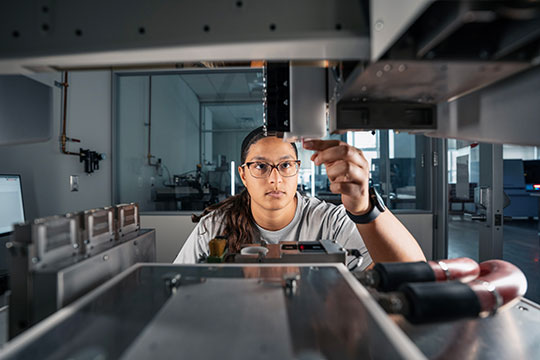
Barnard-Pratt, from Westford, MA, is currently working on a senior capstone project — “Parameter Optimization for 3-D Printing of Sol-Gel-Derived Bioactive Glass.” The project relates to a PhD thesis project completed last year by Alfred University alumna Danielle Perry ’20 (B.S., biology/biomaterials engineering; ’22 M.S., biomaterials engineering), who earned her doctorate in materials science and engineering in December.
Perry’s project — “Tailored Zinc-Copper-Cobalt Sol-gel Bioactive Glass 3D-Printed Implantable Composites for Tissue Regeneration” — focused on bioactive glass composites doped with therapeutic ions for tissue repair. It combined bioactive glass with biodegradable polymers for 3D printing, with the goal of advancing healthcare materials and applications.
Barnard-Pratt’s capstone, which she will present at the annual Undergraduate Research Forum in April, is based on Perry’s PhD thesis research. The project focuses on applications of the 3-D bioplotter located in the CREATE Center of McMahon Engineering Building. The equipment was acquired in 2023 with SUNY funding awarded to the Inamori School of Engineering. The funding was part of a larger SUNY award used to renovate the first floor of McMahon to construct the CREATE Center, which contains several pieces of equipment used for additive manufacturing (3D printing).
The bioplotter can be used to 3-D print various materials—including glass and ceramic-based biomaterials—which are extruded onto a grid, or “scaffolding,” and are then solidified by either instant polymerization (solidification) methods, temperature-controlled polymerization, or exposure to ultraviolet light. Biomedical applications of the bioplotter include research into the repair and/or replacement of both soft (i.e. skin, ligaments, tendons, organs) and hard (i.e. bone, teeth) tissues throughout the body.
The bioplotter “can 3-D print using plastics, glasses…many different materials. It can 3-D print living cells,” Barnard-Pratt said. “My project uses bioactive glasses, which react with the cells in the human body to regenerate tissue. It can speed up the healing process.”
Bioactive glass is a type of glass that is safe inside the human body, reacting with human cells to spur cell growth. It can also react with bone tissue to help form new bone.
The bioplotter can create complex shapes, in this instance a mesh-like material called a “scaffold.” Bioactive glass—which often contains elements such as phosphorous and calcium—is introduced onto the scaffold, which is then placed in the body. The human cells consume the glass, Barnard-Pratt explained, break it down, and incorporate it into the body to build new tissue.
Sol-gel-derived bioactive glasses are glasses made through chemistry by mixing chemicals together in a lab to form powdered glass particles. This gives sol-gel-derived glasses a greater surface area, making them more suitable for these types of applications—tissue regeneration and bone repair—compared to their melt-derived counterparts. Barnard-Pratt is using bioactive glasses produced by Perry to experiment with the bioplotter, printing samples containing both more and less glass materials than Perry’s samples.
“I’m using different weight percentages of the bioglass, looking at how it affects the printing of the material, the rate of degradation,” Kiani said, explaining that the rate a bioactive glass breaks down in the body helps determine its effectiveness in producing healthy new tissue. An optimal rate of degradation is determined in part by how evenly the glass materials are distributed across the scaffold and how evenly they are incorporated into the body. Her research is studying how the bioplotter can best be used to provide the most consistent release of the bioactive glass materials.
The bioplotter is a relatively new piece of equipment at Alfred, Kiani said, noting that Perry, during her research, developed standard operating procedures for its use in printing with bioactive glass materials. Barnard-Pratt’s research will study the effectiveness of 3-D printing with the bioplotter and determine how the equipment can create the most effective scaffolds to carry healing bioactive glass into the body.
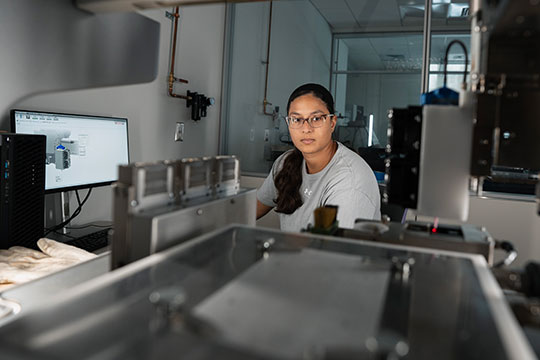
“This (research) is a calibration of the (bioplotter), to see how much glass should be used” with the scaffolds, Barnard-Pratt explained. “I’ve made all the plastics and loaded glass into them. I just need to print out the scaffolds. Once printed, I’ll examine them under a scanning electron microscope” which shows if the bioactive glass is evenly distributed and detects any physical deformities in the material.
Barnard-Pratt credited Tim Keenan, associate professor of biomaterials engineering, with helping steer her toward research in tissue regeneration. Keenan, along with Anthony Wren, associate professor of biomaterials engineering, are co-advisors on her capstone.
“When I got here, Dr. Keenan got me interested in tissue (regeneration) and bioglass. I didn’t know it was a thing,” she said. “I like hands-on work and he felt this would be a good project. I thought it was pretty cool that you could grow back bone using glass.”
After graduating in May, Barnard-Pratt hopes to pursue a career in the biomedical industry, with a focus on prosthetics and tissue engineering. She said her work on the capstone will benefit her in those pursuits. “Having experience with this (3D printing with the bioplotter) will be very helpful.”