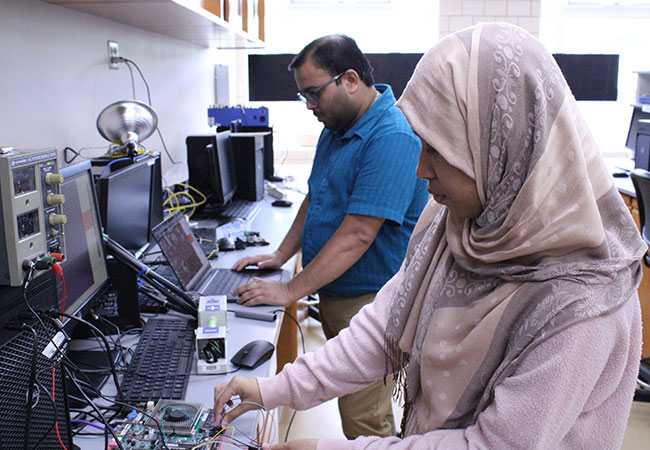


Alfred University students showcased their summer research projects in a poster session held Thursday, July 23, in the Joyce-Walton Center, which marked the culmination of the Inamori School of Engineering’s annual Summer Engineering Research Institute. Approximately 50 students performed research on projects supervised by 16 faculty.
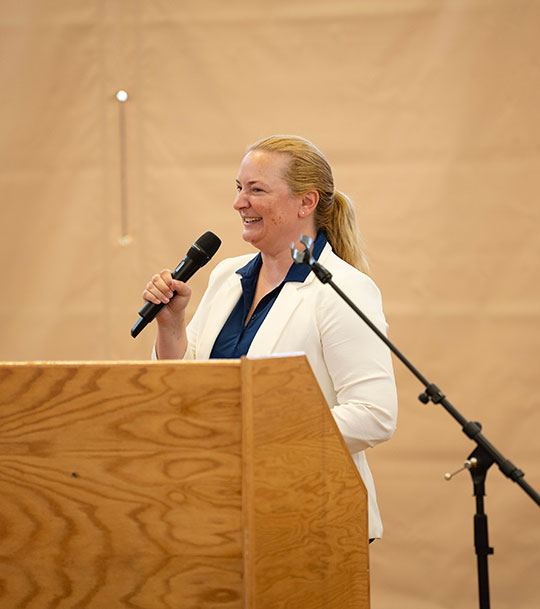
Gabrielle Gaustad ’04, dean of the Inamori School of Engineering at Alfred University, makes comments during the awards ceremony for the poster session exhibiting projects conducted during the annual Summer Engineering Research Institute.
“Research immerses students in solving real-world problems alongside faculty mentors, giving them firsthand experience with the scientific process, advanced instrumentation, and collaborative innovation,” said Gabrielle Gaustad ’04, dean of Alfred University’s Inamori School of Engineering and an advisor for five of the summer research projects.
“Serving as a mentor to undergraduate students this summer was a full-circle moment for me as I had an amazing experience doing summer research as an undergraduate 25 years ago,” Gaustad said, noting that her experience as a student helped her develop critical thinking, technical communication, and project management skills.
Gaustad said the program is unique to Alfred University in that some students only have one year of undergraduate engineering coursework completed before this immersive experience. “By engaging in meaningful research early in their academic careers, our students are positioned to vie for internships, co-ops, and other work placements due to the confidence, experience, and professional skills gained that distinguish them in an increasingly competitive engineering workforce.”
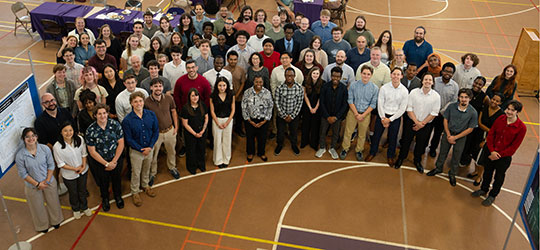
Undergraduate and graduate researchers presented the outcomes of their research projects during the poster session, where students showcased their work. While most students are engineering majors—materials science and engineering, ceramic, glass, biomaterials, renewable energy, and mechanical—the group included students majoring or double-majoring in biology, chemistry, data analytics, computer science and art.
Following the conclusion of the poster session, an awards presentation was held, with the following students recognized and awarded cash prizes (class years listed are for 2026-27 school year):
- Overall Winner — Jovie Riley, sophomore glass science and engineering major from Bakersfield, CA, $1,000 award. Her research project, advised by William LaCourse, emeritus professor of glass science and engineering, was titled “Applications of Ion Exchange.”
- Best Designed Poster — Noa Broekman, junior glass science and engineering major from Los Angeles, CA, $500 award. Her project, advised by Collin Wilkinson, assistant professor of glass science and engineering, was titled “Geometry Independent Viscometry Through Time Domain Relaxation.”
- Best Technical Poster — Abby Atnafe and Elijah Kahl (tie), $250 each. Abby, a junior glass science and engineering/computer science double major from Addis Ababa, Ethiopia, was advised by Wilkinson in per project, titled “How Does Glass Separate? Studying the Structural Evolution of Vycor During Phase Separation.” Elijah, a junior glass science and engineering major from Glen Ridge, NJ, was advised by Wilkinson in his project, titled “Predictive Atomistic Model for UHTC Oxidation Resistance in Hypersonic Applications.”
Following are a few profiles on projects from this summer’s Engineering Research Institute:
Rethinking how to measure viscosity in glass
Noa Broekman, a glass science and engineering major from Los Angeles, CA, begins her junior year in August. Her research project, titled “Geometry Independent Viscometry Through Time Domain Relaxation,” was advised by Collin Wilkinson, assistant professor of glass science and engineering.
Modern display glasses — those used on phones, electronic devices, laptops, televisions — are getting thinner and stronger. Achieving thinner, stronger glasses requires precise control over the glass during processing, especially at high temperatures where the glass can slowly flow. This behavior is studied through high-temperature viscosity.
Noa explained that traditional measures of viscosity in glass—which indicates how glass in its fluid form is resistant to flow and is a predictor of how well a glass product will perform in industrial applications—is achieved using glass samples with a precise geometrical shape since the calculations depend on the sample’s dimensions. The problem with that, she said, is that having to be so precise in creating the samples (through cutting, for example) increases the potential for using samples that may not render accurate viscosity measurements, even small imperfections can affect the results.
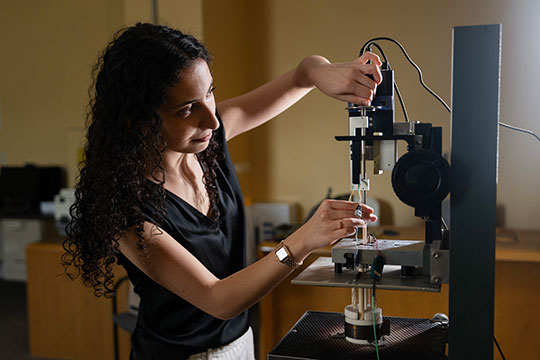
Noa Broekman ’28
“On a research scale, to optimize viscosity in the data, you have to prepare many samples. Glass is melted, put in a mold, and cut to the proper size dimension. That’s very difficult to control,” Noa said, noting that because the shape has to be so precise, there is an increased chance human error could result in a flawed sample.
Noa said her research explores a new way to measure viscosity that reduces how much the sample’s shape matters. “In my method, with the machine we built, geometry is less critical,” she said. “Being able to load different samples is helpful because it broadens our range and understanding” of glass materials’ properties.
The viscosity of the glass samples (beams) is typically measured through beam bending device that applies consistent force on the sample until it begins to bend. The machine Noa created combines a controlling mechanism with beam-bender, which can carefully control how much the sample bends, rather than simply applying a fixed weight or force. The instrument automatically tracks the glass samples response over time, which is directly used to determine the material’s viscosity.
“If you can control the process, you can replicate it for industrial applications,” she said. “Consistency is so important to manufacturing on a mass scale,” such as for the aforementioned glass phone and electronic device screens.
Noa’s research will continue during the upcoming school year and will build upon preliminary results from her studies. She said her hope is that the machine, and the software used to operate the controlling device, can someday be patented. She talked about the unique opportunity she has had to conduct research on this scale.
“You don’t often hear about an undergraduate being able to use the equipment we use, let alone being involved in creating something like this,” she said. “But that’s why I came here. I heard about Alfred and the really great research opportunities, where you can get this type of hands-on experience.”
Noa’s long-term goals include attending graduate school in glass engineering—with a continued focus on glass viscometry and glass relaxation—before pursuing a career in industry.
Repurposing waste glass for agricultural needs
Debora Munuo, a sophomore biomaterials engineering major from Tanzania, will be a sophomore in the fall. She and three other students— Enock Mwesiga, Jovie Riley, and Charlotte Coats—worked on a project that studied ways to convert waste glass containers, such as soda bottles, into plant fertilizer.
The four presented separate posters which outlined the different aspects of the research. The project, supervised by William LaCourse, emeritus professor of glass science, is a continuation of LaCourse-advised research begun during the 2024-25 academic year. Debora's poster was titled “Repurposing Container Glass for Agricultural Use.”
“We’re looking at how to change the composition of waste glass to make fertilizer for basil plants,” Debora explained. “We used a number of different methods: one was ion exchange.”
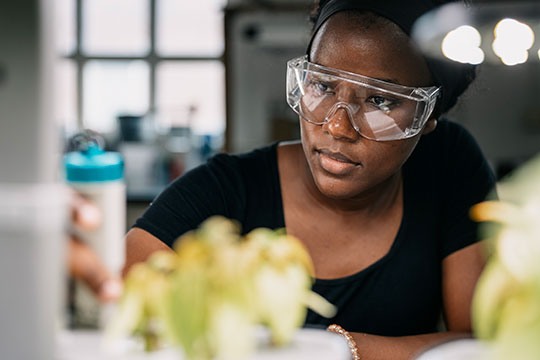
Debora Munuo ’29
The ion exchange process in glass typically replaces smaller sodium ions with larger potassium ions. In this project, ion exchange was done to increase the surface reactivity of the waste glass.
“We had to figure out a way to take the waste glass, crunch it into fine particles. The focus is on determining what size is optimal for incorporating into the fertilizer,” Debora explained.
The waste glass powder, which dissolves in water, is combined with other micro-nutrients in a process called “remineralization” to create fertilizer that carries nutrients to plants. Debora noted that controlling glass particle size is key, as initial high pH spikes can cause plant damage if the dissolution rate isn’t properly regulated.
Debora said she chose to work on the project during this summer’s Engineering Research Institute “because it had to do with living things. As a biomaterials engineering major, I am interested in and have studied biology.” She hopes to be a doctor, so the project aligns with her academic and career goals.
“This has been a great opportunity for me,” Debora said, noting that Alfred University is unique in that it offers hands-on research opportunities to undergraduates that are often reserved for graduate students. “Just the experience of being in the laboratory, doing research and using equipment that undergraduates typically don’t use, is something I can put on my resume. I’m very confident this will help me in my career.”
Creating a power generation system for lunar colonies
Ayomideji “Deji” Israel-Akinbo, who will be senior this fall majoring in mechanical engineering, exhibited a research project that focused on developing a reliable, megawatt-scale nuclear power system suitable for supporting lunar colonies.
Deji, from Makhanda, South Africa, was advised in his research by Holly Shulman, director of Alfred University’s Space Materials Institute. His project, titled “Next Generation Lunar Power,” investigates an innovative closed Brayton cycle integrated with a thermoacoustic generator to maximize thermal efficiency and minimize maintenance.
Brayton is a thermodynamic cycle that describes the operation of certain heat engines that have air or some other gas as their working fluid. Among the most common current applications is gas turbine engines. A Stirling cycle is a heat engine that is operated by the cyclic expansion and contraction of air or other gas by exposing it to different temperatures. Deji’s project studied the “Strayton” engine concept, which combines the Brayton cycle and Stirling’s thermoacoustic cycle to create a highly efficient recuperating gas turbine engine.
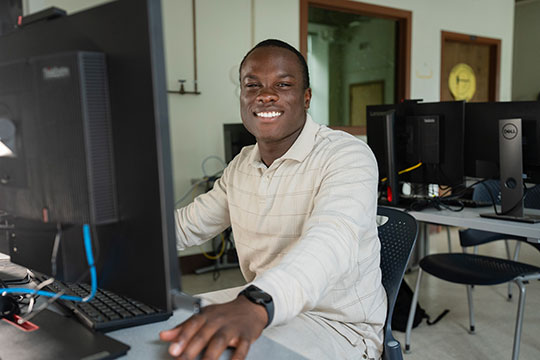
Ayomideji “Deji” Israel-Akinbo ’27
The objective was to “create a megawatt-scale energy generating system for lunar colonies through combined Brayton and Stirling cycles,” Deji said. The two cycles are incorporated into a turbine, creating heat which is converted into energy. The thermoacoustic generator—which replaces the blade cooling system typically used in turbines—cools the turbine, which maximizes efficiency by allowing operating temperatures to safely exceed limits of the turbine’s metallic materials. The project examined different types of materials that could be used in the engine to maximize the level of heat created by its operation.
Deji’s career goals include working in industry with a focus on studying nuclear fusion as a reliable source of energy. He appreciates the chance to participate in high-level research as an undergraduate.
“This is a really good opportunity,” he said. “Having the resources and support to pursue research you’re really interested in is great. I was able to present my interests to (Shulman) and she created a project for me.”
The synthesis of Wadsley-Roth materials
Courtney Cherricks, a materials science and engineering major from Chincoteague, VA, begins her sophomore year at Alfred University in August. Her research project, advised by Scott Misture ’90, ’94 PhD, Inamori Professor of Materials Science and Engineering, is titled “Accelerated Synthesis of Wadsley Roth Phases Using Reduction and Reoxidation.”
Wadsley Roth phases, made up of corner and edge sharing octahedra, are a group of complex transition metal oxides that are widely studied as high-rate anode materials for lithium-ion batteries. They are becoming increasingly popular for use in battery anodes (the negative electrode that releases electrons into the external circuit during discharge) due to their promise of fast charging and safety.
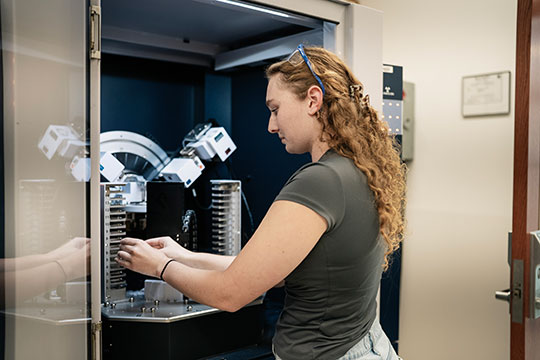
Courtney Cherricks ’29
Courtney’s research compared the syntheses of the Wadsley Roth phase of Nb14W3O44 — a complex niobium tungsten oxide chemical formula used to study high-rate anodes, crystal structures, and fast-charging battery materials — using the syntheses of chemical compounds niobium dioxide (NbO₂) and niobium pentoxide (Nb₂O₅).
The synthesis comparison was achieved by placing niobium dioxide and niobium pentoxide into a tube furnace. The compounds were heated and reduced by introducing hydrogen gas. Reoxidation was achieved by placing them in a box furnace with an air atmosphere. The hypothesis of this project was that an NbO₂ synthesis will form a pure Wadsley-Roth phase at lower temperatures than an Nb₂O₅ synthesis, which proved to be true (more than 100°C lower).
“We found we can do the process at a lower temperature,” Courtney said. “If we’re going to go to manufacturing, the lower temperature will be more efficient and decrease energy usage.”
She noted that synthesizing Wadsley-Roth phases at lower temperatures lowers energy costs, and that manufacturers are more likely to have equipment to accommodate lower temperatures, which results in a quicker production of the material. Long-term, Courtney said, the synthesized Wadsley Roth materials could be “scaled up for manufacturing” for use in lithium ion batteries, with a particular focus on those LI batteries used in power grids.
Courtney hopes to go to graduate school after Alfred, pursuing studies in environmental conservation focusing on materials science. She said the opportunity to work on a research project as an undergraduate will provide her with a great experiential foundation to pursue her goals.
“I had a lot of experience working with graduate students over the summer, seeing what they’re doing and learning from them. Having them has mentors has been great,” she said. “Being able to use the equipment I wouldn’t otherwise be able to use, is something you don’t often get as an undergraduate. This (project) has helped me understand the processes involved in research.”
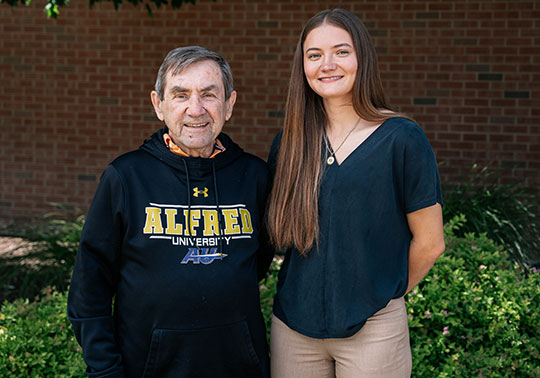
Jovie Riley (right) was recognized as overall winner of the poster session contest held to culminate this year’s Summer Engineering Research Institute. She is shown here with her advisor, William LaCourse, emeritus professor of glass science and engineering.
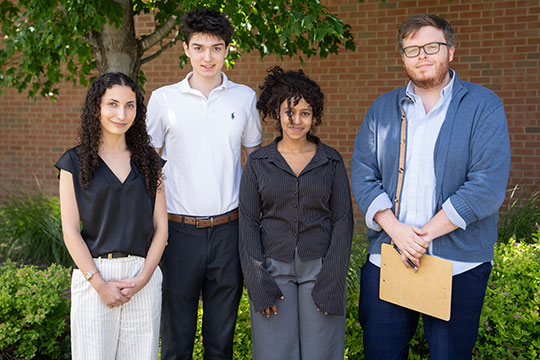
Collin Wilkinson (right), assistant professor of glass science and engineering, with three students he advised in the Summer Engineering Research Institute, from left: Noa Broekman, Elijah Kahl, and Abby Atnafe. Noa won the award for Best Designed Poster, while Elijah and Abby shared the prize for Best Technical Poster.