

Alfred University faculty and students showcased artificial intelligence applications in battery technology and demonstrated microgrid simulation over Labor Day weekend, Sept. 5-6, at the Great New York State Fair in Syracuse.
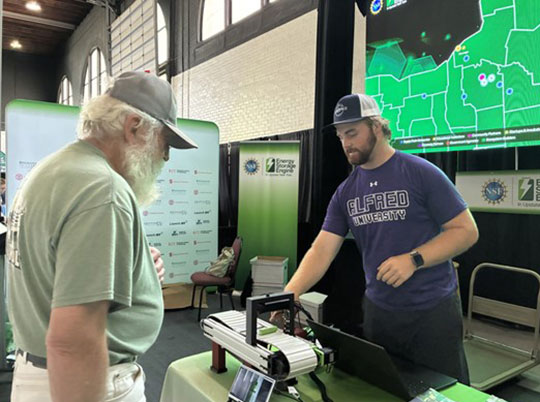
Brady Wright ’26 (right), who earned a bachelor’s degree in electrical engineering in May, presents a computer vision battery assembly demonstration to a visitor at Alfred University’s exhibit at the New York State Fair.
The nine-member team from Alfred—which included seven students and two faculty—presented interactive demonstrations at a booth supported by the NSF Energy Storage Engine in Upstate New York. Leading the team were Dr. Kun Wang, associate professor of materials science and engineering and principal investigator for Alfred University’s Battery AI workforce training project, and Dr. Chandan Kumar, assistant professor of computer science.
The outreach highlighted Alfred University’s active role in the Engine’s workforce training efforts: introducing college students to AI applications in batteries, building practical skills with emerging technologies and preparing them for future careers in the battery and energy storage industry. Visitors explored student projects and spoke with the team about the technologies behind battery assembly and energy management.
Outreach travel was also supported by Alfred University’s Inamori School of Engineering and Center for Advance Ceramics Technology (CACT).
Brady Wright ’26, who earned a B.S. degree in electrical engineering in May, demonstrated a battery assembly device that uses computer vision, an AI technique that enables computers to monitor any defects or errors during battery manufacturing. Wright is advised in his capstone project—which is directly related to the Battery AI workforce training project—by Dr. Xingwu Wang, professor of electrical engineering. Xingwu Wang is co- principal investigator for the project.
After discussing the design with Wright, a visitor who works at Honeywell expressed interest in helping him pursue employment opportunities with the company. The conversation illustrated how presenting a technical project can open a connection with industry.
Tinashe Mberesi, a senior double majoring in electrical engineering and mathematics, presented his battery intelligence platform. He developed the platform during Alfred University’s 2026 undergraduate summer research program under the guidance of Kun Wang. Mberesi’s project brought a student-developed battery technology application to a public audience and showed how summer research can extend learning beyond the classroom.
Other students participating in the outreach were Cody Orzeszek and Zachary R. Conklin, seniors in mechanical engineering; Ashraful Ally, a sophomore in materials science and engineering; and Dilafruz Chamanova, a sophomore in computer science.
Kumar and Jannatun Naiem, a master’s student in electrical engineering, brought a microgrid simulator that uses hardware-in-the-loop technology. The approach connects physical equipment with a computer simulation, allowing energy systems to be studied and tested under controlled conditions. The demonstration introduced visitors to the interaction between energy generation, storage and control.
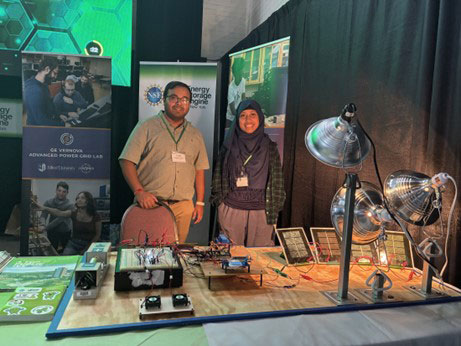
Chandan Kumar (left), assistant professor of computer science at Alfred University, and Jannatun Naiem, a master’s degree student in electrical engineering, at the microgrid simulator demonstration booth the university hosted at the New York State Fair. The demonstration combined physical equipment and computer simulation through hardware-in-the-loop technology.
Alfred’s Battery AI training initiative builds on a $160,644 NSF award announced in 2025 through the Engine’s Generating Regional Opportunities in Workforce (GROW) program. The project introduces students to battery testing, data analysis and machine learning to predict battery degradation and remaining useful life, connecting AI skills with practical needs in the battery industry.
Kun Wang serves as Alfred University’s principal investigator. During Phase I, spanning 2024-2026, co-principal investigators were Xingwu Wang, professor of electrical engineering; Scott Misture, Inamori Professor of Materials Science and Engineering; and Gabrielle Gaustad, dean of the Inamori School of Engineering. For the upcoming Phase II of Alfred’s project, Kumar will join the continuing leadership team as a co-principal investigator.
In Phase II, Alfred University will participate in the Greater Rochester region workforce training project led by Rochester Institute of Technology (RIT) and receive a total of $270,000 for 2026-2029. The project is part of the Energy Storage Engine Scholars Initiative, announced Aug. 11, 2026, which connects four university-led regional coalitions to prepare at least 400 scholars annually for energy storage careers. The initiative combines training in battery safety, advanced manufacturing, power engineering and AI for energy storage with capstone projects and paid internships.
The broader NSF Energy Storage Engine, led by Binghamton University, announced its second phase in March 2026, with priorities that include integrating AI into energy storage and preparing the next generation of engineers and scientists. Alfred’s State Fair outreach connected that regional effort with student projects and conversations about education, technology and careers.
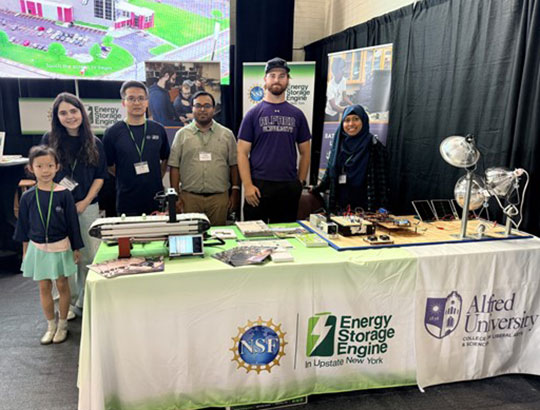
Some members of Alfred University’s outreach team gather at the NSF Energy Storage Engine in Upstate New York booth during Labor Day weekend at the New York State Fair. Pictured from left, are: Jessica Wang, daughter of Kun Wang, associate professor of materials science and engineering; Dilafruz Chamanova, sophomore computer science major; Kun Wang; Chandan Kumar, assistant professor of computer science; Brady Wright, electrical engineering major; and Jannatun Naiem, electrical engineering master’s degree student.