

A new National Science Foundation computing allocation will give Alfred University students and researchers access to the kind of high-performance computing power typically associated with major research institutions.
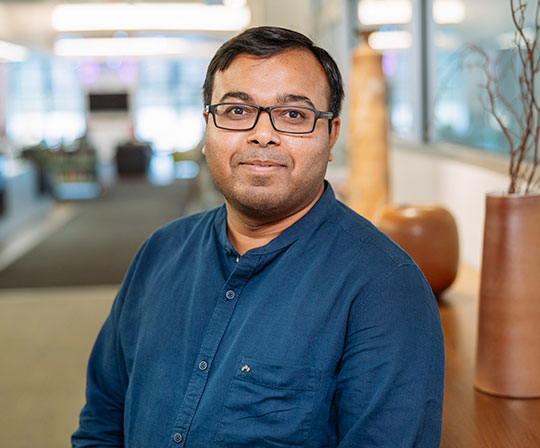
Dr. Chandan Kumar, assistant professor of computer science, has been awarded 970,000 ACCESS credits through the NSF’s Advanced Cyberinfrastructure Coordination Ecosystem: Services & Support program. ACCESS connects researchers with some of the nation’s most powerful supercomputing systems for work that exceeds the capabilities of traditional campus hardware. The allocation will allow Kumar to use substantial computing resources for research and student projects at Alfred, including work in artificial intelligence, machine learning, data science, and other computationally intensive fields.
ACCESS credits are used to pay for computing time across participating national systems. While the exact value depends on the type of resource being used, Kumar said the allocation represents an enormous increase over what can be accomplished on a typical workstation.
“970,000 credits is on the order of 970,000 core-hours,” Kumar said. “That is the equivalent of running a single processor continuously for more than a century, or taking work that might require years on one workstation and distributing it across many processors so it can be completed much more quickly.”
In practice, the allocation will be spread across many computing systems at once and can also be used for access to graphics processing units, or GPUs, which are particularly important for modern artificial intelligence and machine-learning research. For Kumar, the additional computing capacity removes one of the biggest limitations in his own research. His work involves developing artificial intelligence methods that can learn from unlabeled data, which requires researchers to run large numbers of experiments across different models, datasets, and settings.
“My own research depends on running very large numbers of experiments,” Kumar said. “That is simply not feasible on a single lab machine.”
The ACCESS allocation makes it possible to conduct those experiments at a scale that would otherwise require significant local computing infrastructure. It also creates opportunities for projects involving large datasets, complex simulations, and machine-learning models that exceed the capabilities of standard campus computers. Kumar said the impact could extend well beyond his own research.
“More broadly, it opens the door to any project that needs to process large datasets or train models beyond the reach of ordinary campus hardware,” he said. “That includes work across AI, data science, and the sciences.”
The first priority will be incorporating the resources into Kumar’s research and teaching, giving Alfred students direct experience using national computing infrastructure. That experience could allow students to work on projects at a scale rarely available in an undergraduate classroom, while gaining familiarity with the same types of systems used by researchers at major universities, national laboratories, and technology companies. Kumar also sees the grant as a starting point for expanding access across Alfred University.
“I really see this as a proof of concept for Alfred,” he said. “Once colleagues and students see what this kind of computing makes possible, my goal is to help more of them tap into these national resources for their own work.”
Rather than treating the allocation as a resource for one faculty member or one research project, Kumar hopes it can demonstrate how national computing programs can become part of Alfred’s broader research infrastructure. The opportunity could also strengthen Alfred University’s ability to attract students and faculty interested in rapidly growing fields such as artificial intelligence and data science.
“Being able to tell a prospective student that they can work with national-scale computing as an undergraduate here is a real differentiator,” Kumar said. For faculty, access to national computing resources lowers the barrier to pursuing larger and more computationally demanding research projects without requiring the University to first make major investments in local hardware.
Kumar said both advantages can help Alfred continue building its presence in areas where demand for advanced computing is increasing rapidly.
“It gives students access to opportunities they might normally associate with a much larger research university, and it gives faculty the ability to pursue more ambitious work,” he said. “Both strengthen Alfred’s position in areas where student interest and research demand are growing fastest.”
Story by Andrii Maltzev ’27