

Advanced ceramic and glass materials are critical to aerospace, semiconductor manufacturing – including hardware for quantum computing – clean energy systems, healthcare and more. Ceramics—defined as inorganic, non-metallic materials—perform where other materials fail. They are perhaps the widest class of materials with the widest range of materials behaviors with the potential to serve in the widest range of service environments.
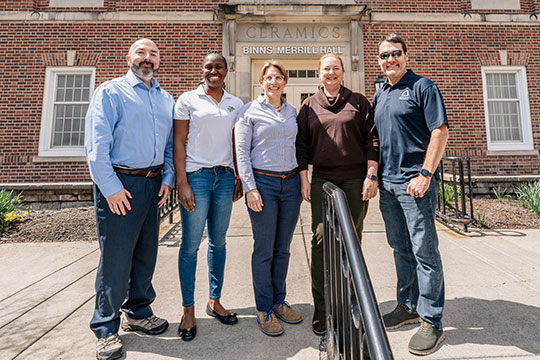
Representatives from Colorado School of Mines and Missouri University of Science & Technology visited the Alfred University campus on Wednesday, April 22, to discuss the NSF grant funding the three institutions will receive to provide need-based scholarships for undergraduate students studying ceramic or glass engineering. Pictured above are, from left: David Lipke, associate professor, Materials Science and Engineering, and associate chair for Academic Affairs, Missouri S&T; Charmayne Lonergan, Roberta and G. Robert Couch Assistant Professor, Materials Science and Engineering, Missouri S&T; Kelley R. Wilkerson, associate teaching professor, Materials Science and Engineering, and associate dean for Undergraduate Education, Missouri S&T; Gabrielle Gaustad, dean of the Inamori School of Engineering, vice president of Statutory Affairs, New York State College of Ceramics, and associate provost for Research, Alfred University; and Geoff Brennecka, professor, George S. Ansell Chair, and department head, Metallurgical and Materials Engineering Department, Colorado School of Mines.
But there is a shortage of ceramic engineers in the U.S. with the skillset needed to take advantage of these essential material properties. A new partnership funded by the National Science Foundation between Alfred University and two other U.S. universities aims to help fill that gap.
Led by Alfred University, the National Science Foundation (NSF) Scholarships in Science, Technology, Engineering and Mathematics (S-STEM) program will provide scholarships for undergraduate students studying ceramic engineering or glass engineering at Alfred University, Colorado School of Mines, and Missouri University of Science and Technology.
Each of the three schools will receive approximately $1 million in NSF funding over five years to fund scholarships. Need-based scholarships will be awarded to between 12 and 15 U.S. students total at the three schools each year, with students eligible to receive support for their sophomore, junior and senior years of study. Students will also receive a variety of professional development opportunities, including mentors, industry field trips and networking, and internship opportunities.
Research, professional development, and networking opportunities will also be provided to undergraduate students studying ceramic engineering or glass engineering at Alfred University, Mines, and Missouri S&T. These three universities currently offer the only undergraduate degrees in ceramic engineering in the U.S.
Over the summer, scholarship recipients will visit each of the three schools, for two weeks each time, working on a variety of projects. Undergraduate research projects, which will be conducted during the academic year and also during the summer, will focus on several high demand industry sectors including semiconductor development, hypersonics, energy and health care. These projects will be cross-cutting across the other schools, focusing on each university’s core strengths in ceramic materials research.
“I am excited about the hands-on undergraduate research that these students will be able to do together,” said Gabrielle Gaustad ’04, Dean of the Inamori School of Engineering at Alfred, explaining that students will work in teams—organized so that students from the different schools will work together on research—with faculty from the host universities serving as advisors for the projects. Projects will carry over from one school to the next. “My undergraduate summer research opportunity at Alfred University in ceramic engineering really set me on a fun and impactful career path so I’m thrilled to bring these opportunities to current students.”
“Those who focus on ceramics and glasses form such a tight-knit community within the already small profession of materials science that the friendships and professional networks last for decades,” said Geoff Brennecka, head of the Metallurgical and Materials Engineering Department at Colorado School of Mines. “The time that these S-STEM students spend together on their summer rotations and interacting with faculty and professionals in the ceramics field will build strong foundations of valuable professional networks for the rest of their careers.”
“By removing financial barriers and elevating student experiences across three leading programs, this effort strengthens both individual student outcomes and the field as a whole,” said David Lipke, Associate Chair for academic affairs in Missouri S&T’s Department of Materials Science and Engineering. “It’s an investment with impact well beyond the classroom to strengthen the national pipeline to a discipline that underpins critical technologies.”
Alfred University is the lead institution for the S-STEM program partnership, with Gaustad, serving as Alfred’s principal investigator. Lipke, along with Kelley Wilkerson and Charmayne Lonergan, faculty in the department of Materials Science and Engineering, will oversee the program at Missouri University of Science and Technology, while Brennecka, along with professors Laura Carroll and Kim Scott, will lead efforts at Colorado School of Mines.