Courses for the Early Childhood Education Major are listed in our digital Undergraduate Catalog.
View Major Courses
Students majoring in Early Childhood Education must fulfill the following requirements:
- Complete coursework that demonstrates depth and breadth in the arts and sciences and fulfills requirements in basic competencies in the following areas of knowledge: written communication, mathematics, computer, literature, foreign language, arts, social science, historical studies, and natural science.
- Select an academic area that is aligned with the current New York State Learning Standards. Examples include areas such as English, mathematics, science, and social studies (history and/or political science).
Students are able to declare an Early Childhood Education major upon entrance to the University, or anytime thereafter. However, students are only allowed to proceed beyond the Fall semester of their Junior year once the following requirements are met:
- Interview with a member of the education faculty
- Have a cumulative grade point average of 2.75
- Achieve a 3.0 grade point average or higher in the prerequisite education courses EDUC 230 and EDUC 231.
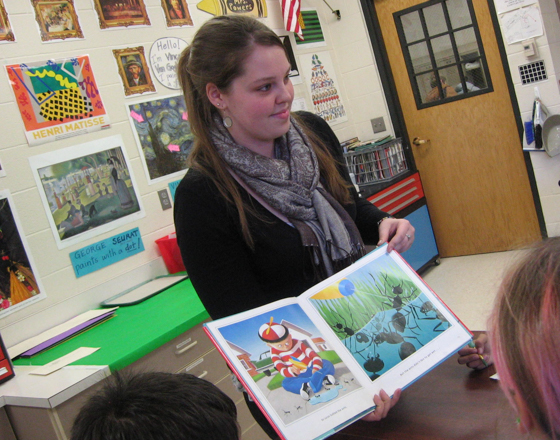
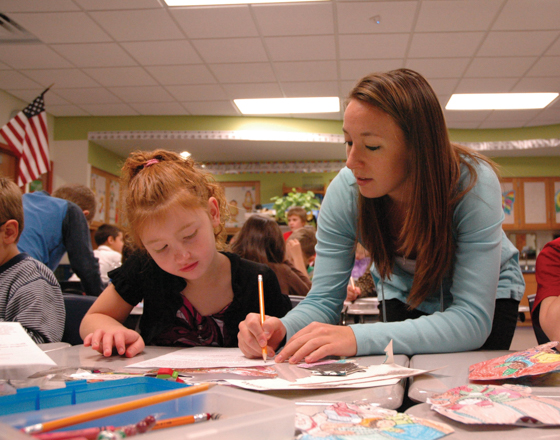
Alfred University's Early Childhood Education major is field-based, with two practicum placements taken the semester prior to student teaching. These experiences provide an excellent opportunity to observe and model a variety of instructional strategies and practices at various grade levels.
- Spring semester of the junior year - the education portion of the program begins with field-based coursework in early childhood/childhood curriculum, orientation, literacy, integrated methodology of social studies, mathematics, and science. The required concurrent field experience in two different placements in an area school system is designed as an opportunity to blend theory with experiential application.
- Fall semester of the senior year - students are placed in area schools for student teaching. Courses in literacy, methods applications, and classroom management and evaluation are designed to assist students in planning lessons that incorporate the New York State Learning Standards. During the semester of student teaching, students gain a solid understanding of the scope and sequence of education in the K-6 classroom. They apply current educational methodologies and develop lesson and unit plans under the guidance of cooperating teachers and university professors.
Students must complete 30 hours in an academic area of concentration. The following are examples of academic concentrations:
- Biology
- Chemistry
- English
- Environmental Studies
- Geology
- History
- Mathematics
- Natural Science (Biology, Chemistry, Environmental Studies, Geology and Physics)
- Physics
- Political Science
- Psychology
- Sociology
- Spanish
Alfred University is an approved teacher preparation program for New York State Early Childhood/Childhood Education teacher certification.
Examinations:
- Content Specialty Test (CST)
- The appropriate Content Specialty Test(s) for the appropriate developmental level(s) and certification area(s)
- Must pass before applying for a teaching certificate
- Educating All Students (EAS)
- Must pass before applying for a teaching certificate
- auTPA:
- Completed during the student teaching semester
- Must pass before a student will be recommended for certification
New York State Mandated Workshops:
All students must complete state-required workshops in Child Abuse Identification and Reporting, School Violence Prevention and Intervention (SAVE), and Training in Harassment, Bullying, Cyberbullying, and Discrimination in Schools: Prevention and Intervention (DASA). The SAVE workshop is provided within EDUC 231 every semester and the DASA workshop is offered online every semester. The Child Abuse Identification and Reporting class is not offered for undergraduates at AU, but it can be taken online through NYSED.
Fingerprinting/Background Check:
NYS requires candidates applying for Initial (first) certification to complete a fingerprinting/background check. Students will need to have fingerprinting completed for the Practicum/Fieldwork semester in order to comply with school district policies. Fingerprinting information can be obtained from the Division of Education office.
NYSED - Teacher certification acceptable grades policy:
Only courses with a grade of C or above for undergraduate level courses will be acceptable in meeting the content core and pedagogical core requirements.
Graduates of Alfred University's Education Division have an outstanding placement rate. They excel in their professional careers because they:
- Learn how to convert their knowledge of a subject matter into compelling lessons that meet the needs of all learners.
- Act on their knowledge in a caring and professional manner that leads to achievement for all learners.
- Learn how to learn.
- Develop multicultural perspectives and understanding.
- Know how to use technology to enhance learning. For example, students use LiveText to:
- Create e-portfolios and share them with professors, classmates, and employers
- Instantly review instructor's feedback
- Create and share knowledge in collaborative learning groups