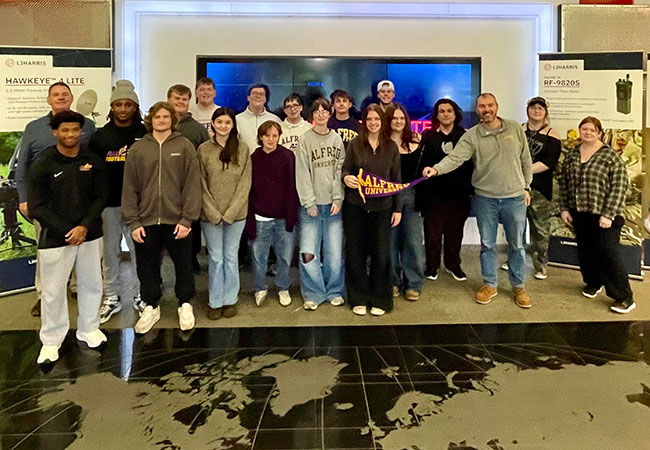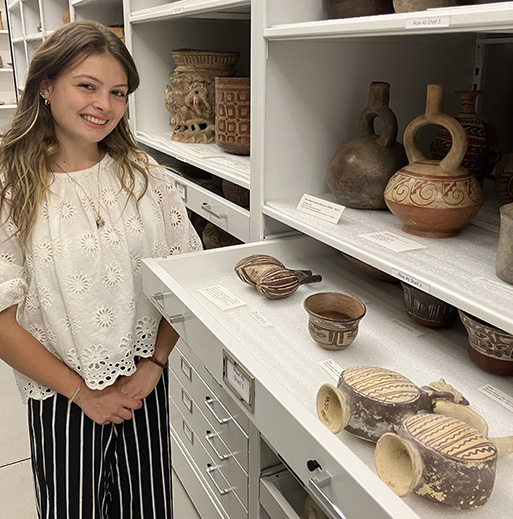


More than 50 students from four area high schools visited Alfred University on Thursday, Oct. 29, taking in demonstrations and touring facilities related to the Inamori School of Engineering’s energy-focused programs and research, and talking with undergraduate engineering students about their studies.
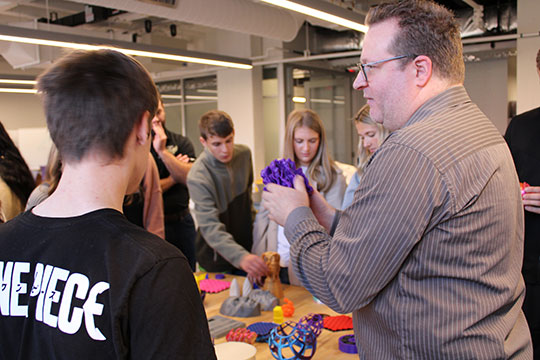
Erin Taylor, Digital Fabrication Lab specialist at Alfred University, shows high schools students some objects made with 3-D printers in the Inamori School of Engineering’s CREATE Center. The students visited campus for Thursday’s AUEnergy event.
The AUEnergy event, sponsored by the Alfred University Office of Admissions, brought students from Andover Central, Arkport Central, Canisteo-Greenwood Central, and Ellicottville Central high schools for a day of activities highlighting the university’s engineering programs.
David Gottfried, director of the Center for Advanced Ceramic Technology at Alfred University, welcomed attendees and gave an overview of various engineering programs offered at Alfred. He discussed travel and research opportunities available to undergraduates, such a trips to attend events like the Materials Science and Technology (MS&T) Conference held recently in Pittsburgh, and the annual Summer Engineering Research Institute, which provides students the chance to work side-by-side with faculty and graduate students on meaningful research.
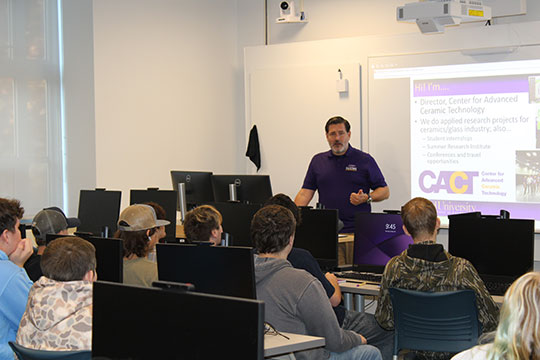
David Gottfried, director of the Center for Advanced Ceramic Technology (CACT) at Alfred University, gives welcoming remarks to high school students attending the AUEnergy event held Thursday.
Students took in demonstrations of a wind tunnel, which is used to study air flow and aerodynamics, and a solar flasher device used to measure the energy harvesting capabilities of photovoltaic (PV) cells. The group also learned about the properties of glass and how the material is used in a wide variety of applications.
Following the demonstrations, students gathered in the Ceramic Research, Education and Technology Enterprise (CREATE) Center, located in the first floor of the McMahon Engineering Building, which houses a research center focusing on the development of novel materials and scalable processes in the areas of additive manufacturing, high-temperature processing, and ceramic machining/finishing. They took in demonstrations on the Center’s 3D printing capabilities, given by Erin Taylor, Digital Fabrication Lab specialist, and talked with Alfred University undergraduates who displayed their research and coursework in a poster session.
Three Alfred University juniors—Kendra Crumbacher, Charlotte Coats, and Allison Parnes—presented a poster titled “Rediscovering F1’s Hybrid Power Unit System.”
The project, completed as part of the Circuit Theory class taught by Xingwu Wang, professor of electrical engineering, related to the principles of electrical circuits. The three students’ project focused on how those principles apply to hybrid electric powertrain engines used in Formula 1 racing cars.
“F1 engineers are studying how to make engines more energy efficient,” said Coats, a ceramic engineering major from Wayland, NY, and a self-described “fanatic” of Formula 1 racing.
The students outlined the various components of F1 hybrid power unit, which runs as both a traditional combustion engine and one powered by electricity. One component, the Motor Generative Unit-Kinetic (MGU-K), takes otherwise wasted energy in the vehicle’s braking system and stores it in the battery for later use in powering the engine.
The MGU-K “distributes the kinetic energy from the braking system and resupplies power to the battery,” said Parnes, a materials science and engineering major from Long Island, NY. This is accomplished by alternating the electrical current between AC (alternating current) and DC (direct current). With the MGU-K in a F1 car’s hybrid engine, AC occurs when the driver lets off the brakes, providing power to the engine; when the driver applies the brakes, the conversion system sends DC power directly to the battery, where it is stored.
“The waste energy from the braking system goes to the battery,” explained Crumbacher, a ceramic engineering major from Evansville, IN. “When the gas pedal is applied, the circuit reverses and supplies electrical energy to the motor.”
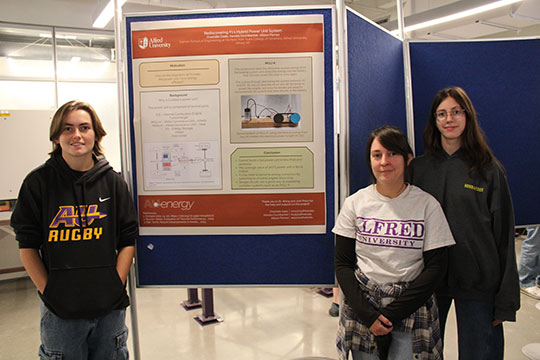
To demonstrate how the MGU-K component works, the students constructed a simplified circuit that uses two small DC motors to create mechanical energy that powers a small LED light. “The circuit is a simplification of the (MGU-K) power unit,” Crumbacher said.
Coats said the poster is beneficial to students in that is provides an understanding of how a complicated system, such as a hybrid-powered engine, works.
“For aspiring engineers, it’s good to take complex systems and break them down into useful parts. We wanted to show that you don’t need a lot of money to demonstrate (the principles of) this type of system,” Coats said, referring to the inexpensive simplified circuit being used to demonstrate the functionality of an FI hybrid power unit that costs, on average, more than $10 million.
After the poster session, the group of high school students toured the Inamori School if Engineering’s GE Vernova Advanced Power Grid Lab, the Edibon Power Systems Simulation Lab, and the battery testing lab.