

Alfred University alumnus Joseph Cesarano III ’83, who invented a revolutionary method for 3D printing with ceramic materials which has been used for the manufacture of mission critical parts for space exploration, gave a talk Wednesday that was co-sponsored by Alfred University’s Space Materials Institute and the Center for Advanced Ceramic Technology.
Cesarano, who earned a bachelor’s degree in ceramic engineering from Alfred University in 1983 and sits on the university’s Board of Trustees, is founder and president of Albuquerque, NM-based Robocasting Enterprises LLC. The company is named for the additive manufacturing technology, “Robocasting,” that Cesarano invented and patented while working as a scientist for Sandia National Laboratory in New Mexico.
Robocasting is an additive manufacturing (3D printing) technique where objects are built layer-by-layer by extruding a shear-thinning, paste-like feedstock (such as a ceramic slurry, gel, or composite) through a precision nozzle controlled by a computer or industrial robot. Cesarano licensed the technology and founded Robocasting Enterprises in his garage in 2000. In 2007, a commercial opportunity emerged for manufacturing advanced filters used to purify molten metals and Robocasting Enterprises LLC was born.
Since 2007, Robocasting has continued to improve and scale up operations with the goal of transitioning 3D printing of ceramics from a small-lot prototyping technology into a large-scale manufacturing technology. The company is housed in a state-of-the-art facility in Albuquerque with capabilities for both large-scale production and small-lot R&D custom fabrication.
On Monday, Cesarano gave a talk via Zoom to students, faculty, and staff in Alfred University’s Inamori School of Engineering about projects his company has done for the National Aeronautics and Space Administration (NASA). Much of the work stems from the lattice structures his company created using Robocasting. The company has produced more than 5 million of the filters used to remove impurities from molten metals.
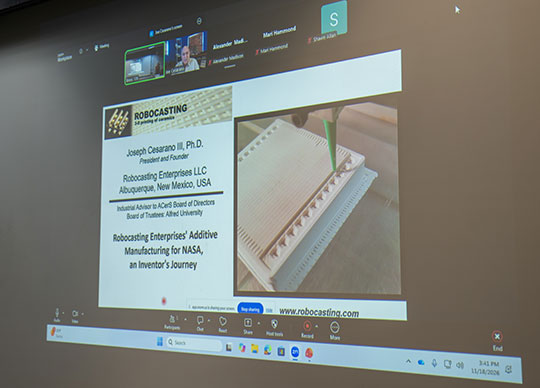
A slide from a talk given over Zoom on Wednesday by Alfred University alumnus Joseph Cesarano III ’83, founder and president of Robocasting Enterprises LLC. The slide shows an example of “Robocasting,” the additive manufacturing process invented by Cesarano which involves the extrusion of a shear-thinning, paste-like feedstock (such as a ceramic slurry, gel, or composite) through a precision nozzle controlled by a computer or industrial robot.
Robocasting Enterprises, from 2000 to 2022, completed an ARPA-E (Advance Research Projects Agency-Energy) for the U.S. Department of Energy’s High Intensity Thermal Exchange through Materials, Manufacturing Processes, and Design (HITEMMP) program which focused on developing 3D-printed ceramic heat exchangers capable of withstanding extreme heat and pressure.
For NASA, Robocasting Enterprises’ technology has been used to develop lattice assemblies that promote reversible carbon dioxide adsorption and desorption in spacecraft cabins, as well as the recovery of lost oxygen. “We developed a full scale unit to accommodate a crew of four,” Cesarano said, noting the system has the potential for use on a spacecraft traveling to Mars.
Another project with NASA focuses on using 3D-printed lattice structures to disinfect water. The lattices use zeolites, silver-doped ceramics, and catalysts to promote gas removal/conversion and potable water disinfection. “For a mission to Mars, or for a habitable (structure) on the moon, this is very important,” Cesarano said.
Robocasting technology is also being used to improve heat and moisture management in Portable Life Support Systems—a self-contained backpack unit worn with a spacesuit to keep astronauts alive during extravehicular activity (EVA) outside a spacecraft. “Porous structures (such as the lattice materials created by Robocasting Enterprises) can pull water away and direct it out of the interior of the suit,” Cesarano said.
Cesarano talked briefly about the challenges of operating his own business.
“What I’ve learned is the technology must be solid, with real value,” he said. “Technology is 10 to 20 percent of the business; getting people to see the value in it is the tough part.”
He also advised to not be intimidated by business “experts” who may be critical of the work being done. “If you’re passionate about your work, it’s easier for the engineer to learn the business than it is for the businessman to learn about the technology.”
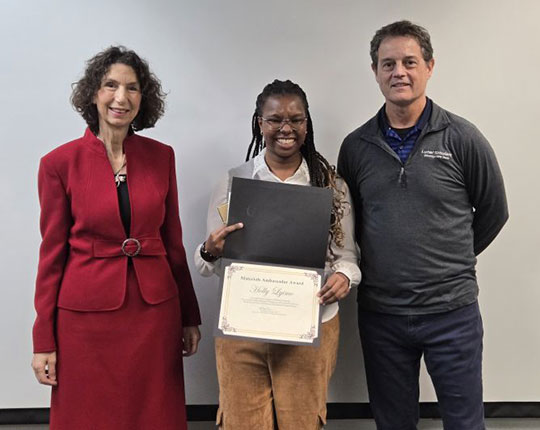
Following Cesarano’s talk, Mathew Creedon, technical specialist in the Center for Advanced Ceramic Technology, presented the first annual Materials Ambassador Award to Holly Lyimo, a sophomore ceramic engineering major from Tanzania. The award—given by the American Ceramic Society (ACerS) Western New York Section, for which Creedon serves as chairman—is given to someone, Creedon said, “who goes the extra mile in getting the word out about ceramics and materials.”
Lyimo, who enrolled at Alfred in fall 2025 as a mechanical engineering major before changing her major to ceramic engineering, is chair of Alfred University’s chapter of Materials Advantage, a joint student membership program for undergraduate and graduate students in materials science and engineering. The group seeks to strengthen community engagement within materials science and ceramics; assist with outreach and recruitment initiatives; and support initiatives focused on professional development, mentorship, and student involvement within the organization.
She also serves as a materials research assistant in the Inamori School of Engineering and a materials research intern for the Space Materials Institute. In August, Lyimo was elected president of the Student Senate at Alfred University.