

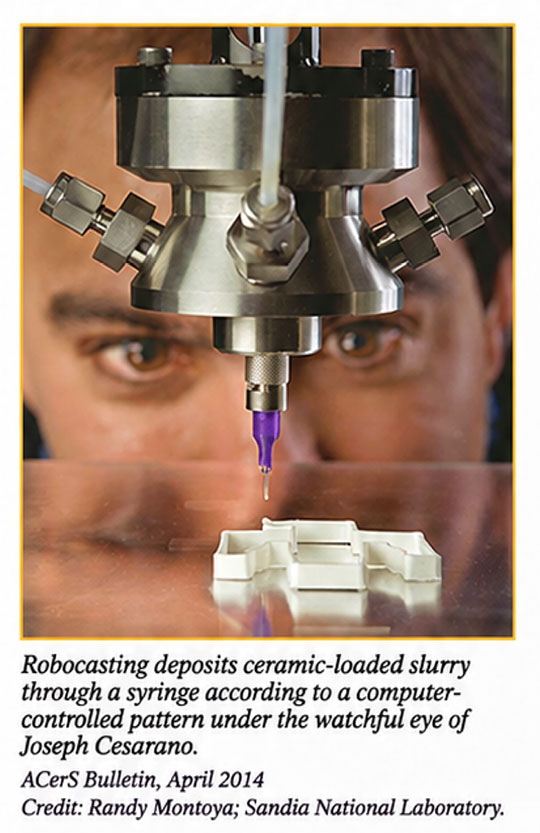
The Space Materials Institute (SMI) and Center for Advanced Ceramic Technology (CACT) at Alfred University is hosting a talk by Joseph Cesarano III, a 1983 Alfred graduate with a bachelor’s degree in ceramic engineering and inventor of “Robocasting,” a ceramic additive manufacturing method with a wide range of applications, including the manufacture of mission critical parts for the National Aeronautics and Space Administration (NASA).
 Cesarano, who serves on the Alfred University Board of Trustees, will give a talk titled “Robocasting Enterprises’ Additive Manufacturing for NASA, an Inventor’s Journey” on Wednesday, Nov. 18, from 3:30-4:45 p.m. The presentation will be offered both in person—in Binns-Merrill Hall, Room 106—and virtually via Zoom (email [email protected] for link).
The event—organized by Holly Shulman, director of the SMI, and David Gottfried, CACT director—is sponsored by the Western New York Section of the American Ceramic Society (ACerS). It will also feature the presentation of the inaugural “Materials Ambassador Award,” which recognizes a student who has demonstrated excellence in materials outreach.
Cesarano—who has a master’s degree in ceramic engineering and a Ph.D. in materials science, both from the University of Washington—invented and patented Robocasting while working as a scientist at Sandia National Laboratories in New Mexico.
Robocasting is an additive manufacturing (3D printing) technique where objects are built layer-by-layer by extruding a shear-thinning, paste-like feedstock (such as a ceramic slurry, gel, or composite) through a precision nozzle controlled by a computer or industrial robot. Cesarano licensed the technology and founded his company, Robocasting Enterprises, in his garage in 2000. In 2007, a commercial opportunity emerged for manufacturing advanced filters used to purify molten metals and Robocasting Enterprises LLC was born.
Since 2007, Robocasting—for which Cesarano serves as president— has continued to improve and scale up operations with the goal of transitioning 3D printing of ceramics from a small-lot prototyping technology into a large-scale manufacturing technology. The company is housed in a state-of-the-art facility in Albuquerque with capabilities for both large-scale production and small-lot R&D custom fabrication.
Cesarano’s talk is for students, industry professionals, and researchers interested in the space economy In his talk on Nov. 18, He will discuss the Robocasting technology and its applications for space research and exploration and will share insights into his journey as an inventor as well as his perspectives as an employer.
Launched in 2024, the Space Materials Institute facilitates industry and agency projects with Alfred University that engage students in hands-on experiential learning opportunities, while allowing companies to develop and protect intellectual property. The New York State College of Ceramics at Alfred University is a key provider of quality ceramic, glass and materials engineers to the advanced materials workforce pipeline.
The Space Materials Institute works with Alfred University’s Center for Advanced Ceramic Technology (CACT) to initiate and grow New York State capabilities in the space and aerospace sectors. The CACT at Alfred University is one of 15 Centers for Advanced Technology located across New York State created to speed technology transfer from universities to the marketplace. It specializes in applied and technical research that solves real-world problems to provide practicable, scalable solutions in support of commercializing cutting edge products and solutions.