

On Monday, Nov. 9, Alfred University held events in conjunction with National First-Generation College Celebration Day, an annual day recognizing first-generation college students. In the afternoon, the university hosted a panel discussion of six current students and faculty/staff who were the first in their families to attend an institution of higher education, and in the evening hosted a celebration honoring Alfred’s first-generation students.
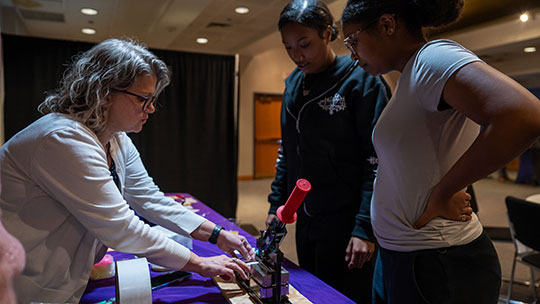
Eliza Ordway (left), director of Student Activities at Alfred University, with seniors Gabriele Hargrove (center) and Idalia Paula during Monday, Nov. 9, activities recognizing National First-Generation College Celebration Day. Hargrove and Paula—both first-generation students at Alfred—with Ordway’s assistance, were creating magnets commemorating National First-Generation College Celebration Day.
National First-Generation College Celebration Day is recognized annually on Nov. 8 to commemorate the signing of the Higher Education Act of 1965 by President Lyndon B. Johnson. The day was founded in 2017 by the Council for Opportunity in Education and FirstGen Forward (formerly the Center for First-Generation Student Success) to celebrate the resilience and contributions of students whose parents or guardians did not complete a four-year college degree.
On Monday, Alfred University’s Division of Student Experience hosted a panel discussion of issues and challenges faced by first-generation students. Panelists include three current Alfred students (two undergraduate and one graduate), two staff members and a faculty. Moderator Kim Harvey, vice president for Student Experience, posed three questions to group.
Harvey asked panelists what it means to be the first in their families to attend college.
“To me it means that I am able to achieve something that had seemed unrealistic,” said Gabriele Hargrove, a senior marketing major from the Bronx. “I learned you don’t have to accept and be comfortable with struggle and hardship.”
“Just being the one to start it all,” said Natalie Danquah, a senior biology major (minors in chemistry and biomaterials engineering) from Ghana, Africa. “I see first generation (college students) as being resilient.”
“I’m showing the generations below me what it means to go to school,” said Karissa Allen-Grant, coordinator for student activities at Alfred University, a first-generation college student who earned a bachelor’s degree from mercy College (now Mercy University) and a master’s degree from the New School. “It makes me proud to know that my family is proud.”
Added Thomas Boyle, a nurse in Alfred University’s Health and Wellness Center: “I see the difference between myself and my parents and grandparents. They were doing something to make money and survive in the world.” He said he was able, by pursuing a college education, “to have the background and knowledge to do what I want to do to make a living. The difference is between doing what you need to do and what you want to do.”
Being a first-generation college student “symbolizes my ambition: pursing something bigger than what was imagined for me,” said Erika Haag, a first-year student from Williamsport, PA, enrolled in the Mental Health Counseling graduate degree program. As a first-generation college student, Haag earned a bachelor’s degree from Commonwealth University of Mansfield (PA).
“Being a first-gen student means setting a precedent for the younger generations, by setting goals and moving toward them, and using the opportunity for betterment,” said Rafael Outland, assistant professor of counseling.
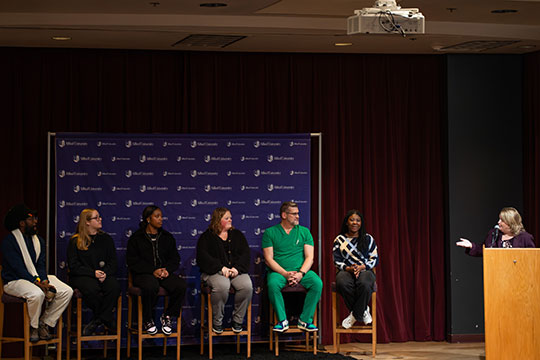
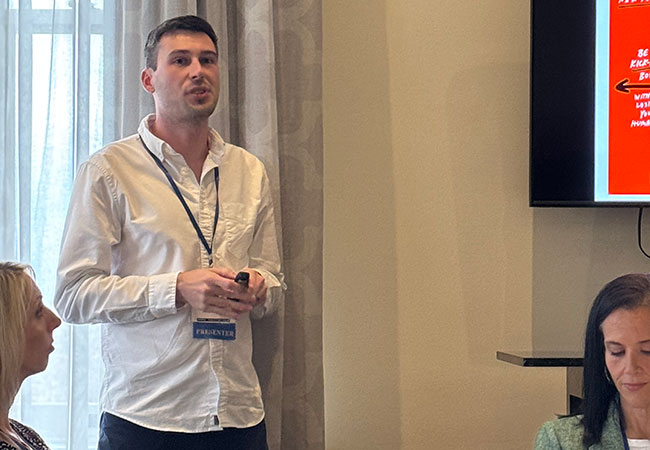
Alfred University hosted a panel discussion on Monday, Nov. 9, with students, staff and faculty who are or were first-generation college students. The discussion was part of the university’s observance of National First-Generation College Celebration Day. Shown in photo above are panelists (from left): Rafael Outland, assistant professor of counseling; Erika Haag, a first-year student enrolled in the Mental Health Counseling graduate degree program; Gabriele Hargrove, a senior marketing major; Karissa Allen-Grant, coordinator for student activities at Alfred University; Thomas Boyle, a nurse in Alfred University’s Health and Wellness Center; and Natalie Danquah, a senior biology major. At the podium is Kim Harvey, vice president for Student Experience, who served as moderator for the discussion.
Mentorship, along with inclusivity and intersection, is one of three key pillars in Alfred University’s mission of helping students realize their purpose. Harvey asked panelists what mentors helped guide them as first-generation student.
Haag pointed to Taylor Donahue, her supervisor at the Commonwealth University of Mansfield, where she served as a resident assistant while pursing her undergraduate studies. “He gave me a lot of guidance and reassurance. Someone I could fall back on if I needed it,” she said.
Danquah said one of her earliest mentors was Angie Taylor, chief inclusivity officer.
“If it wasn’t for her, I may not have made it through my first year,” Danquah said. “There are so many people who can help you out. Because of her, I learned to talk to people.”
Hargrove cited the HEOP (Higher Education Opportunities Program) and its staff for helping her acclimate to college life.
“HEOP has provided me with every single resource I’ve needed,” she said. “They’ve always pointed me toward the help I’ve needed. They support students to the fullest. They’re willing to listen first and understand. HEOP is a support system. They understand what I have gone through and where I’m going.”
Panelists were asked if there was anything that surprised them when they enrolled—a problem they had to figure out on their own. Most cited challenges that were financial in nature.
“The financial burden of going to college,” Outland said. “It’s not for poor people. There is a brokenness about it.”
“I agree,” Haag said. “The first thing I needed to figure out was filling out the FASFA (federal financial aid forms). I had no idea what I was doing.”
Allen-Grant said overcoming the financial difficulties that first-generation college students often face helped inspire her to pursue work in higher education financial aid. She served seven years as assistant director of Student Financial Services at her alma mater, Mercy University, before coming to Alfred in 2022. “I see first-hand how hard it can be for students. (As a student) I didn’t know what questions to ask. It’s why I first got into financial aid—to help students understand it,” she related.
“I had to figure out how to ask questions. How to talk to people when I needed help,” said Hargrove, noting that at her high school in the Bronx, “Not many of us asked questions. A lot of us come from backgrounds where communication really doesn’t exist.”
Danquah agreed, saying that “communicating and asking questions” were a challenge. “Coming here to college, I had to ask questions or I wouldn’t get what I needed. I had to learn to advocate for myself.”