

A senior design team of mechanical engineering alumni, all of whom graduated in May 2026, has recently published a research article in Energies, a peer-reviewed, open-access journal covering a broad range of energy science topics.
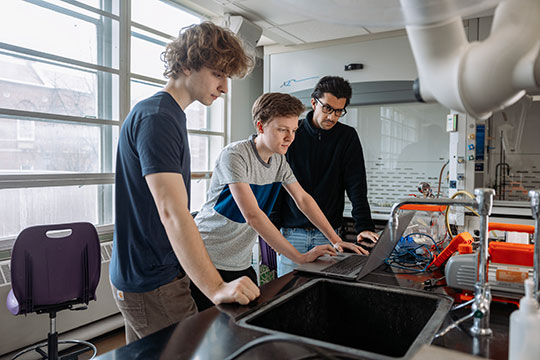
Alfred University alumni (from left) David Howe, Corey Field, and Saqlain Zaheer—all of whom earned bachelor’s degrees in mechanical engineering in May—look over data related to their senior capstone research project, which looked at ways to create heat sinks that will protect satellite batteries from the intense heat they are exposed to while in orbit. The photo was taken in the spring while the trio were finishing their capstone research, which is the basis of a paper they co-authored with their academic advisor, Mehdi Kabir, assistant professor of mechanical engineering. The article appeared in the October issue of the journal, Energies.
Corey Field, David Howe, and Saqlain Zaheer, along with their research advisor, Mehdi Kabir, assistant professor of mechanical engineering in Alfred University’s Inamori School of Engineering, co-authored the article titled “Comparative Performance of Foam-Enhanced Eutectic Alloy and Organic Phase-Change Material Heat Sinks for Passive Thermal Management of Small Spacecraft”.
Field, Howe, and Zaheer each earned bachelor’s degrees in mechanical engineering in May. Their paper published in Energies stems from research the three conducted as part of their senior capstone project conducted during the 2025-26 academic year, for which Kabir served as their academic advisor.

Mehdi Kabir, assistant professor of mechanical engineering
The study cited in the article presents an experimental and simulation-based investigation of phase-change material (PCM) heat sinks incorporating micro-/nano-structured thermal conductivity enhancers, including copper foam and carbon foam, infiltrated with either conventional paraffin PCM or a bismuth-based low-melting-point alloy (LMPA). The heat sinks were evaluated under vacuum conditions as passive thermal management systems designed to maintain the temperatures of battery modules and electronic components within allowable thermal limits for small spacecraft and CubeSat satellites.
This project was also awarded financial support by the NASA New York Space Grant Consortium at Cornell University.