

Two Alfred University students attended the fifth annual Society of North American Scholars (SNAS) Interdisciplinary Research Conference, held October 9-10 at George Mason University in Arlington, VA. The conference brought together students, researchers, and scholars from different disciplines to discuss the growing role of Artificial Intelligence in education, technology, economics, and society.
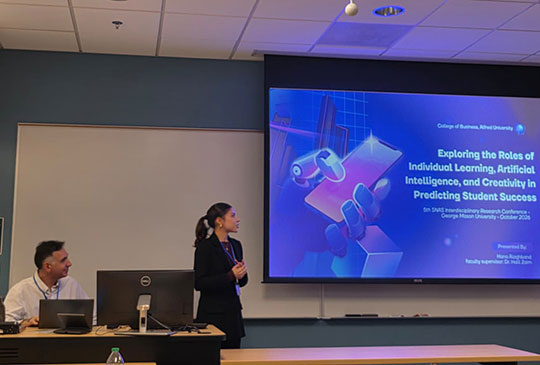
Alfred University junior Hana Alaghband (right) gives a presentation on her research at the Society of North American Scholars (SNAS) Interdisciplinary Research Conference held earlier this month at George Mason University in Arlington, VA. Looking on is Halil Zaim, associate professor of management, who collaborated with Alaghband on in the AI-focused research.
The theme of this year’s conference, “Trustworthy Innovation, Learning, and Human Development in the Age of Intelligent Systems,” focused on how emerging technologies can support human development while addressing ethical and societal challenges.
Hana Alaghband, a junior double-majoring in data analytics and computer science, and Jeshika Sharma, junior double-majoring in marketing and political science, were accompanied on the trip by two faculty from Alfred University’s College of Business: Halil Zaim, associate professor of management, and Ali Coskun, associate professor of accounting. Alaghband presented research conducted with Zaim, which examined the factors that contribute to student success and whether AI usage plays a significant role in academic achievement.
The project, which began as a class assignment, surveyed 272 college students and explored three factors: individual learning, creativity, and AI usage. “Our project looked at what actually predicts student success, especially now that AI is such a big part of how students learn,” Alaghband explained.
One of the most surprising findings was that AI usage was not a statistically significant predictor of student success. Instead, individual learning and creativity emerged as the more important factors.
“We expected it to be a strong predictor, but it wasn’t significant at all,” Alaghband said. “To me that was a really important takeaway, that AI can be a great tool, but it doesn’t replace the thinking and effort that drive real learning.”
Presenting the findings to researchers and students from other universities also gave Alaghband an opportunity to develop her communication skills and gain confidence in her work.
“Presenting in front of scholars and students from other universities pushed me to really know my work and be able to talk about it confidently,” she said. “Getting to represent Alfred University at a conference like this meant a lot to me.”
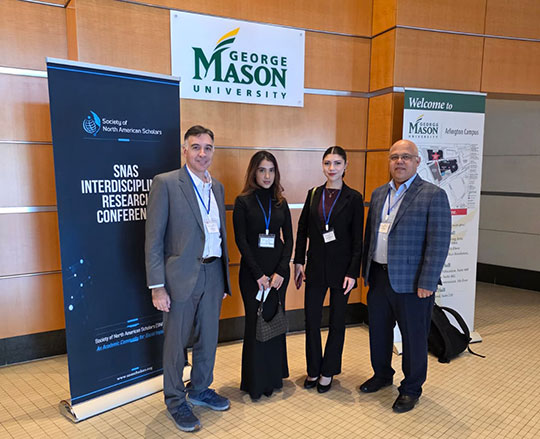
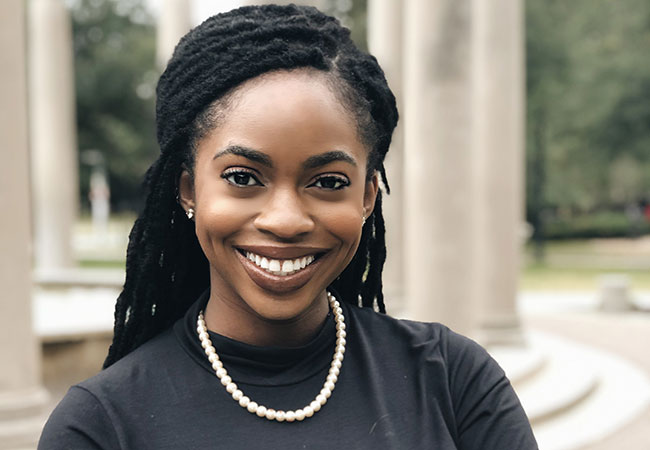
Two faculty and two students from Alfred University attended the recent Society of North American Scholars (SNAS) Interdisciplinary Research Conference in Arlington, VA. They are pictured above, from left: Halil Zaim, associate professor of management; juniors Jeshika Sharma and Hana Alaghband; and Ali Coskun, associate professor of accounting.
Sharma, who attended the conference as a guest, found the experience equally valuable. One presentation that particularly stood out to her examined the appropriate role of AI in education, drawing on research from Turkey and Afghanistan. The presentation raised questions about how students can benefit from AI without becoming overly dependent on it. Sharma said exposure to different research methods and findings challenged some of her assumptions and encouraged her to consider new approaches to analyzing and presenting information.
Both students also emphasized the role Alfred University played in preparing them for the experience. Sharma credited classroom presentations, undergraduate research forums, mentorship opportunities, and continuous feedback from faculty with helping students develop the confidence to participate in academic discussions.
Alaghband expressed gratitude for the opportunity to take her research beyond the classroom and share it with a broader academic audience. “Getting to turn a class project into research I could present at a national conference, alongside Dr. Zaim, is something I’m grateful for,” she said.
For Alaghband, one of the most meaningful parts of the conference was meeting other students and scholars who shared her enthusiasm for research.
“Meeting other students and scholars, hearing their work, and realizing I belonged in that space gave me a lot of confidence,” she said. “It made me excited to keep doing research.”
Story by Andrii Maltsev ’27