

Seven Alfred University students, accompanied by Assistant Professors of Computer Science and Mathematics Garegin Grigoryan and Chandan Kumar, recently attended an IEEE (Institute of Electrical and Electronics Engineers) workshop on AI-Native Networking, Resilience and Forensics hosted by Rochester Institute of Technology.
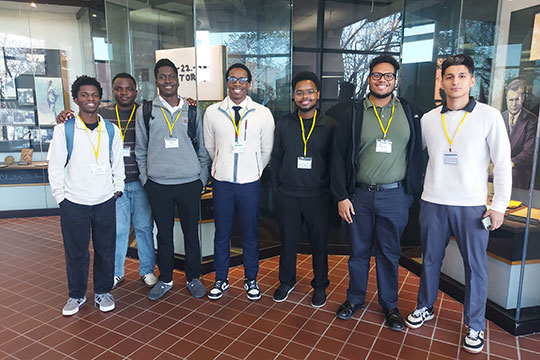
The Oct. 24 workshop brought together researchers, industry professionals and students to explore emerging technologies and challenges at the intersection of artificial intelligence and computer networking.
According to Grigoryan, the workshop focused on the evolution of networking infrastructure and protocols to support AI-related tasks, including AI training, inference and distributed computing. It also examined how AI tools are being incorporated into networking research.
Among the highlights was a presentation by the FABRIC Testbed team on conducting autonomous networking experiments with AI assistance. The presentation was particularly relevant to Alfred University students, who use the FABRIC Testbed to conduct realistic networking experiments in their CSCI 315 Computer Networking course.
Another highlight was a technical panel titled "Networking for the AI Era?" which brought together industry and academic leaders to discuss how networking infrastructure must evolve to accommodate the large volumes of data and time-sensitive demands associated with AI applications. Students also attended a panel on trustworthy distributed AI infrastructure, which explored the importance of security, monitoring and accountability in AI systems.
Kumar highlighted several presentations on agentic AI, including discussions of system failures, recovery, forensic analysis and decision-making. He also pointed to a presentation titled "Pooling GPUs for One Big Job vs. Slicing One GPU for Many Robots," which connected directly to concepts covered in his CSCI 470: AI for Computer Vision course.
For both professors, one of the most valuable aspects of the workshop was the opportunity for students to see how concepts introduced in the classroom are applied in professional environments. "The students learnt how the tools and techniques that they learnt in the classroom is being used in the professional setting and also learnt how the industry is using them at scale," Kumar said.
Beyond gaining technical knowledge, students had opportunities to connect with peers, researchers and industry professionals while learning about current research directions and potential career paths.
Some students also toured RIT's campus and Cybersecurity Institute, where they explored research facilities, reviewed student research posters and met with faculty members to learn about graduate programs. The visit provided an opportunity for students considering advanced degrees to explore potential master's and doctoral pathways while building connections with faculty and fellow students from other institutions.
Grigoryan emphasized that exposure to active research and industry developments can help students better understand the relevance of their coursework.
"It is important for students to see that the concepts we study in class are active research and industry areas," Grigoryan said. "This gives them motivation to study and a clear perspective."
Kumar echoed this sentiment, noting that workshops involving industry professionals offer valuable insight into the technologies currently being used, the challenges companies face and the possibilities being explored. "Such workshops are a real learning experience for students as they see the connection between what they studied in the classroom being used to solve real world problems," he said.
The professors expressed their appreciation to Dr. Nirmala Shenoy of Rochester Institute of Technology and Conference Student Outreach Coordinator Benjamin Brumm for organizing the event and inviting Alfred University students to participate.