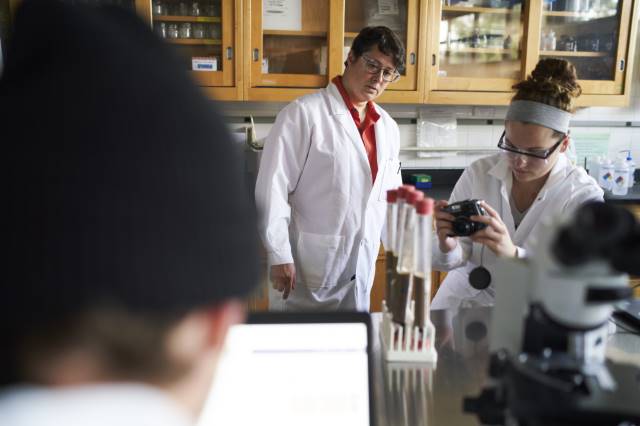
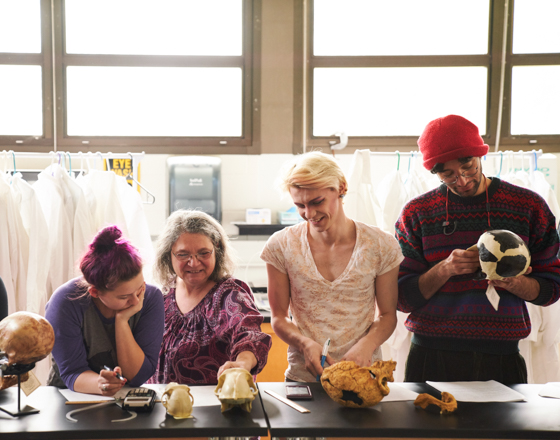
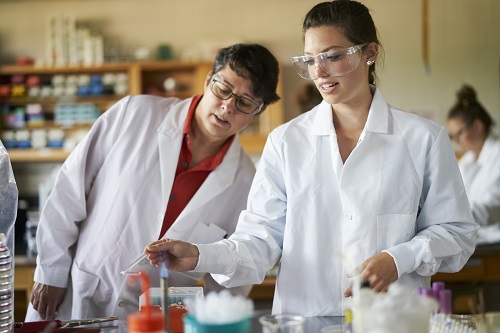
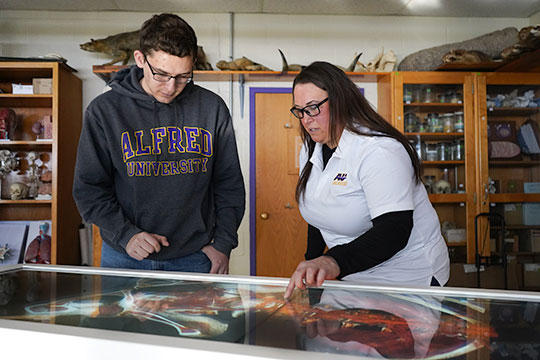
Students working in the biology lab, analyzing fluid containers. Student with gloves weighing substance and mashing it. A professor demonstrating on a centrifuge talking to two students. A sweeping shot of a student analyzing something under a microscope. Students watering plants. Two students outdoors identifying an analyzing plant life.
Biology (BS)
Alfred University’s Biology program provides students with a diverse and interactive education in a non-traditional, hands-on setting. Here, you will DO science and not just learn about it. The program promotes and supports this style of learning through laboratory and field courses, inquiry-based instruction, research activities, internships, discussions and seminars concerning modern biological research.
You will complete a core of courses and select a prescribed number of elective courses related to your personal and career interests. Additional courses in chemistry, mathematics, and physics are required or recommended. All courses taken as part of the Biology major must be passed with a grade of C or better.
In addition to fulfilling the requirements of the major in Biology, as well as the College of Liberal Arts & Sciences general education requirements, you'll be required to complete the College's First Year Experience Program or Transfer Student Program.
Foundation & Core Courses (26 credits)
Take one of the following:
- BIOL 150 Biological Foundations - 4 credits
- BIOL 155 Biological Foundations: Research Project - 4 credits
Take all of the courses below:
- BIOL 211 Cell Biology - 4 credits
- BIOL 212 Principles of Genetics - 4 credits
- BIOL 213 Structure & Function of Organisms - 4 credits
- BIOL 226 Biostatistics - 4 credits
- BIOL 314 Community & Systems Biology - 4 credits
- BIOL 390 Junior Seminar - 1 credit
- BIOL 490 - Biology Research Seminar - 1 credit
Specialization
Take 16 credits from the list below (It is recommended to complete one of research intensive courses):
- BIOL 300 Topics in Biology - 4 credits
- BIOL 302 General Microbiology - 4 credits
- BIOL 306 Field Techniques in Plan Biology - 4 credits
- BIOL 307 Anatomy & Physiology: Nerves, Muscles, Skeleton - 4 credits
- BIOL 308 Anatomy & Physiology: Viscera - 4 credits
- BIOL 315 Genetics & Evolution of Populations - 4 credits
- BIOL 320 Toxicology - 4 credits
- BIOL 322 Botany - 4 credits
- BIOL 346 Animal Nutrition - 4 credits
- BIOL 348 Animal Behavior - 4 credits
- BIOL 353 Topical Ecology - 4 credits
- BIOL 354 Ecology - 4 credits
- BIOL 355 Field Techniques in Plant Biology - credits
- BIOL 357 Conservation Biology - 4 credits
- BIOL 375 Comparative Vertebrate Anatomy - 4 credits
- BIOL 376 Animal Physiology - 4 credits
- BIOL 400 Research Topics - 4 to 5 credits [Research Intensive course]
- BIOL 402 Immunology - 4 credits
- BIOL 405 Bioinformatics - 4 credits [Research Intensive course]
- BIOL 420 Biochemistry: Proteins & Metabolism - 4 credits
- BIOL 422 Biochemistry: Nucleic Acids - 4 credits
- BIOL 425 Physiological Plant Ecology - 4 credits [Research Intensive course]
- ATHT 392 Biomechanics - 2 credits
- ATHT 393 Physiology of Exercise - 4 credits
- ENVS 315 Herpetology - 3 credits
- ENVS 320 Advanced GIS Applications - 4 credits
- ENVS 330 Ornithology - 4 credits
Related Courses (28 credits):
- CHEM 105 General Chemistry I - 4 credits
- CHEM 106 General Chemistry II - 4 credits
- CHEM 315 Organic Chemistry I - 4 credits
- CHEM 316 Organic Chemistry II - 4 credits
- MATH 151 Calculus I - 4 credits
- PHYS 111 Introduction to General Physics I - 4 credits OR
- PHYS 125 Physics I - 4 credits
- PHYS 112 Intro to General Physics II - 4 credits OR
- PHYS 126 Physics II - 4 credits
College & University Requirements:
College of Liberal Arts & Sciences Education (40 credits)
University Requirements (7 credits)
Electives (7 credits)
Please see the Biology Three Year Plan included on the BA in Biology webpage for course availability.
Foundation & Core Courses (26 credits)
Take one of the following:
- BIOL 150 Biological Foundations - 4 credits
- BIOL 155 Biological Foundations: Research Project - 4 credits
Take all of the courses below:
- BIOL 211 Cell Biology - 4 credits
- BIOL 212 Principles of Genetics - 4 credits
- BIOL 213 Structure & Function of Organisms - 4 credits
- BIOL 226 Biostatistics - 4 credits
- BIOL 314 Community & Systems Biology - 4 credits
- BIOL 390 Junior Seminar - 1 credit
- BIOL 490 - Biology Research Seminar - 1 credit
Specialization:
Take 16 credits from the list below (It is recommended to complete one of research intensive courses):
- BIOL 300 Topics in Biology - 4 credits
- BIOL 346 Animal Nutrition - 4 credits
- BIOL 348 Animal Behavior - 4 credits
- BIOL 353 Tropical Biology - 4 credits
- BIOL 375 Comparative Vertebrate Anatomy - 4 credits
- BIOL 376 Animal Physiology - 4 credits
- ENVS 315 Herpetology - 3 credits
- ENVS 330 Ornithology - 4 credits
- BIOL 400 Research Topics - 4 to 5 credits [Research Intensive course]
Related Courses (28 credits):
- CHEM 105 General Chemistry I - 4 credits
- CHEM 106 General Chemistry II - 4 credits
- CHEM 315 Organic Chemistry I - 4 credits
- CHEM 316 Organic Chemistry II - 4 credits
- MATH 151 Calculus I - 4 credits
- PHYS 111 Introduction to General Physics I - 4 credits OR
- PHYS 125 Physics I - 4 credits
- PHYS 112 Intro to General Physics II - 4 credits OR
- PHYS 126 Physics II - 4 credits
College & University Requirements:
College of Liberal Arts & Sciences Education (40 credits)
University Requirements (7 credits)
Electives (7 credits)
Foundation & Core Courses (26 credits)
Take one of the following:
- BIOL 150 Biological Foundations - 4 credits
- BIOL 155 Biological Foundations: Research Project - 4 credits
Take all of the courses below:
- BIOL 211 Cell Biology - 4 credits
- BIOL 212 Principles of Genetics - 4 credits
- BIOL 213 Structure & Function of Organisms - 4 credits
- BIOL 226 Biostatistics - 4 credits
- BIOL 314 Community & Systems Biology - 4 credits
- BIOL 390 Junior Seminar - 1 credit
- BIOL 490 Biology Research Seminar - 1 credit
Specialization
Take 16 credits from the list below (It is recommended to complete one of research intensive courses):
- BIOL 300 Topics in Biology - 4 credits
- BIOL 322 Botany - 4 credits
- BIOL 355 Field Techniques in Plant Biology - 4 credits
- BIOL 420 Biochemistry: Proteins & Metabolism - 4 credits
- a 4 credit 300 or 400-level biology course taken in consultation with your academic advisor
- BIOL 400 Research Topics - 4 to 5 credits [Research Intensive course]
- BIOL 425 Physiological Plant Ecology - 4 credits [Research Intensive course]
Related Courses (28 credits):
- CHEM 105 General Chemistry I - 4 credits
- CHEM 106 General Chemistry II - 4 credits
- CHEM 315 Organic Chemistry I - 4 credits
- CHEM 316 Organic Chemistry II - 4 credits
- MATH 151 Calculus I - 4 credits
- PHYS 111 Introduction to General Physics I - 4 credits OR
- PHYS 125 Physics I - 4 credits
- PHYS 112 Intro to General Physics II - 4 credits OR
- PHYS 126 Physics II - 4 credits
College & University Requirements:
College of Liberal Arts & Sciences Education (40 credits)
University Requirements (7 credits)
Electives (7 credits)
Foundation & Core Courses (26 credits)
Take one of the following:
- BIOL 150 Biological Foundations - 4 credits
- BIOL 155 Biological Foundations: Research Project - 4 credits
Take all of the courses below:
- BIOL 211 Cell Biology - 4 credits
- BIOL 212 Principles of Genetics - 4 credits
- BIOL 213 Structure & Function of Organisms - 4 credits
- BIOL 226 Biostatistics - 4 credits
- BIOL 314 Community & Systems Biology - 4 credits
- BIOL 390 Junior Seminar - 1 credit
- BIOL 490 - Biology Research Seminar - 1 credit
Specialization
Take 16 credits from the list below (It is recommended to complete one of research intensive courses):
- BIOL 300 Topics in Biology - 4 credits
- BIOL 306 Human Pathophysiology
- BIOL 307 Anatomy & Physiology: Nerves, Muscles, Skeleton - 4 credits
- BIOL 308 Anatomy & Physiology: Viscera - 4 credits
- BIOL 320 Toxicology - 4 credits
- BIOL 400 Research Topics - 4 to 5 credits [Research Intensive course]
- BIOL 402 Immunology - 4 credits
- BIOL 420 Biochemistry: Proteins & Metabolism - 4 credits
- ATHT 392 Biomechanics - 2 credits
- ATHT 393 Physiology of Exercise - 4 credits
Related Courses (28 credits):
- CHEM 105 General Chemistry I - 4 credits
- CHEM 106 General Chemistry II - 4 credits
- CHEM 315 Organic Chemistry I - 4 credits
- CHEM 316 Organic Chemistry II - 4 credits
- MATH 151 Calculus I - 4 credits
- PHYS 111 Introduction to General Physics I - 4 credits OR
- PHYS 125 Physics I - 4 credits
- PHYS 112 Intro to General Physics II - 4 credits OR
- PHYS 126 Physics II - 4 credits
College & University Requirements:
College of Liberal Arts & Sciences Education (40 credits)
University Requirements (7 credits)
Electives (7 credits)
Foundation & Core Courses (26 credits)
Take one of the following:
- BIOL 150 Biological Foundations - 4 credits
- BIOL 155 Biological Foundations: Research Project - 4 credits
Take all of the courses below:
- BIOL 211 Cell Biology - 4 credits
- BIOL 212 Principles of Genetics - 4 credits
- BIOL 213 Structure & Function of Organisms - 4 credits
- BIOL 226 Biostatistics - 4 credits
- BIOL 314 Community & Systems Biology - 4 credits
- BIOL 390 Junior Seminar - 1 credit
- BIOL 490 - Biology Research Seminar - 1 credit
Specialization
Take 16 credits from the list below (It is recommended to complete one of research intensive courses):
- BIOL 300 Topics in Biology - 4 credits
- BIOL 315 Genetics & Evolution of Populations - 4 credits
- BIOL 322 Botany - 4 credits
- BIOL 353 Topical Biology - 4 credits
- BIOL 354 Ecology - 4 credits
- BIOL 355 Field Techniques in Plant Biology - 4 credits
- BIOL 357 Conservation Biology - 4 credits
- BIOL 425 Physiological Plant Ecology - 4 credits [Research Intensive course]
- ENVS 315 Herpetology - 3 credits
- ENVS 320 Advanced GIS Applications - 4 credits
- ENVS 330 Ornithology - 4 credits
Related Courses (28 credits):
- CHEM 105 General Chemistry I - 4 credits
- CHEM 106 General Chemistry II - 4 credits
- CHEM 315 Organic Chemistry I - 4 credits
- CHEM 316 Organic Chemistry II - 4 credits
- MATH 151 Calculus I - 4 credits
- PHYS 111 Introduction to General Physics I - 4 credits OR
- PHYS 125 Physics I - 4 credits
- PHYS 112 Intro to General Physics II - 4 credits OR
- PHYS 126 Physics II - 4 credits
College & University Requirements:
College of Liberal Arts & Sciences Education (40 credits)
University Requirements (7 credits)
Electives (7 credits)
Foundation & Core Courses (26 credits)
Take one of the following:
- BIOL 150 Biological Foundations - 4 credits
- BIOL 155 Biological Foundations: Research Project - 4 credits
Take all of the courses below:
- BIOL 211 Cell Biology - 4 credits
- BIOL 212 Principles of Genetics - 4 credits
- BIOL 213 Structure & Function of Organisms - 4 credits
- BIOL 226 Biostatistics - 4 credits
- BIOL 314 Community & Systems Biology - 4 credits
- BIOL 390 Junior Seminar - 1 credit
- BIOL 490 Biology Research Seminar - 1 credit
Specialization
BIOL 320 Toxicology
Take 16 credits from the list below (It is recommended to complete one of research intensive courses):
- BIOL 300 Topics in Biology - 4 credits
- BIOL 302 General Microbiology - 4 credits
- BIOL 306 Human Pathophysiology - 4 credits
- BIOL 320 Toxicology - 4 credits
- BIOL 402 Immunology - 4 credits
- BIOL 405 Bioinformatics - 4 credits [Research Intensive course]
- BIOL 420 Biochemistry: Proteins & Metabolism - 4 credits
- BIOL 422 Biochemistry: Nucleic Acids - 4 credits
Related Courses (28 credits):
- CHEM 105 General Chemistry I - 4 credits
- CHEM 106 General Chemistry II - 4 credits
- CHEM 315 Organic Chemistry I - 4 credits
- CHEM 316 Organic Chemistry II - 4 credits
- MATH 151 Calculus I - 4 credits
- PHYS 111 Introduction to General Physics I - 4 credits OR
- PHYS 125 Physics I - 4 credits
- PHYS 112 Intro to General Physics II - 4 credits OR
- PHYS 126 Physics II - 4 credits
College & University Requirements:
College of Liberal Arts & Sciences Education (40 credits)
University Requirements (7 credits)
Electives (7 credits)
All Biology double majors complete a common core and related courses, and will select 12 credits of specialization courses based on their interests. All courses taken as part of the Biology major must be passed with a grade of C or better; transferred courses must have approval from the Division of Biology to receive major credit.
Learn more about Double Majors
Biology Core Courses: Take all from this section
- BIOL 150 Biological Foundations - Fall/Spring
or BIOL 155 Biol. Foundations: Research Project - BIOL 211 Cell Biology - Spring
- BIOL 212 Principles of Genetics - Fall
- BIOL 213 Structure and Function of Organisms - Fall
- BIOL 314 Community and Systems Biology - Spring
- BIOL 226 Biostatistics - Spring
- BIOL 390 Junior Seminar - Fall
- BIOL 490 Biology Research Seminar - Spring
Specialization (elective) Courses: Select 12 credits from the following courses
- BIOL 300 Topics in Biology
- BIOL 302 General Microbiology - Fall
- BIOL 306 Human Pathophysiology - Fall
- BIOL 307 Anatomy & Phys: Nerves, Muscles, Skeleton - Fall
- BIOL 308 Anatomy and Physiology: Viscera - Spring
- BIOL 315 Genetics & Evolution Populations - Spring, even years
- BIOL 320 Toxicology - Fall, odd years
- BIOL 322 Botany - Spring, even years
- BIOL 324 Phage Genomics - Spring
- BIOL 346 Animal Nutrition - Spring, even years
- BIOL 348 Animal Behavior
- BIOL 353 Tropical Biology
- BIOL 354 Ecology - Fall, odd years
- BIOL 355 Field Techniques in Plant Biology
- BIOL 357 Conservation Biology - Spring, odd years
- BIOL 375 Comparative Vertebrate Anat. - Fall, even years
- BIOL 376 Animal Physiology - Spring, even years
- BIOL 400 Research Topics
- BIOL 402 Immunology
- BIOL 405 Bioinformatics - Fall, odd years
- BIOL 420 Biochemistry: Proteins and Metabolism - Spring
- BIOL 422 Biochemistry: Nucleic Acids - Fall, even years
- BIOL 425 Physiological Plant Ecology - Fall, odd years
- ATHT 392 Biomechanics - Spring, even years
- ATHT 393 Physiology of Exercise - Fall, odd years
- ENVS 315 Herpetology - Fall, even years
- ENVS 320 Advanced GIS Applications - Spring
- ENVS 330 Ornithology - Fall, odd years
Related Courses: Take all from this section
- CHEM 105 General Chemistry I
- CHEM 105L General Chemistry I Laboratory
- CHEM 106 General Chemistry II
- CHEM 106L General Chemistry II Laboratory
- Take one additional 300-level Chemistry course
Alfred University's Biology program has an international reputation for producing graduates who are solidly prepared to enter the workforce or continue on to postgraduate study programs.
Alfred University graduates have been admitted to numerous medical, dental, and veterinary schools as well as programs for physician assistants and physical therapy. Examples of recent health-related graduate school admissions include:
- University of Florida
- Ohio State
- University of Illinois
- Gannon University
- Cornell University
Our graduates are also successfully admitted to graduate programs for various disciplines in Biology. Examples of graduate school admissions include:
- Auburn University - Biological Sciences
- Washington University - Genome Sciences
- Nazareth College - Education
- SUNY ESF - Ecology and Evolutionary Biology
Biology graduates are successful in biology-related occupations as:
- Research Technicians
- Animal Control Officers
- Biology Teachers
- Falconry Experts
- STEM Specialists
A total of 24 credits is required for the Biology Minor.
You must take one of the following BIOL courses:
- BIOL 150 Biological Foundations
- CHEM 105 General Chemistry I
- Plus at least 16 additional credits of BIOL courses (excluding BIOL 226, 390, 450, 485, and 490), selected in consultation with a Biology advisor
The Division of Biology and Biochemistry rewards deserving students for their progress, performance, and dedication to the field. Eligible students may qualify for the following awards:
Brenda Bernstein Butner Award in Botany
The Brenda Bernstein Butner Award in Botany funds outstanding student research projects on native plants. This award provides a stipend for a semester-long or summer project.
University Advisory Committee for the Health Professions Scholarships
Each year three merit-based awards are given to one sophomore, one junior and one senior student interested in animal or human medicine and who, by their academic, extracurricular and health-related practical experiences, have demonstrated a strong motivation and potential for pursuing a career in a health profession.
Diana Mossip Memorial Scholarship
One of our most treasured scholarships is in memory of Diana Mossip who entered Alfred University in 1994 and was killed in a tragic automobile accident while still a student in 1996. Diana was a National Merit Scholar and a member of the Honors Program. She was majoring in Biology and had planned a career in veterinary medicine. Diana was a member of the Biology Club, assisted with blood drives, and enjoyed living in the Brick Residence Hall.
As an organ donor, Diana provided the gift of life to several people. Her family provides the gift of education by awarding the scholarship annually to two deserving students who are planning future careers in veterinary, human or dental medicine.
Study What You Love
Independent study projects in biology provide an opportunity for students to pose original questions of interest to them and formulate responses which may be research based, literature based, or the result of a creative endeavor. Students are encouraged to have fun with their projects and enjoy the opportunity for in-depth study in an area of their choosing.
Students develop and carry out their ideas with the advice and guidance of a faculty member and the final project is presented to the Division of Biology and Biochemistry in the form of a thesis, poster, oral presentation, or other acceptable format.
Course Credit
The independent study is taken as either BIO 450 (Independent Study) or BIO 485 (Internship in Biology), depending on the degree of independent work.
Funding
Students may apply for an Alfred Research Grant for Undergraduate Students (ARGUS) to help fund their projects. Faculty may have other sources of funding to support student work as well.
Selected Biology Student Independent Research Projects
- An investigation of prion protein interactions and other causal factors in the development and onset of Alzheimer’s Disease
- The effect of enrichment methods on cribbing in Equus caballus
- The influence of equine conformation on performance
- How to address Toxocara in humans and companion animals as a public health issue
- Assessment of intra- and inter- species interactions and use of space between captive common squirrel monkey, black capped squirrel monkey, howler monkey, and capuchin monkeys
- GMO’s effect on health and the environment
- Investigating the relationship between hair dye and hair tensile strength
- Gender markers in Nepenthes
- Molecular genetics of autofluorescence in Avena sativa
- Color vision in California sea lions (Zalophus californianus)
- Indications of Exhibit Quality based on Captive Felid Behaviors
- Territorial behavior and dominance hierarchies between three species of African cichlids
- Chemotaxis responses to pheromones in cockroaches
- Attempts to establish a cricket colony and future chemotactic studies
- Integrated human health: A review of the integration of complementary and alternative medicine with conventional healthcare
- Behavioral responses to novel objects in North American river otters (Lonta canadensis)
- Learning, imitation, and time-expenditure frequencies in Lontra canadensis
- Manufacturing cockroach pheromones and testing their effectiveness
- The effect of latitude on reproductive behavior and timing in the North American river otter (Lontra canadensis)
- Differences in seasonal reproduction patterns between tropical and temperate squirrel monkey (Saimiri sciureus) populations
- Research in equine nutrition: diet changes in PSSM horse
- Human impacts on extinction and threat of extinction of island avifauna
- Investigation of the presence of the phorid fly Apocephalis borealis and other causes of CCD in honeybee hives of Alfred NY
- Engineering Chimeras to Monitor Multiplex Interactions
- Genetics of Zebrafish
- Zinc finger nucleases: The past and present of in vivo genome editing
- The effects of cigarette smoke on plants
- Integrated human health: a review of the integration of complementary and alternative medicine with conventional medicine
- Microbial community analysis of a human versus a canine oral cavity
- Spore formation by the gram negative bacteria Chitinophaga pinensis
- Antimicrobial activity of silver containing cements
- The synthesis of small molecules to inhibit FabI in the fatty acid synthesis pathway of apicoplast parasites
- Interaction analysis of a putative MafA-like protein and a hypothetical protein with AniA, an anaerobically induced outer membrane protein of Neisseria gonorrhoeae
- Identification of nematode species found in the oat rhizosphere
- Identification of bacteria found in the rhizosphere of oats (Avena sativa)
- Phylogenetic analysis of microorganisms living in streams impacted by acid mine drainage
- Evaluation of microbial community structures and coliform persistence in the Alfred Wastewater Treatment Facility reed bed sludge treatment system
- Microbial community analysis of fungi in oat rhizosphere
- Nematode maintenance and culture
- Novel apparatus for growing and examining plant-microbe rhizosphere relationships
- Microbial degradation of petroleum hydrocarbons within various soil textures
- Biofilm Formation of Neisseria gonorrhoeae: A Sea of Unexplored Possibility
- The effects of minimal fluoride exposure on the uptake of nutrients in agricultural and horticultural plants
- Genetic diversity of American beech and Canadian hemlock in Allegany County
- The Therapeutic potential of Viral-Vector Based, Antigen Specific, Vaccines for Oral Cancer
- Tissue culture and cytogenetics of Amazon water lilies
- Steady State Nitric Oxide Levels in Neisseria gonorrhoeae
- Physiological analysis of Growth Patterns in Two Mutant Strains of Neisseria gonorrhoeae
- Tissue culture of insectivorous plants
- Anaerobic Liquid Culture of Neisseria gonorrhoeae
- An Investigation into the Sources of Fecal Coliforms in the Canacadea Creek
- The chemical basis of autofluorescence of oat hulls
- Analysis of the Role of the Highly Conserved Region in Bacterial Quinoprotein Dehydrogenase Based on Relative Kinetic Studies of Site-Directed Mutation in Escherichia coli
- Oil-degrading Microbes at AU
- Effect of Cranberry Extracts on Helicobacter pylori
- Statistical analysis of body piercings in AU students
- An Investigation of Extremophiles in Extraterrestrial Environments
- Sensitivity of Neisseria gonorrhoeae to Human Serum
Alfred Stories
News
Learn how Alfred University's Biology and Biochemistry programs are changing the landscape of learning through the latest classroom technologies, continuous faculty research and hands-on student engagement.